
School Building Condition Surveys: A Comprehensive Resource for 2026
- OMNIA Building Consultants

- 9 hours ago
- 12 min read
Relying solely on a DfE CDC report to manage your estate's future is like trying to navigate a complex storm with a decades-old map. It's understandable why so many school leaders feel a sense of trepidation as the 2026 technical standards approach. You're likely balancing the urgent need for health and safety compliance against a maintenance budget that feels increasingly stretched, whilst worrying about whether your current documentation will stand up to a rigorous audit. We recognise that the distinction between basic data collection and a truly professional school building condition survey is often blurred, leaving responsible bodies feeling uncertain about their next steps.
This comprehensive resource is designed to provide peace of mind by showing you exactly how a professional survey secures vital education funding and ensures long-term regulatory compliance. We'll outline how expert technical oversight provides the evidence needed for successful CIF or UCS applications, turning reactive repairs into a proactive roadmap for estate maintenance. By the end of this guide, you'll understand the transition to 2026 standards and how to prioritise your limited resources to protect both your pupils and your property's integrity. We'll help you move from a position of uncertainty to one of controlled, strategic stewardship.
Table of Contents
Understanding the Scope of a School Building Condition Survey
Why Condition Surveys are Vital for Education Funding and Compliance
Key Elements Included in a Professional Education Estate Survey
How to Organise and Prepare for an On-Site Building Inspection
Strategic Asset Management: Beyond the Initial Survey Report
Understanding the Scope of a School Building Condition Survey
A school building condition survey is a comprehensive, technical assessment that evaluates the physical state of every element across an educational estate. It involves a detailed inspection of the building fabric, mechanical systems, and electrical infrastructure to identify defects and estimate the remaining life of assets. By employing an independent professional, school leaders gain an objective, unbiased perspective that prioritises safety and structural integrity over internal politics or budget assumptions. This rigorous process ensures that every square metre of the facility is scrutinised to protect the long-term viability of the site. A school building condition survey is a strategic tool for maintaining school building maintenance and safety.
The survey serves as a fundamental pillar within the broader discipline of facility management, providing the empirical data required to manage an educational estate effectively. It's not merely a "to-do list" of repairs; it's a technical document that defines the stewardship of the school's most valuable physical assets for years to come.
The Distinction Between CDC Reports and Professional Surveys
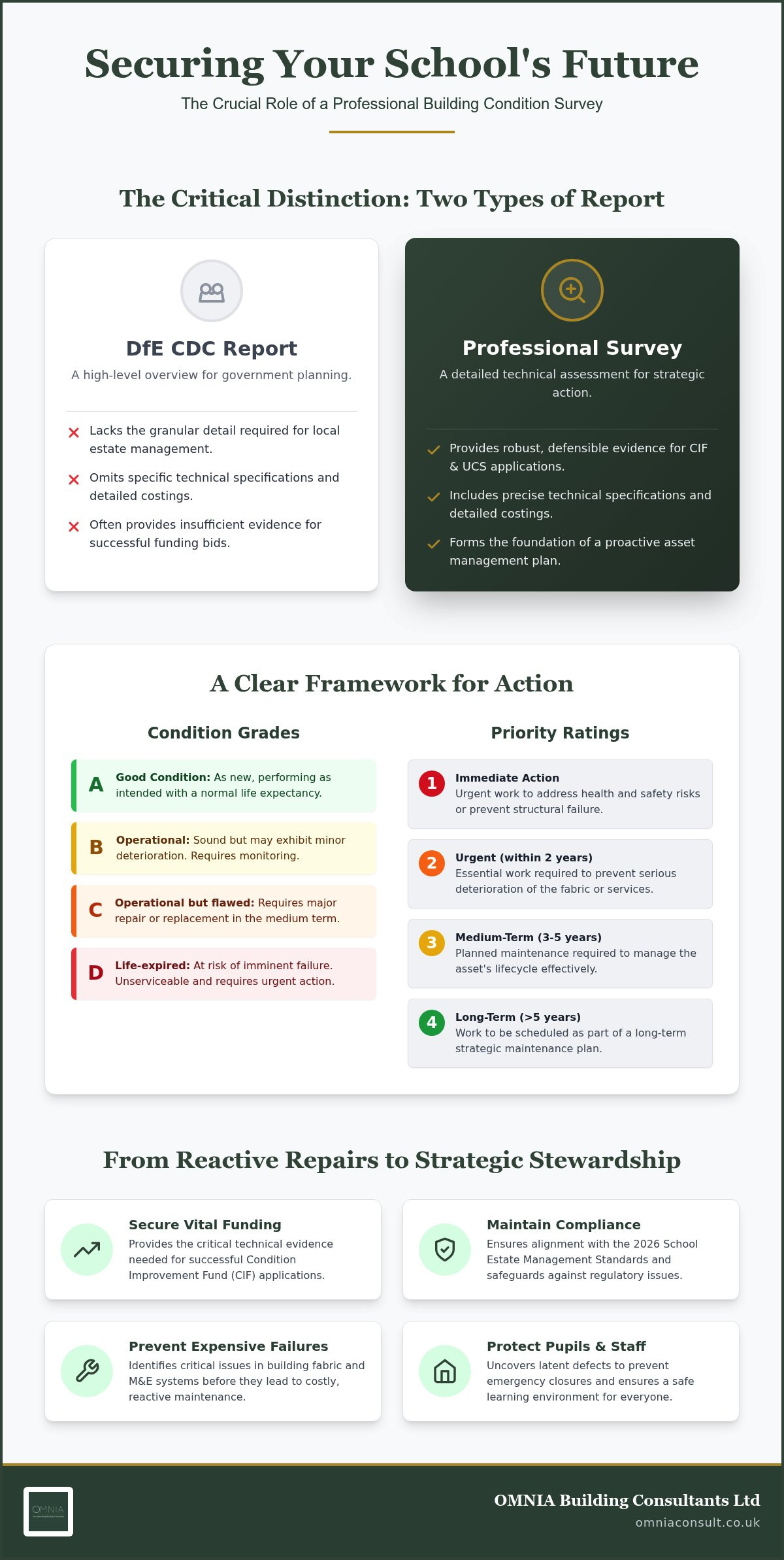
Many responsible bodies mistake the Department for Education’s Condition Data Collection (CDC) reports for a definitive maintenance roadmap. Whilst CDC reports provide a useful high-level baseline for government planning, they lack the granular detail required for local estate management. A professional survey provides the specific technical specifications and detailed costings that CDC reports omit. This level of precision is vital when applying for Urgent Capital Support (UCS), where the DfE requires robust evidence of a building's failing state to approve funding. Without this depth, schools often find their bids rejected because they haven't provided enough technical proof to justify the investment.
Condition Grades and Priority Ratings Explained
Surveyors utilise a standardised grading system to categorise the state of school assets. These range from Grade A, representing an item in good condition, to Grade D, which indicates a life-expired asset at risk of imminent failure. These grades are then paired with Priority Ratings from 1 to 4. A 'Priority 1' rating demands immediate action to address health and safety risks or prevent further structural damage; conversely, a 'Priority 4' suggests works that can be planned for the longer term. These metrics are the engine room of the asset management planning buildings process. They allow governors and trustees to move away from reactive "fire-fighting" and instead invest their limited capital where it will have the greatest impact on pupil safety and operational continuity.
Why Condition Surveys are Vital for Education Funding and Compliance
The upcoming 2026 School Estate Management Standards represent a significant shift in how educational facilities must be managed. For the "Responsible Body" of a school or trust, maintaining statutory health and safety compliance is no longer a passive duty. It requires a proactive, data-driven approach that stands up to external scrutiny. A professional school building condition survey acts as the definitive evidence base, uncovering latent defects that might otherwise lead to emergency closures. Identifying these issues early protects pupils and ensures that the estate remains operational, avoiding the logistical nightmare of sudden building failures that can derail an entire academic year.
Securing Capital Funding via Professional Evidence
Securing investment from the Education and Skills Funding Agency (ESFA) is a competitive process that demands high-quality data. To succeed in applications for the Condition Improvement Fund (CIF), schools must demonstrate a clear "need" backed by technical evidence rather than anecdotal claims. A standard visual check is rarely enough to satisfy assessors. Detailed costings provided in a professional survey report significantly improve bid writing success rates by giving the ESFA confidence in the project's scope and value. Research into the condition of public school facilities indicates that aging infrastructure is a universal challenge; however, those who present the most robust technical evidence are the ones who secure the limited capital available. Using this data allows for multi-year investment strategies that move beyond year-to-year survival and towards genuine estate improvement.
Compliance with 2026 Technical Standards
The 2026 technical requirements introduce stricter benchmarks for energy efficiency, ventilation, and structural safety. Meeting these standards is essential for long-term sustainability and for reducing the mounting operational costs associated with inefficient buildings. When a survey identifies necessary remedial works, the transition from assessment to execution must be handled with professional precision. This is where CDM Principal Designer services become vital, ensuring that all health and safety obligations are met during the pre-construction phase. By aligning your estate with these updated benchmarks, you safeguard the integrity of your buildings whilst demonstrating a commitment to modern educational standards. If you are looking to secure your school's future, a professional building assessment provides the clarity needed to proceed with confidence.
Key Elements Included in a Professional Education Estate Survey
A professional school building condition survey is a technical forensic exercise that categorises assets based on their remaining useful life and current state of repair. It moves beyond the visual "snapshots" found in standard reports to provide a granular assessment of every physical component across the estate. This level of detail is essential for creating a reliable maintenance programme that protects the building's integrity and ensures the safety of all occupants. By examining everything from the subterranean drainage to the highest roof peak, the survey provides a clear, evidence-based narrative of the school's physical health.
The scope of a comprehensive assessment typically encompasses four primary areas:
Building Fabric: A detailed inspection of the external envelope, including roofs, walls, windows, and doors.
Mechanical & Electrical (M&E): An evaluation of heating systems, ventilation, and electrical distribution boards.
External Areas: A review of the school's boundaries, site drainage, and the condition of playgrounds or car parks.
Internal Finishes: An assessment of floors, ceilings, and partitions to identify hidden issues like rising damp or structural cracking.
The Importance of Fabric and Structural Assessments
The external fabric is a school's first line of defence against the elements. Roofs and windows are frequently the highest priority for maintenance because their failure often leads to secondary damage, such as mould growth or ruined internal finishes. During the inspection, surveyors look for subtle signs of structural movement or significant damp that could indicate deeper problems. If major issues are flagged, such as subsidence or failing lintels, the report will recommend a commercial structural survey UK to provide a more specialised analysis. Addressing these fabric failures early prevents the exponential cost increases associated with emergency structural repairs.
Mechanical and Electrical (M&E) Lifecycle Planning
Understanding the lifecycle of M&E systems is vital for avoiding sudden operational failures. A surveyor will assess the remaining life of boilers and heating systems, ensuring they're efficient and safe for continued use. This data is particularly relevant when considering that a National Center for Education Statistics report on school facilities highlights how aging systems are a primary driver of repair costs. Modern surveys also evaluate the adequacy of lighting and ventilation for learning environments, aligning the estate with energy efficiency and decarbonisation goals. By planning for the replacement of plant and machinery before they reach the end of their life, school leaders can manage their budgets with precision and avoid the disruption of a cold school in mid-winter.
How to Organise and Prepare for an On-Site Building Inspection
Efficient preparation is the foundation of a successful school building condition survey. When a site team is well-prepared, the surveyor can focus entirely on technical assessment rather than navigating logistical barriers. This proactive approach ensures that the resulting data is as accurate and comprehensive as possible, providing a clear picture of the estate's health. Whilst many schools focus on the day of the visit, the groundwork laid in the weeks prior often dictates the quality of the final report.
To ensure a smooth process, follow these five essential steps:
Step 1: Collate Documentation. Gather all relevant records, including Operation and Maintenance (O&M) manuals, previous CDC reports, and recent fire risk assessments.
Step 2: Define the Scope. Clearly identify specific areas of concern, such as a leaking gym roof or persistent damp in a science block, to ensure they receive detailed attention.
Step 3: Ensure Safe Access. Verify that the surveyor can reach all areas, particularly plant rooms, roof voids, and restricted basement sections.
Step 4: Notify Stakeholders. Inform staff and governors of the surveyor’s presence to minimise disruption to the school day and ensure cooperation.
Step 5: Review the Draft. Check the initial report for factual accuracy regarding room usage or recent minor repairs before the final version is issued.
Preparing the Site for the Surveyor
A surveyor’s time on-site is most productive when they have immediate access to the right information. Providing up-to-date floor plans and asset registers allows the team to orient themselves quickly. It’s also vital to arrange keys, fobs, or access codes for restricted areas in advance. A brief site induction for the visiting consultant is a mandatory health and safety requirement; it also provides an opportunity to discuss any known site-specific hazards. By treating the surveyor as a technical partner, you facilitate a more thorough inspection of the building's fabric and services.
Defining the Survey Scope and Objectives
Clarity regarding your objectives is essential. You must decide whether you require a standard school building condition survey for routine maintenance or a deeper structural assessment to support a specific capital project. Setting clear deadlines is also critical, especially if the report is intended to support a CIF or UCS funding application. Communicating your long-term estate goals to the consultant ensures the report isn't just a list of defects, but a strategic document that aligns with your school's vision. If you're ready to secure your estate's future, you can book a professional building assessment to begin the process with confidence.
Strategic Asset Management: Beyond the Initial Survey Report
A school building condition survey should never be viewed as a static, "one-off" document to be filed away once funding is secured. Instead, it serves as the essential raw data for a living asset management plan that evolves alongside your estate. True technical stewardship involves moving beyond a simple list of defects and adopting a holistic view of the building's lifecycle. By treating the survey as a foundation, school leaders can ensure that every pound spent on maintenance is an investment in the facility's long-term integrity rather than a temporary fix. This strategic approach transforms a technical assessment into a powerful tool for informed decision-making.
Developing a 5-Year Maintenance Strategy
Using the priority ratings and condition grades identified during the inspection, schools can develop a robust 5-year maintenance strategy. This timeline allows responsible bodies to schedule works logically, prioritising urgent health and safety repairs whilst budgeting for large-scale replacements, such as boilers or roofing systems, before they reach the point of emergency failure. Integrating this data into the school’s wider financial planning provides a transparent roadmap for governors and trustees, ensuring that estate requirements are balanced against educational priorities. This forward-thinking programme reduces the likelihood of disruptive, unbudgeted costs that can jeopardise a school's operational stability.
Professional Oversight and Contract Administration
When the time comes to translate survey recommendations into physical repairs, professional oversight is the primary safeguard for your investment. Detailed technical specifications are vital; they define the exact quality of materials and workmanship required, leaving no room for contractor ambiguity or costly disputes. These documents ensure that every contractor bid is based on the same rigorous standards, protecting the school from corner-cutting or inferior substitutes. For complex renovations, engaging commercial project management companies ensures that works are delivered on time, within budget, and in full compliance with the latest safety regulations. OMNIA acts as your technical partner throughout this entire lifecycle, providing the contract administration and project management expertise needed to turn a technical report into a high-performing educational environment. This end-to-end support ensures that the original vision for the estate is realised with precision and professional integrity.
Securing the Future of Your Educational Estate
Managing a school estate is a complex undertaking that requires more than just maintaining the status quo. By transitioning from basic data collection to a professional school building condition survey, you gain the technical clarity needed to navigate the 2026 standards with absolute confidence. This strategic approach doesn't just identify immediate defects; it provides the robust evidence required to unlock vital capital funding and ensures that your maintenance budget is utilised where it has the most significant impact on pupil safety and building integrity.
At OMNIA, we act as your trusted technical partner. Our chartered building surveying expertise and deep understanding of DfE technical standards ensure your estate remains safe, compliant, and efficient. With a proven track record in education estate management, we're here to guide you through every stage of the building lifecycle. You can book a professional school building condition survey with OMNIA to start building your roadmap for 2026. Taking this proactive step today ensures a stable, high-performing learning environment for your students tomorrow.
Frequently Asked Questions
How often should a school building condition survey be carried out?
A school building condition survey should typically be carried out every three to five years to ensure your estate data remains current and accurate. This frequency aligns with the Department for Education's technical standards and allows responsible bodies to track the deterioration of assets effectively. Regularly updating your assessment ensures that you aren't making critical financial decisions based on obsolete information, whilst also maintaining a clear audit trail for health and safety compliance.
Is a building condition survey the same as a CDC report?
No, a professional condition survey is significantly more detailed than a standard Condition Data Collection (CDC) report. Whilst CDC reports provide the government with a high-level overview of the national estate, they often lack the granular technical specifications and costings required for local maintenance planning. A professional survey offers a deeper forensic analysis of the building fabric and mechanical systems, providing the specific evidence needed for complex project management and funding bids.
Can a condition survey help our school secure CIF funding?
Yes, a professional school building condition survey is essential evidence for successful Condition Improvement Fund (CIF) applications. The Education and Skills Funding Agency (ESFA) requires robust technical proof of "need" to approve capital investment. By providing detailed priority ratings and professional cost estimates, the survey demonstrates that your project is both urgent and well-planned, significantly increasing your chances of securing the necessary capital for major repairs or system replacements.
What is the standard content of a school condition survey report?
A standard report includes a comprehensive assessment of the building fabric, mechanical and electrical systems, external site areas, and internal finishes. Each element is assigned a condition grade and a priority rating, as discussed earlier in this resource. This structured data allows you to identify immediate safety risks whilst planning for the long-term stewardship of your assets through a clear, evidence-based roadmap for estate repairs and replacements.
Who is qualified to conduct a school building condition survey?
These surveys should be conducted by qualified professionals, typically RICS-accredited Chartered Building Surveyors with specific experience in the education sector. Professional qualifications ensure that the surveyor understands the unique regulatory landscape of schools and the technical standards set by the DfE. Relying on chartered expertise provides the school’s responsible body with the quiet expertise and professional indemnity required to make high-stakes decisions regarding building safety and long-term asset integrity.
How long does an on-site survey typically take for a medium-sized school?
For a medium-sized school, the on-site inspection typically takes between one and three days to complete thoroughly. This duration depends on the complexity of the site, the number of buildings, and the ease of access to restricted areas like roof voids and plant rooms. A methodical approach ensures that every component is scrutinised without rushing, allowing the surveyor to capture the precise data needed for a high-quality final report.
Will the survey include assessments of asbestos or legionella?
A standard condition survey is a visual, non-intrusive assessment and does not replace specialist asbestos or legionella audits. Whilst your surveyor will flag visible concerns or obvious risks during their inspection, statutory compliance for these specific areas requires dedicated, separate surveys. It's vital to maintain your specialist compliance registers alongside your building condition data to ensure a holistic approach to the health and safety of your school estate.
What happens if the survey identifies a Grade D priority 1 issue?
A Grade D Priority 1 rating indicates a life-expired asset that poses an immediate risk to health and safety or the structural integrity of the building. Identifying such an issue requires urgent action from the responsible body to mitigate the risk. This data is critical for supporting emergency funding applications, such as Urgent Capital Support (UCS), providing the technical justification needed to secure funds for immediate remedial works or replacement.


