
Building Asset Management: A Strategic Guide for 2026
- OMNIA Building Consultants

- 20 hours ago
- 11 min read
If your building maintenance strategy is still reactive, you aren't just managing an asset; you're managing a liability that's waiting to disrupt your next quarterly budget. It's a common frustration amongst estate managers: the sudden, costly repair that appeared out of nowhere, or the nagging worry that compliance records across multiple sites aren't as robust as they should be. You likely feel that your ageing building fabric is beginning to dictate your operational pace, rather than supporting your organisational goals.
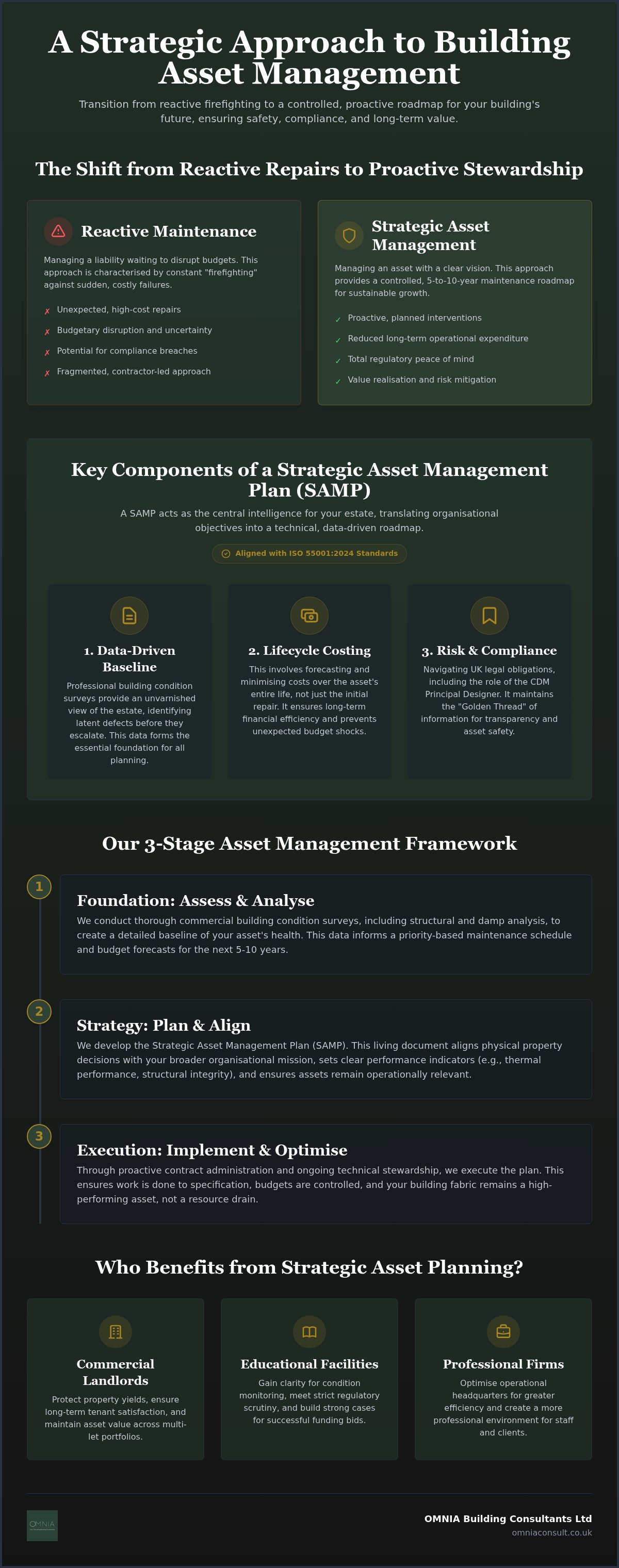
We understand that true peace of mind comes from a steady hand and a clear vision. This guide provides a blueprint for the strategic asset management planning buildings require to support business continuity and growth. By embracing a more technical stewardship, you can move from constant firefighting to a controlled, 5-to-10-year maintenance roadmap. We'll explore the critical transition to the ISO 55001:2024 standards and provide a framework to help you reduce long-term operational expenditure whilst ensuring your buildings remain safe, efficient, and fully compliant well into 2026.
Table of Contents
What is Asset Management Planning for Buildings?
Asset management planning for buildings is far more than a simple schedule of repairs. It is a deliberate, structured process designed to oversee the operation and maintenance of physical assets throughout their entire lifecycle. Whilst general facilities management often focuses on the day-to-day operational needs of a site, strategic asset management planning buildings require a much broader perspective. It involves looking ahead to ensure that every structural element remains an asset rather than a drain on resources. This shift in focus is particularly vital as we move into 2026, where the transition to the updated ISO 55001:2024 standards places a renewed emphasis on the Strategic Asset Management Plan (SAMP). These updated standards require a more robust decision-making framework and a clearer focus on data-driven stewardship.
Relying solely on contractor-led maintenance often results in a fragmented, reactive approach. A contractor is typically motivated by the immediate task, whereas a technical partner acts as a steward of your long-term interests. By integrating professional surveying with high-level strategy, we help you bridge the gap between simple compliance and genuine value realisation. This approach ensures that your asset management planning buildings strategy isn't just a document on a shelf, but a living roadmap for your portfolio's health.
The Core Objectives of an Asset Plan
A robust Asset Management Plan (AMP) serves several critical functions. Primarily, it ensures that your buildings remain fit for purpose whilst minimising lifecycle costs. This is achieved by aligning physical property decisions with your broader organisational mission and financial constraints. Additionally, a well-constructed plan maintains the "Golden Thread" of information. This continuous record of building fabric and safety data is essential for transparency, risk mitigation, and ensuring that every decision is backed by accurate, historical context.
Who Benefits from Strategic Asset Planning?
Different sectors face unique challenges, yet all benefit from a structured approach. Commercial landlords with multi-let portfolios can use these plans to protect their yields and ensure long-term tenant satisfaction. Educational facilities and schools, which operate under strict regulatory scrutiny, gain the clarity needed for condition monitoring and successful funding bids. Professional firms also find that optimising their operational headquarters leads to greater efficiency and a more professional environment for both staff and clients. By treating the building fabric as a strategic tool, these organisations can better predict expenditure and avoid the disruption of unexpected failures.
Key Components of a Strategic Asset Management Plan (SAMP)
A Strategic Asset Management Plan (SAMP) acts as the central intelligence for your estate. It translates organisational objectives into technical requirements, ensuring that every pound spent on maintenance contributes to a broader goal. Without a robust SAMP, asset management planning buildings becomes a series of disconnected reactions rather than a cohesive journey. This document provides the framework for long-term stewardship, bridging the gap between high-level financial planning and the practical realities of building fabric maintenance.
Performance indicators serve as the pulse of the SAMP. These aren't just financial metrics; they involve specific targets for building fabric health and structural integrity. These targets might include specific U-values for thermal performance or tolerable moisture levels in structural masonry. By monitoring these indicators, you can detect subtle shifts in asset performance, allowing for interventions that are far less disruptive than emergency repairs. Integrating architectural design and space planning at this stage further ensures that assets remain operationally relevant, preventing the functional obsolescence that often plagues ageing commercial properties.
Data Collection: The Condition Survey Baseline
Effective stewardship begins with an unvarnished view of the current estate. Professional commercial building condition surveys provide this essential baseline for asset management planning buildings. By conducting thorough structural and damp surveys, you identify latent defects before they escalate into structural failures. This raw data is then linked to a priority-based maintenance schedule, informing budget forecasting for the next decade. Technical specifications define the quality standards for these future works, ensuring that repairs are durable rather than temporary patches. This level of detail prevents the common trap of "value engineering" that inadvertently strips long-term resilience from a building for the sake of immediate savings.
Managing Heritage and Listed Assets
Portfolios often contain Grade 2 listed buildings that require a more nuanced approach. These assets cannot be managed with standard maintenance protocols because their historic fabric demands specific expertise and traditional materials. A specialist listed building consent consultant is vital here, helping to navigate the complexities of heritage planning whilst ensuring the building remains viable for modern use. Effective Regulatory Compliance and Risk Management is particularly challenging with heritage assets, as you must balance historic preservation with contemporary safety and accessibility requirements. It requires a technical partner who understands the traditional craft of building fabric alongside the rigorous demands of modern regulatory frameworks. If you are looking to secure the future of your heritage assets, our team can provide the specialist surveying and planning expertise required to maintain their long-term value.
The Financial Impact: Lifecycle Costing and Maintenance
The financial viability of a professional estate depends on how effectively you transition from short-term fixes to long-term investment strategies. In the context of asset management planning buildings, this shift is the difference between a predictable annual budget and an endless cycle of emergency funding requests. Lifecycle costing is the total cost of an asset from acquisition to disposal. By understanding this figure, commercial landlords can see beyond the initial purchase price or monthly utility bills to grasp the true economic weight of their portfolio.
Calculating the Total Cost of Ownership (TCO) allows for a more sophisticated approach to financial stewardship. It encompasses everything from structural surveys and damp remediation to the eventual decommissioning of the site. Professional contract administration acts as the primary safeguard during this process. It prevents the budget creep often seen in large-scale renovations by ensuring contractors adhere strictly to technical specifications and agreed timelines, keeping the project's financial trajectory on track.
Reactive vs Proactive Maintenance Models
Reactive maintenance is deceptively expensive. Whilst it might seem cheaper to wait for a component to fail, the hidden costs of operational downtime and premium emergency call-out rates quickly erode any perceived savings. Proactive models, by contrast, utilise scheduled maintenance planning to address minor issues before they become structural crises. This technical stewardship doesn't just save money; it protects the long-term capital value of the building, ensuring it remains an attractive and functional asset for tenants or staff.
Strategic Procurement and Bid Writing
Securing the right partners for complex building projects requires more than just a list of quotes. Professional bid writing plays a vital role in articulating the technical requirements of a project to attract high-quality contractors who are capable of delivering excellence. During the tender process, we ensure that technical specifications aren't just suggestions, but are mandatory benchmarks for every bidder. This level of rigour is essential for successful asset management planning buildings, as it guarantees that the work performed today won't require expensive rectification tomorrow. Leveraging technical consultancy during procurement allows for a more transparent and competitive environment, ensuring you achieve genuine value without sacrificing the integrity of the building fabric.
Navigating Regulatory Compliance and Risk Management
Building owners in the UK navigate a rigorous legal landscape that demands more than occasional attention. From fire safety protocols to accessibility standards, the statutory duties attached to commercial property are extensive. For those involved in asset management planning buildings, compliance must be viewed as an ongoing programme of stewardship rather than a one-off audit. This proactive stance ensures that your estate remains safe for occupants and protected from the significant legal and financial risks associated with non-compliance.
Technical specifications play a vital role in this process. They provide the precise standards required to maintain safety-critical systems, such as fire suppression or structural reinforcements. When these specifications are integrated into your long-term plan, you create a clear audit trail that demonstrates a commitment to regulatory excellence. This level of detail is often the missing link in generic maintenance schedules; it provides the "teeth" needed to ensure contractors deliver work that meets current UK legislation.
The CDM 2015 Framework in Asset Management
The Construction (Design and Management) Regulations 2015 apply to all building projects, including maintenance and minor renovations. Engaging professional CDM Principal Designer services is essential for managing health and safety risks during the pre-construction phase. This role is critical in influencing the safety of the building throughout its entire lifecycle. Neglecting these duties, even for seemingly small projects, can lead to severe legal repercussions. By integrating health and safety files directly into your asset management software, you ensure that vital information is always accessible for future works, preventing the loss of the "Golden Thread" of safety data.
Listed Building Consent and Planning Compliance
Managing a heritage portfolio adds another layer of complexity. Modern building regulations often conflict with the requirements of historic preservation; this requires a nuanced approach to risk. Navigating these challenges often involves listed building consent consultants who can negotiate with local authorities on your behalf. Ensuring that your planning applications are technically robust is the best way to avoid costly delays and heritage enforcement actions. This intersection of modern safety and historic integrity is where technical consultancy provides the most value, guiding you through the planning process with precision. If you require expert guidance on your next project, explore our regulatory compliance and planning services to secure your asset's future.
Integrating Professional Technical Consultancy into Your Strategy
Successful asset management planning buildings requires a fundamental shift in perspective. Instead of viewing consultancy as a one-off procurement cost, it's far more effective to integrate technical expertise as a core part of your organisational strategy. OMNIA Building Consultants Ltd acts as a technical partner rather than just a surveyor, providing the "quiet expertise" needed to guide you through the complexities of the built environment. This partnership ensures that your bespoke asset management framework is not just a theoretical document, but a practical tool for long-term stewardship that evolves alongside your portfolio.
Many organisations find that while they possess high-quality architectural designs or detailed survey reports, a disconnect often occurs during the execution phase. Professional oversight ensures that the technical specifications established during planning are delivered precisely on-site. This is where commercial project management companies provide immense value. They offer the end-to-end technical stewardship required to protect your investment, ensuring that every renovation or repair project contributes directly to the long-term viability of the asset.
The Value of Professional Oversight
Contract administration serves as a vital tool for quality control and risk mitigation. It provides a formal, structured environment for managing contractor relationships, ensuring that work is completed to the required standard and within the agreed budget. By bridging the gap between architectural design and the realities of practical structural surveys, we ensure that every project is both functional and structurally resilient. This continuity of care from the initial survey to project completion reduces the risk of miscommunication and ensures your strategic vision remains intact throughout the project lifecycle.
Next Steps for Your Building Portfolio
To begin refining your asset management planning buildings strategy for the coming years, start with a comprehensive gap analysis of your current estate data. Identify where records are missing or outdated, particularly regarding fabric condition and statutory compliance. Once you have a clear baseline, you can set a 5-year vision that prioritises critical repairs and essential regulatory updates. Finally, engage a consultant to organise these elements into a cohesive Strategic Asset Management Plan. This proactive approach provides a clear roadmap for your team, reducing long-term operational expenditure and offering total regulatory peace of mind as you move towards 2026.
Securing Your Portfolio's Future
The shift from reactive maintenance to a structured 5-to-10-year roadmap is the most effective way to protect your organisational budget and ensure long-term building viability. By embracing technical stewardship and maintaining a robust "Golden Thread" of data, you move beyond simple repairs into a model of genuine asset value realisation. This approach ensures that every structural intervention supports your broader business objectives whilst meeting the heightened standards of the 2026 regulatory landscape.
Effective asset management planning buildings requires this holistic view, combining chartered building surveying expertise with rigorous project oversight. OMNIA Building Consultants Ltd provides the steady hand and "quiet expertise" needed to navigate these complexities with confidence. Whether you are managing a heritage estate or a modern commercial portfolio, we ensure that your property remains a resilient asset rather than a growing liability.
Contact OMNIA Building Consultants Ltd for expert asset management planning to begin your journey towards total regulatory peace of mind. Your buildings are your most significant physical investments; with the right strategic approach, they will remain your most reliable operational strengths for years to come.
Frequently Asked Questions
What is the difference between an asset management plan and a maintenance schedule?
An asset management plan is a high-level strategic document that aligns property assets with organisational goals over a 5-to-10-year period. In contrast, a maintenance schedule is a tactical list of specific tasks performed within a single year. Whilst the schedule focuses on the "how" and "when" of repairs, the broader asset management planning buildings require involves the "why" of long-term investment and disposal decisions.
How often should a commercial building condition survey be updated?
Commercial building condition surveys should generally be updated every three to five years to remain accurate. However, if you've recently completed major renovations or acquired new assets, an immediate update is advisable. Maintaining current data ensures your maintenance roadmap reflects the actual state of the building fabric. This frequency allows you to capture the gradual degradation of materials before they escalate into the costly structural failures discussed in previous sections.
Does asset management planning apply to Grade 2 listed buildings?
Asset management planning is essential for Grade 2 listed buildings because their historic fabric requires more specialised and expensive stewardship than modern structures. A strategic plan allows you to anticipate the long-lead times required for listed building consent and the procurement of traditional materials. By integrating heritage requirements into your 10-year vision, you ensure that historic preservation doesn't conflict with the modern operational needs of your professional headquarters.
What are the legal requirements for a CDM Principal Designer in the UK?
Under the CDM 2015 Regulations, a Principal Designer must be appointed for any project involving more than one contractor. Their primary duty is to plan, manage, and monitor the pre-construction phase to eliminate or control health and safety risks. This includes coordinating the work of other designers and ensuring that a comprehensive health and safety file is prepared. Neglecting this role can lead to significant legal liabilities for the building owner.
How can strategic asset planning reduce my annual insurance premiums?
Strategic asset planning can lower insurance premiums by providing insurers with documented evidence of proactive risk management. When you demonstrate a commitment to regular structural surveys and damp remediation, you present a lower risk profile for claims related to building failure or water damage. Insurers often look favourably upon organisations that maintain a "Golden Thread" of safety data, as it suggests a controlled environment where catastrophic failures are much less likely.
Can OMNIA help with planning applications for complex commercial developments?
OMNIA provides comprehensive support for planning applications, including those for complex commercial developments and heritage sites. Our team combines architectural design with technical surveying to ensure that every application is robust and compliant with local authority requirements. By acting as your "Trusted Navigator" through the planning process, we help you avoid the delays that often arise from incomplete technical data or a lack of understanding of local building restrictions.
What role does technical specification writing play in asset management?
Technical specification writing is the bridge between a strategic vision and a successful on-site delivery. These documents define the exact materials, methods, and quality standards that contractors must follow during renovations or repairs. Without precise specifications, projects are vulnerable to "value engineering" that prioritises short-term savings over long-term durability. In asset management planning buildings, clear specifications ensure that every pound spent on the estate contributes to the building's sustained capital value.
How do I start an asset management plan for a multi-site school estate?
Starting an asset management plan for a school estate begins with establishing an accurate data baseline through professional building condition surveys across all sites. This allows you to identify critical maintenance backlogs and prioritise urgent safety or compliance works. Once the baseline is established, you can develop a 5-year maintenance roadmap that aligns with your educational funding cycles. This structured approach provides the transparency needed to secure capital funding and ensure pupil safety.


