
Commercial Building Lifecycle Planning: A Strategic Guide to Technical Stewardship
- OMNIA Building Consultants

- 13 hours ago
- 11 min read
What if the most significant financial risk to your property portfolio isn't market volatility, but the silent, unmapped deterioration of the assets themselves? For many estate managers, the sudden arrival of unforeseen repair costs feels like an inevitability rather than a manageable variable. You likely recognise the frustration of juggling reactive maintenance whilst trying to implement effective commercial building lifecycle planning amidst the pressures of CDM 2015 and shifting safety regulations.
Mastering this process is the key to moving from a state of constant fire-fighting to one of professional stewardship. By adopting a strategic approach, you can protect your asset's value, ensure full regulatory compliance, and finally achieve predictable maintenance budgets that satisfy stakeholders. This guide provides a comprehensive look at how technical data and professional oversight extend asset lifespans and enhance divestment value. We'll explore the essential role of building condition surveys and asset management planning in creating a resilient, high-performing property strategy that secures your long-term success.
Table of Contents
What is Commercial Building Lifecycle Planning?
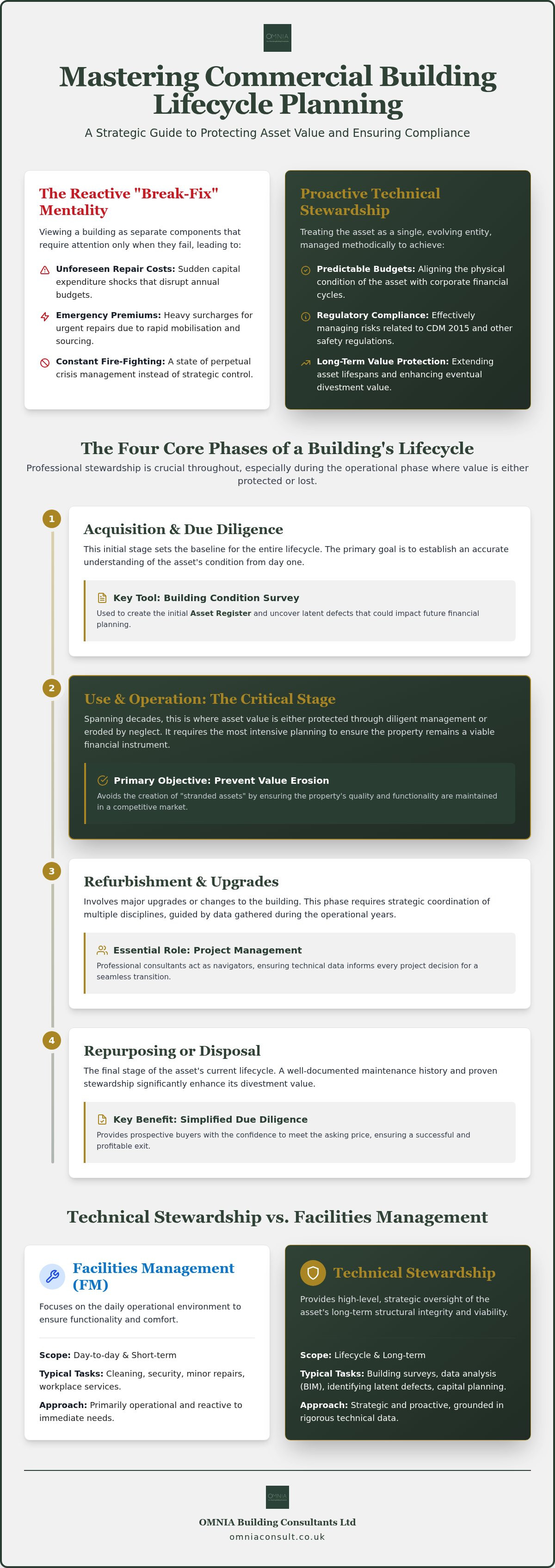
At its core, commercial building lifecycle planning is the methodical management of a property's physical and financial health from its initial acquisition through to its eventual disposal. It represents a fundamental shift in perspective. Rather than viewing a building as a collection of separate components that require attention only when they fail, this strategic approach treats the asset as a single, evolving entity. This is the transition from a reactive "break-fix" mentality to a model of proactive technical stewardship.
Effective planning ensures that the physical condition of the asset aligns perfectly with corporate financial cycles. By understanding when a roof will require replacement or when plant machinery will reach the end of its useful life, organisations can avoid the sudden capital expenditure shocks that disrupt annual budgets. The living heart of this process is the Asset Register. This document acts as a comprehensive inventory, capturing the age, condition, and maintenance history of every critical element within the building fabric.
The Strategic Value of Long-Term Planning
Adopting a lifecycle-focused strategy offers significant commercial advantages. One of the most immediate benefits is the reduction of "emergency premiums." When a structural component fails unexpectedly, the cost of urgent repairs often carries a heavy surcharge due to rapid mobilisation and material sourcing. Consistent planning eliminates these surprises.
Sustained Occupancy: It ensures the building remains fit for purpose, meeting the evolving needs of commercial tenancies and preventing long void periods.
Divestment Value: A well-documented maintenance history simplifies technical due diligence, providing prospective buyers with the confidence to meet your asking price.
Technical Stewardship vs. Facilities Management
It's vital to distinguish between technical stewardship and traditional facilities management (FM). Whilst FM focuses on the daily operational environment, such as cleaning, security, and minor repairs, stewardship looks at the long-term structural integrity and viability of the asset. This high-level consultancy relies on professional surveying and the integration of data, often utilising Building Information Modeling (BIM) to create accurate digital representations for better decision-making throughout the commercial building lifecycle planning process.
Professional building consultants provide the strategic oversight that day-to-day contractors cannot. They identify latent defects and structural risks long before they manifest as visible problems. This ensures that the planning element of FM is grounded in rigorous technical data rather than guesswork, allowing for a more controlled and professional property environment.
The Core Phases of the Building Lifecycle
The journey of a commercial asset is rarely a linear path. It encompasses four distinct stages: acquisition, operation, refurbishment, and eventually, repurposing or disposal. Whilst the initial construction phase is the birth of the asset, the "Use and Operation" stage is where the true value is either protected or lost. This phase often spans decades and requires the most intensive commercial building lifecycle planning to ensure the property remains a viable financial instrument. Professional stewardship during this period prevents the gradual erosion of asset quality that leads to "stranded assets" in a competitive market.
Each phase demands a specific set of technical specifications and a unique level of professional oversight. Transitions between these stages are often complex. For instance, moving from standard operations into a major upgrade requires the strategic coordination of multiple disciplines. This is where commercial project management companies act as essential navigators. They ensure that technical data gathered during the operational years informs every subsequent project decision. Supporting this rigorous approach, MIT's research on building LCA emphasises that the environmental and economic performance of a building is inextricably linked to the decisions made during its operational life.
Acquisition and Initial Technical Due Diligence
The acquisition stage sets the baseline for the entire lifecycle. A Building Condition Survey is the primary tool used here to establish an accurate Asset Register from day one. It's not merely about identifying current faults; it's about uncovering latent defects that could derail financial planning years into the future. By identifying structural risks or aging plant machinery at the point of purchase, owners can establish a realistic roadmap for future expenditure, ensuring that the purchase price reflects the true long-term commitment required.
The Refurbishment and Modernisation Pivot
There comes a point in every asset's life where routine maintenance is no longer the most cost-effective path. This is the pivot point where you transition to project management for building renovations. Using historical lifecycle data, consultants help you decide between the repair or total replacement of building fabric. This stage is critical for maintaining architectural integrity whilst simultaneously upgrading the property to meet modern energy standards and regulatory requirements. If you are currently assessing a portfolio for potential upgrades, consulting with an expert building consultant can provide the technical clarity needed to move forward with precision.
Navigating Regulatory and Historic Constraints
Regulatory compliance is often viewed as an administrative hurdle, yet in the context of commercial building lifecycle planning, it serves as a vital risk-mitigation strategy. Statutory obligations such as the Construction (Design and Management) Regulations 2015 (CDM 2015) aren't merely checkboxes; they dictate the safety and viability of every physical intervention. Failing to integrate these requirements into your long-term roadmap can lead to significant legal exposure and unforeseen delays during major refurbishment projects. Professional stewardship ensures that your maintenance schedule remains ahead of shifting legislation, protecting both the asset and the organisation's reputation.
The CDM Principal Designer Role in Lifecycle Works
The CDM Principal Designer plays a pivotal role in maintaining the continuity of an asset's technical data. During the refurbishment phases of a lifecycle, this professional manages health and safety information to protect both the current workforce and future contractors. The "Health and Safety File" should never be treated as a static document. Instead, it acts as a functional tool for future planning, ensuring that every modification is documented for those who will maintain the building in decades to come. Understanding Whole Building Life Cycle Assessment basics helps in aligning these safety requirements with broader environmental and structural goals, ensuring that every project phase is executed with precision.
Managing Historic and Listed Assets
For owners of Grade II or Grade I listed commercial properties, lifecycle planning becomes significantly more nuanced. These assets require a delicate balance between modern commercial utility and rigorous heritage conservation. Material choices are often restricted to traditional options that carry higher procurement costs and require specialist labour. This is not a task for general contractors. It requires a steady hand and a deep understanding of conservation principles.
Securing listed building consent is a complex process where professional consultancy is indispensable. Engaging listed building consent consultants ensures that maintenance strategies respect the building's historic fabric whilst allowing for necessary modernisations. This proactive approach prevents the accumulation of "heritage debt," where neglected historic elements become prohibitively expensive to restore later in the asset's life. By planning for these constraints years in advance, you can maintain the building's prestige without compromising its commercial performance.
Creating a Robust Forward Maintenance Register (FMR)
A Forward Maintenance Register (FMR) serves as the tactical engine of commercial building lifecycle planning, translating high-level strategy into a granular, actionable schedule. It moves the conversation away from abstract goals and towards a concrete timeline of technical interventions. Without a robust register, even the most well-intentioned commercial building lifecycle planning remains a theoretical exercise rather than a practical tool for asset preservation. To build a register that offers genuine utility, a methodical five-step process is required:
Step 1: Conduct a comprehensive Building Condition Survey to identify and document every physical asset.
Step 2: Categorise assets by both their Criticality to operations and their Remaining Useful Life (RUL).
Step 3: Assign specific technical specifications for ongoing maintenance and eventual replacement cycles.
Step 4: Forecast financial requirements over a 5, 10, or 25-year horizon to provide fiscal clarity.
Step 5: Implement a formal review cycle to update the FMR based on actual performance and environmental factors.
Data Codification and Technical Accuracy
Generic maintenance intervals often lead to significant budget leakage or, conversely, the risk of early failure. Relying on "industry averages" for component lifespans ignores the specific environmental stresses and usage patterns of your property. Professional surveyors are essential here to validate the data within the register. They integrate structural, damp, and fabric surveys into a single source of truth, ensuring that the RUL assigned to a component is based on physical reality rather than a manufacturer's estimate. This precision identifies not just when an asset might fail, but why it is deteriorating, allowing for targeted interventions that extend its functional life.
Budgeting for Major Lifecycle Events
A robust FMR allows for a clear distinction between OPEX and CAPEX. Whilst day-to-day operational expenditure is manageable, major capital events like plant replacement or structural repairs require long-term financial planning. Institutional boards and stakeholders require this transparency to justify significant investments over a 25-year horizon. This evidence-based approach is particularly critical when preparing for office refurbishment project management, where FMR data dictates the scope and priority of works. By identifying these needs years in advance, you can secure the necessary funding and avoid the disruption of emergency works. If you require a professional baseline for your portfolio, our experts can assist with comprehensive Asset Management Planning to secure your building's future.
The OMNIA Approach: Professional Stewardship for Your Assets
OMNIA Building Consultants operates as a technical partner rather than a standard service provider. We recognise that effective commercial building lifecycle planning requires more than just isolated data points; it demands a cohesive strategy that bridges the gap between professional surveying and strategic execution. By integrating our expertise in Building Condition Surveys with architectural design and project management, we provide a holistic roadmap that secures the long-term viability of your property assets. This joined-up thinking ensures that your property strategy remains resilient against both physical deterioration and shifting market demands.
Central to our approach is the development of rigorous Technical Specifications. These documents ensure that lifecycle works are executed correctly from the outset, preventing the need for costly remedial actions later. As a firm of chartered professionals, we act as the guardian of your building's fabric whilst simultaneously protecting your legal and financial liability. Our focus remains on the continuity of care, ensuring that every intervention aligns with the established Asset Register and Forward Maintenance Register discussed in previous sections. This methodical oversight provides the peace of mind that your investments are being managed with "quiet expertise" and technical precision.
End-to-End Contract Administration
The transition from a strategic plan to physical works is where many property strategies falter. OMNIA mitigates this risk through professional JCT contract administration services. We manage the complexities of the construction phase, ensuring technical compliance and maintaining strict quality control. By acting as a professional buffer between you and the physical contractors, we ensure that the project remains on schedule and within the parameters of your technical requirements. This role is vital for maintaining the integrity of the lifecycle plan, as it prevents the "cutting of corners" that often leads to premature component failure.
A National Partner for Complex Portfolios
Managing a national property portfolio requires a level of consistency that fragmented local consultancies cannot provide. OMNIA offers a single point of contact for complex estates, ensuring that reporting standards and data codification remain uniform across all asset types. Whether you are managing modern office blocks or historic listed structures, our national coverage provides the assurance that your entire portfolio is under the same rigorous standard of professional oversight. This consistency is essential for institutional boards who require clear, comparable data to make informed investment decisions. Securing the future of your assets begins with a commitment to professional stewardship. To move towards a more predictable and value-driven estate, contact OMNIA today to discuss your requirements for commercial building lifecycle planning.
Securing the Future of Your Property Portfolio
Effective commercial building lifecycle planning is the fundamental difference between an asset that drains capital and one that consistently delivers value. By moving beyond reactive maintenance and embracing a model of technical stewardship, you can transform unforeseen repair costs into predictable, manageable investments. This journey requires a precise integration of professional surveying, rigorous data codification, and expert project management to ensure long-term viability.
As Chartered Building Surveyors and specialists in listed building consent, OMNIA provides the comprehensive asset management strategy needed to navigate these technical complexities. We act as your steady hand, ensuring every phase of your building's life is met with technical integrity and regulatory precision. It's a commitment to continuity that protects both the fabric of the building and your financial interests. To begin this transition, Consult OMNIA for Expert Building Lifecycle Planning. With the right professional partner, your portfolio can achieve a standard of excellence that stands the test of time.
Frequently Asked Questions
What is the primary goal of commercial building lifecycle planning?
The primary goal is to maximise the functional lifespan and financial value of an asset through proactive stewardship. It involves moving beyond a simple "break-fix" mentality to ensure the building remains fit for purpose whilst protecting long-term maintenance budgets. By aligning physical asset health with corporate financial cycles, owners can avoid sudden capital expenditure shocks and maintain a controlled, professional property environment that satisfies stakeholders and investors alike.
How often should a commercial building condition survey be updated?
Updating a survey every three to five years is standard practice for maintaining technical accuracy across a portfolio. This frequency ensures that the Asset Register reflects the actual physical condition of the fabric rather than relying on theoretical deterioration models. Regular updates allow for the precise calibration of the Forward Maintenance Register, ensuring that budgets remain realistic and that critical interventions are prioritised before they manifest as costly emergency repairs.
Does lifecycle planning include CDM 2015 compliance?
Yes, it integrates statutory obligations like CDM 2015 as a core part of the risk-mitigation strategy. Effective commercial building lifecycle planning ensures the role of the CDM Principal Designer is established during refurbishments to manage health and safety information correctly. This proactive approach protects future contractors and ensures the Health and Safety File remains a functional tool for the building's entire life, rather than just a static compliance document.
Can lifecycle planning help reduce insurance premiums for commercial properties?
It provides the robust technical data and maintenance history that insurers often require to assess structural risk accurately. By demonstrating a professional approach to fabric maintenance and identifying latent defects early, owners can present a lower risk profile during premium negotiations. Whilst not a guarantee of lower costs, a clear roadmap for future works suggests a well-managed asset, which can lead to more favourable terms and enhanced peace of mind.
What is the difference between a Forward Maintenance Register and an Asset Register?
An Asset Register acts as a comprehensive inventory of every physical component, whilst the Forward Maintenance Register (FMR) is the tactical schedule derived from that data. The register documents the "what" and "where," whereas the FMR outlines the "when" and "how much" regarding maintenance and replacement. Together, they provide the technical foundation for stewardship, allowing owners to move from simple documentation to a model of active, data-driven management.
How does listed building status affect lifecycle planning costs?
Listed status increases costs by requiring specialist materials and skilled labour that respect the building's historic fabric. Lifecycle plans for Grade I or II assets must also factor in the professional consultancy fees needed to secure listed building consent for any modifications. Planning for these constraints years in advance prevents the accumulation of "heritage debt," where neglected historic elements become significantly more expensive to restore or repair later in the lifecycle.
Is lifecycle planning only for large institutional property owners?
No, this discipline is essential for any owner who wishes to protect their investment and ensure operational continuity. Whilst large institutions often manage complex portfolios, smaller owners benefit significantly from the predictable budgets that commercial building lifecycle planning provides. It prevents the sudden capital shocks that can disrupt smaller organisations, ensuring that every asset, regardless of its size, is managed with the same rigorous standards of professional technical oversight.
What technical specifications are included in a typical lifecycle plan?
A typical plan includes detailed standards for the maintenance, repair, and eventual replacement of the building fabric and structural components. These specifications outline material performance criteria and installation methods to ensure that lifecycle works are executed correctly the first time. By defining these technical requirements clearly, the plan prevents the use of substandard materials that could lead to early failure, thereby protecting both the building's integrity and the owner's liability.


