How to Organise JCT Contract Administration Services for Commercial Renovations
- OMNIA Building Consultants

- 8 hours ago
- 11 min read
What if the greatest risk to your commercial renovation isn't a structural failure, but the subtle mismanagement of the contract itself? It's a common concern for property owners who recognise that while the design vision is vital, the technical stewardship of the build determines the final outcome. You likely feel the pressure of potential hidden costs within the building fabric, or perhaps you're struggling to find the time to monitor site progress amidst your daily responsibilities. Choosing the right JCT contract administration services is about more than just ticking boxes; it's about securing a steady hand to guide your investment through complex legal and technical landscapes.
We understand that the choice between JCT and NEC frameworks can be confusing, and the fear of budget overruns is always present. This article provides a comprehensive guide to navigating these complexities to ensure your project is delivered on time, within budget, and fully compliant. We'll outline a clear roadmap for project oversight, from mitigating financial risks to ensuring a successful handover with all necessary certificates in place. By the end, you'll have the clarity needed to maintain control over your renovation without being overwhelmed by the daily minutiae of the site.
Table of Contents
What are JCT Contract Administration Services for Renovations?
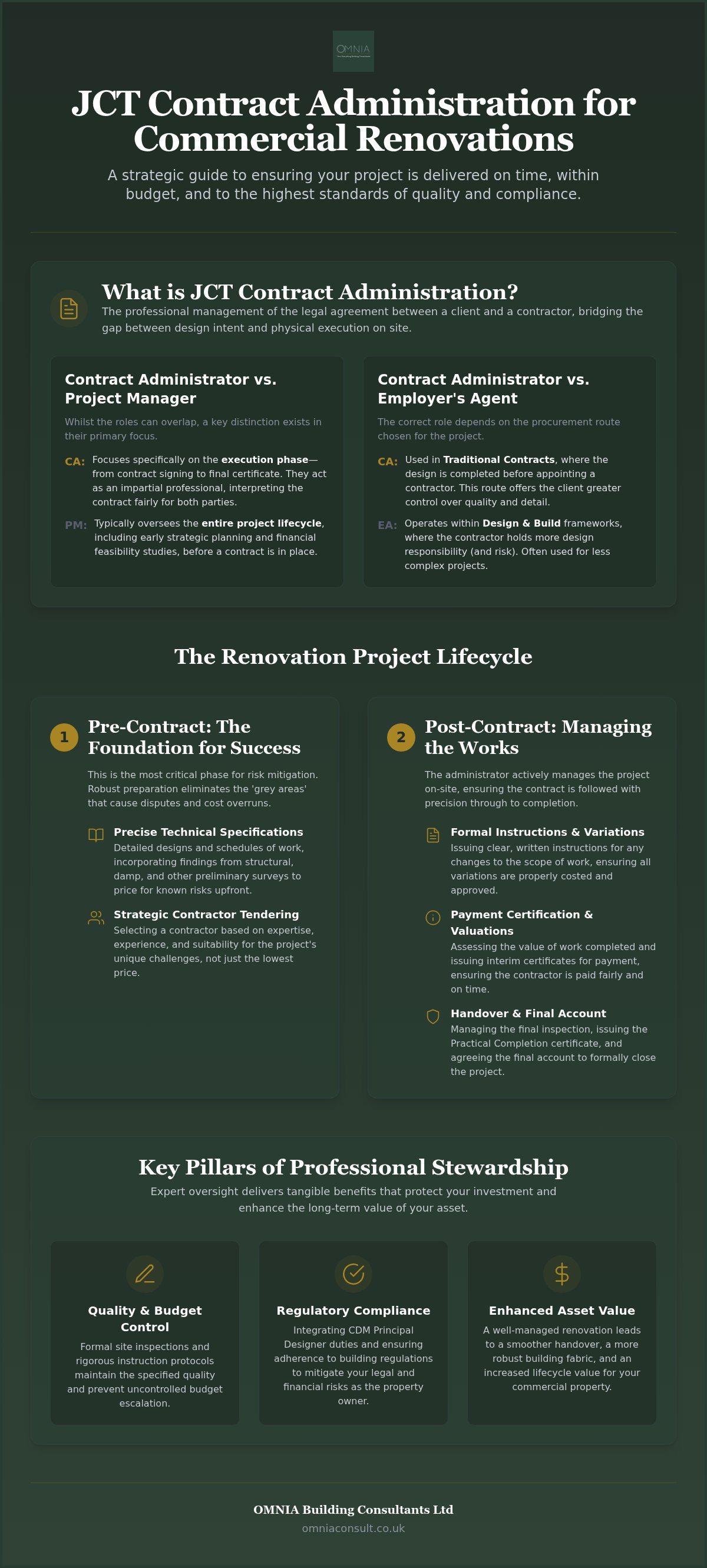
At its core, contract administration is the professional management of the legal agreement between an employer and a contractor. For commercial renovations, this role is essential because it bridges the gap between a technical design and the physical reality of a site. The Joint Contracts Tribunal (JCT) provides the standard forms of contract that govern most UK construction projects, and the administrator ensures every clause is followed with precision.
Whilst the terms are often used interchangeably in casual conversation, a distinction exists between a Contract Administrator and a Project Manager. A Project Manager typically oversees the entire lifecycle, including early strategic planning and financial feasibility. In contrast, JCT contract administration services focus specifically on the execution phase: the period from the signing of the contract to the final certificate. In complex renovation projects, these roles often overlap, as the technical challenges of an existing building require the administrator to have a deep understanding of the project's strategic goals.
Renovations demand a higher level of technical stewardship than new builds. When you strip back the plaster of a Victorian warehouse or modernise a 1970s office block, you inevitably encounter the unknown. Whether it's hidden structural fatigue or unidentified damp, the administrator must manage these discoveries without letting the project spiral. Engaging professional JCT contract administration services ensures that every technical nuance is addressed, with the primary goal of delivering the specified quality on schedule and within the agreed budget.
The Role of the Contract Administrator
The administrator acts as an impartial professional, ensuring fair play between the client and the contractor. They don't just take sides; they interpret the contract fairly for both parties. This involves managing all formal communications, issuing instructions for variations, and certifying payments. They verify that every element of the build aligns with the detailed technical building specifications and regulatory standards, preventing the cutting of corners that often plagues unmonitored sites.
Contract Administrator vs Employer's Agent
The choice between a Contract Administrator and an Employer's Agent depends on your procurement route. A CA is typically used in Traditional JCT contracts, where the design is fully completed before the contractor is appointed. An Employer's Agent operates within Design and Build frameworks. For complex renovations, particularly those involving historic fabric or listed buildings, the Traditional route is often preferred. It allows the landlord to retain more control over the quality and detail, whereas Design and Build shifts more risk to the contractor. Selecting the right framework is a critical first step in protecting your asset's long-term value.
Preparing for Success: The Pre-Contract Stage
The pre-contract phase is the most critical period for risk mitigation. Expert JCT contract administration services begin long before work starts on site. By establishing a robust technical framework, we eliminate the "grey areas" that lead to disputes, delays, and cost overruns. This preparation ensures that every stakeholder understands the scope, quality, and timeframe expected, creating a controlled environment for the renovation to proceed.
Technical Specifications and Design
Precision in architectural design for commercial property is the best defence against future variations. When specifications are vague, contractors are forced to make assumptions, which often leads to financial friction later. We integrate findings from initial structural or damp surveys directly into the work schedule. This proactive approach ensures that unforeseen defects, such as hidden rot or compromised masonry, are accounted for in the initial pricing. Adhering to the principles found in The Construction Playbook, we focus on lifecycle value and clear outcomes. This ensures that materials and methods are clearly defined to maintain the long-term integrity of the building fabric, rather than simply opting for the cheapest immediate fix.
The Tender and Appointment Process
Selecting the right contractor is a strategic decision, not just a financial one. A low bid might seem attractive, but if it's based on unrealistic timelines or a misunderstood scope, it will eventually cost more. The tender process must be structured to reveal the true capability of each bidder and ensure they have the capacity to deliver the works.
Inviting reputable contractors with proven experience in similar commercial renovations.
Managing the Request for Information (RFI) process to ensure every bidder has the same level of clarity on technical queries.
Analysing bid returns to identify hidden costs, unrealistic lead times, or missing scope items that could lead to future claims.
Formulating the contract and ensuring all parties fully understand their obligations, including liquidated damages and insurance requirements, before work commences.
Setting clear KPIs and milestones within the JCT or NEC contract documents manages expectations from day one. If you are unsure how to structure your technical documents, our team can help you organise your pre-contract documentation to ensure a smooth transition to the construction phase.
Managing the Works: A Step-by-Step Guide to Post-Contract Administration
Once the ink is dry on the contract, the focus shifts from preparation to active stewardship. The role of JCT contract administration services during the construction phase is to ensure the contractor’s performance remains aligned with your vision. It involves a methodical sequence of inspections, valuations, and instructions that keep the renovation on track while protecting your financial interests. This phase is where technical expertise meets practical site management to prevent small issues from becoming expensive delays.
Site Oversight and Quality Control
Site meetings serve as the project's pulse. We hold these regularly to review progress against the agreed programme and address technical queries in real time. During the strip-out phase of a renovation, it’s common to discover unforeseen conditions like hidden damp or structural inconsistencies. We manage these discoveries by issuing formal instructions, ensuring the contractor doesn't simply proceed with a sub-optimal fix. Professional progress reports provide you with a clear, objective view of the site without requiring your presence every day. This oversight also ensures strict adherence to health and safety protocols, protecting you from the legal liabilities of a poorly managed site.
Financial Management and Certification
Maintaining a healthy cash flow is vital for project momentum, but payments must be earned. We conduct regular valuations to assess the work completed to date, ensuring the contractor is paid fairly for verified progress. This prevents the "front-loading" of costs that can leave a client exposed if a contractor runs into financial difficulty. If the project scope evolves, we manage the contingency budget through formal variation orders, providing a paper trail for every pound spent.
Interim Certificates: Issuing formal payment notices based on physical work completed, providing financial transparency for both parties.
Variation Orders: Formally documenting changes to the scope or design to avoid disputes over final costs.
Final Account: Negotiating the final project cost, ensuring all variations and credits are accurately accounted for.
Retention Management: Holding a percentage of the contract sum (usually 3% to 5%) until the rectification period ends to ensure any defects are fixed.
As the project nears completion, we oversee the staged release of these retention funds. The first half is typically released at Practical Completion, with the remainder following the rectification period. This structured transition ensures your asset is ready for immediate use, fully compliant with all building regulations, and delivered to the high standard your investment deserves.
Navigating Regulatory Compliance and Technical Risk
Compliance in a renovation context is a moving target. Unlike new builds, existing structures carry legacy risks that require constant vigilance. Professional JCT contract administration services ensure that legal and technical obligations are managed with precision, protecting the employer from the severe penalties associated with non-compliance. By treating regulatory standards as a core part of the project's technical stewardship, we maintain a safe, lawful, and commercially viable site.
CDM 2015 and Health & Safety Stewardship
Under the Construction (Design and Management) Regulations 2015, the client holds significant legal responsibilities. These duties cannot be ignored. Integrating CDM Principal Designer services into the contract administration role provides a seamless flow of safety information from the design phase through to completion. It ensures that the Pre-Construction Information is shared correctly and that the contractor's plan is fit for purpose.
The administrator monitors the contractor’s Construction Phase Plan to ensure it remains site-specific as the project evolves. On complex renovation sites where multiple contractors may be working simultaneously, this stewardship is vital. We don't just check documents; we monitor site behaviour and safety documentation to ensure the project lifecycle remains incident-free. This proactive approach fulfills your legal duties whilst maintaining the momentum of the build.
Renovating Listed and Heritage Assets
Working with Grade 2 listed buildings introduces a unique layer of technical risk. The restrictions associated with historic building fabric require a delicate balance between modern commercial requirements and traditional preservation. A skilled administrator manages these complexities by ensuring all works comply strictly with the terms of the Listed Building Consent. This prevents legal disputes and protects the integrity of the asset.
Liaising with conservation officers is a critical part of this process. We ensure that traditional materials and methods are used where required, preventing the need for costly remedial works. This involves constant communication to ensure the project schedule remains realistic despite the constraints of a heritage asset. If you are planning a project involving sensitive building fabric, you can speak with our technical experts to ensure your renovation meets every regulatory standard.
Ensuring rigorous compliance with Building Regulations is equally important. Whether it's fire safety upgrades or thermal performance improvements, the administrator verifies that every installation meets current UK standards. This thoroughness provides peace of mind that your asset is not only aesthetically pleasing but also fully compliant and safe for future occupants.
Securing Professional Oversight for Your Renovation
A commercial renovation is a significant capital expenditure that demands more than just a capable contractor. Entrusting your project to professional commercial project management companies ensures that your investment is protected by rigorous technical stewardship. OMNIA Building Consultants Ltd acts as your Trusted Navigator, managing the inevitable friction between design aspirations and site realities. Professional JCT contract administration services provide the necessary framework for this relationship, ensuring that every decision is documented and every pound is accounted for throughout the build.
The Value of Chartered Expertise
Chartered status isn't merely a badge; it's a commitment to the highest professional standards. Working with a firm that adheres to RICS guidelines provides you with the security of professional indemnity insurance, which protects you from financial loss arising from professional negligence. It removes the emotional burden of managing a contractor directly, giving you a technical advocate who can challenge sub-standard work without stalling the project's momentum. OMNIA Building Consultants Ltd’s technical specifications reduce the risk of future disputes by removing ambiguity from the contractor’s scope of work. This level of oversight ensures that quality is never sacrificed for speed, maintaining the integrity of your building fabric.
Integrating CA into Asset Management Planning
We believe a renovation should be viewed as a critical stage in a building's lifecycle rather than a one-off task. A well-administered contract results in a high-quality finish that reduces long-term maintenance costs and enhances the asset's market value. By maintaining detailed project records and a comprehensive Health and Safety file, you're better prepared for future regulatory audits or insurance queries. This holistic approach ensures your property remains attractive to high-quality tenants and stays compliant for years to come.
The journey towards a successful handover begins with a clear understanding of your building's current state. From the initial survey through to final certification, we guide you through every milestone of the renovation process. Our goal is to ensure a seamless transition where all certificates are in place, the site is safe, and the building is ready for immediate occupation. By securing expert oversight, you aren't just finishing a project; you're future-proofing your commercial asset.
Future-Proofing Your Commercial Property Investment
Successfully delivering a commercial renovation requires more than just a vision; it demands a disciplined framework that bridges the gap between design and reality. By prioritising pre-contract precision and maintaining rigorous site oversight, you protect your investment from the financial and legal risks inherent in complex building works. Whether you're modernising a contemporary office or restoring a sensitive heritage asset, professional JCT contract administration services provide the technical stewardship needed to ensure your project stays on track.
As Chartered Building Surveyors with national UK coverage, OMNIA specialises in navigating the complexities of listed building compliance and large-scale renovations. We provide end-to-end support, from initial tender to final certification, acting as your technical partner at every stage. Don't leave your project's success to chance. Contact OMNIA today for professional JCT contract administration services and secure the expert oversight your asset deserves. We're here to guide you toward a successful, compliant, and stress-free handover.
Frequently Asked Questions
What is the difference between a project manager and a contract administrator?
A Project Manager oversees the strategic lifecycle of a project, including early feasibility and overall team coordination. In contrast, a Contract Administrator focuses specifically on the execution of the construction contract. They manage the technical details, certify payments, and ensure legal compliance during the build. Whilst their roles overlap in renovation projects, the CA is primarily responsible for the stewardship of the formal agreement between the employer and the contractor.
How much do JCT contract administration services for a renovation typically cost?
Fees for JCT contract administration services are typically structured as a percentage of the total contract value or as a fixed professional fee. The exact cost depends on the project's scale, technical complexity, and the level of site monitoring required. Every renovation is unique; professional surveyors usually provide a tailored quote after reviewing the technical specifications and the anticipated duration of the works on site.
Can an architect act as the contract administrator for my commercial renovation?
Architects often serve as Contract Administrators, but many property owners choose Chartered Building Surveyors for commercial renovations. Surveyors possess a deep understanding of building pathology and existing fabric, which is essential when dealing with older structures. Their expertise in structural and damp issues allows them to manage technical risks more effectively than a design-focused professional, ensuring the build remains both compliant and durable over its entire lifecycle.
Which construction contract is best for a commercial renovation: JCT or NEC?
JCT contracts are the traditional choice for UK renovations where the design is fully defined before work begins. They offer a familiar legal framework for most contractors. NEC contracts are more proactive and focus on collaborative risk management, which can be beneficial for high-risk projects. The best choice depends on your procurement route and how much design responsibility you wish to delegate to the contractor during the build.
What happens if a contractor fails to meet the project deadline under a JCT contract?
If a contractor misses a deadline, the CA must determine if the delay is "excusable" under the contract terms. If the contractor is at fault, the CA may issue a non-completion certificate. This allows the employer to claim Liquidated and Ascertained Damages (LADs). These are pre-agreed financial sums designed to compensate for the loss of use of the building, providing a clear mechanism for resolving delays without litigation.
Is contract administration required for small-scale office refurbishments?
Professional JCT contract administration services are highly recommended for small refurbishments to maintain quality and budget control. Even minor works must comply with CDM 2015 regulations and Building Standards. A CA ensures that the contractor delivers the work to the required technical specification and manages the payment process fairly. This prevents small projects from spiraling into disputes or leaving the property owner with unresolved latent defects after completion.
How does the contract administrator handle hidden defects found during a renovation?
When hidden defects are discovered, the CA issues a formal instruction to the contractor to investigate the issue. They then evaluate the technical requirements for rectification and assess the cost implications. By managing the contingency budget and issuing variation orders, the CA ensures that the defect is resolved correctly without compromising the project's overall momentum. This structured approach provides the employer with financial clarity and technical peace of mind.