Construction Compliance Management Services: The 2026 UK Guide
- OMNIA Building Consultants

- 1 hour ago
- 11 min read
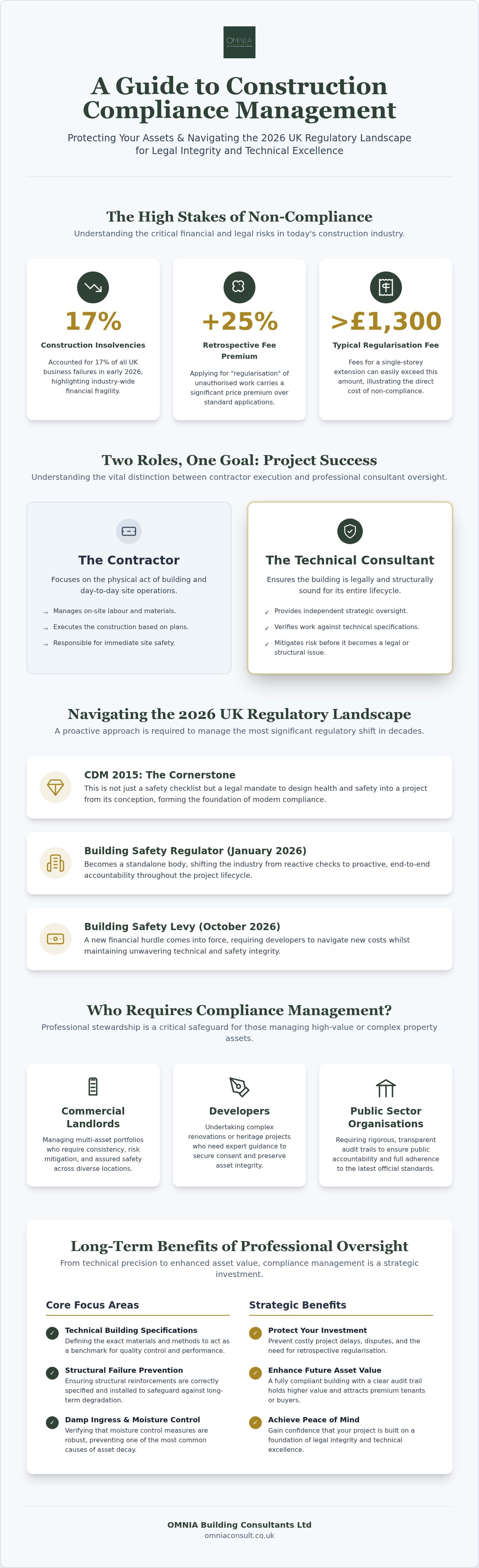
Did you know that applying for retrospective "regularisation" of building work carries a 25% price premium over standard applications, often pushing fees for a single-storey extension above £1,300? In an industry where insolvencies accounted for 17% of all business failures in early 2026, the financial and legal stakes of securing professional construction compliance management services have never been higher. It's a complex environment where technical precision isn't just a preference; it's a necessity for asset survival.
We understand that the evolving UK regulatory landscape, from the intricacies of CDM 2015 to the newly active Building Safety Levy, can create significant anxiety for developers and asset managers alike. You deserve the peace of mind that comes from knowing your project is built on a foundation of legal integrity and technical excellence. This guide explores how professional compliance management protects your assets, ensures adherence to the latest 2026 standards, and mitigates risk throughout the construction lifecycle. We'll examine the role of the Building Safety Regulator and provide a clear roadmap for achieving long-term asset protection through expert technical oversight and methodical planning.
Table of Contents
What are Construction Compliance Management Services?
At its core, compliance represents the rigorous adherence to the legal, safety, and technical standards that govern the built environment. Professional construction compliance management services move beyond simple site safety; they provide a high-level strategic framework that ensures every element of a project aligns with Building regulations in the United Kingdom. While a contractor is responsible for day-to-day site operations, a technical consultant provides the independent oversight required to verify that the work meets its intended technical specifications. This distinction is vital. One focuses on the act of building, whilst the other ensures the building is legally and structurally sound for its entire lifecycle.
Compliance management is essential for maintaining investor confidence and long-term asset longevity. It's a proactive approach to stewardship that mitigates risk before it manifests as a costly legal or structural issue. A building consultant acts as a bridge between the initial design intent and the eventual execution on site. They translate complex architectural plans into actionable requirements whilst maintaining a steady hand on the evolving regulatory landscape. This ensures that the finished project isn't just aesthetically pleasing, but technically robust and fully compliant with current UK law.
The Scope of Professional Compliance Services
Detailed technical building specifications serve as the primary driver for compliance on any site. These documents define the exact materials and methods required to meet performance standards, acting as a benchmark for quality control. Professional compliance services protect your investment by focusing on technical precision, specifically targeting risks such as structural failure and damp ingress. By ensuring that moisture control measures and structural reinforcements are correctly specified and installed, consultants prevent the most common causes of long-term asset degradation.
Who Requires Compliance Management?
The need for technical stewardship is universal across the commercial and public sectors. With construction insolvencies accounting for 17% of all business failures in February 2026, professional oversight is a critical safeguard for those managing high-value projects. We typically support the following groups:
Commercial landlords: Those managing multi-asset portfolios who require consistency and safety across diverse locations.
Developers: Professionals undertaking complex renovations or heritage projects who rely on expert guidance to secure listed building consent.
Public sector organisations: Entities that require the rigorous audit trails necessary for public accountability and adherence to the latest standards set by the Building Safety Regulator.
By providing a transparent record of compliance, these services ensure that every stakeholder, from the lender to the end-user, can have absolute confidence in the integrity of the building.
Navigating the UK Regulatory Landscape in 2026
The UK regulatory environment is undergoing its most significant shift in decades. With the Building Safety Regulator becoming a standalone body in January 2026, the emphasis has moved from reactive checks to proactive, end-to-end accountability. Modern project management now requires a deep understanding of how the Building Safety Act 2022 interacts with existing frameworks like The Building Regulations 2010. For developers, this means navigating new financial hurdles, such as the Building Safety Levy coming into force on 1 October 2026, whilst ensuring technical integrity isn't compromised.
CDM 2015 remains the cornerstone of this landscape. It isn't just a safety checklist; it's a legal mandate that ensures health and safety are designed into a project from the outset. When managing Grade 2 listed buildings, these requirements become even more nuanced. Securing listed building consent is only the first hurdle. Professional construction compliance management services provide the technical rigour needed to ensure that listed building consent is not just a piece of paper, but a lived reality on the construction site, preserving heritage whilst meeting modern safety standards.
The CDM Principal Designer Role
Under the current framework, the appointment of a specialist for CDM Principal Designer services is a statutory requirement for most projects. This role is responsible for organising health and safety during the pre-construction phase, ensuring that all designers involved coordinate their work to reduce risks. The Principal Designer holds a primary duty to identify, eliminate, or control all foreseeable risks to the health and safety of any person involved in the project's construction or future maintenance. By acting as a technical strategist, they ensure that construction compliance management services are a core component of the project's DNA rather than an afterthought.
Building Regulations and Technical Standards
Meeting Part A of the Building Regulations requires more than just a structural survey; it demands a comprehensive structural assessment that accounts for modern loading requirements and the upcoming Future Homes Standard. As we look towards the 2027 implementation of new energy efficiency rules, integrating fire safety and accessibility standards into the architectural design is non-negotiable. Success depends on a smooth transition from a planning application to technical execution. If you're concerned about how these shifting rules affect your portfolio, our team can help you organise a compliant project strategy. This methodical oversight ensures that technical standards are maintained through every phase of the project lifecycle.
The Critical Role of Building Surveys in Compliance
Compliance begins with a clear understanding of the physical asset. Whilst regulatory frameworks provide the rules, technical surveys provide the evidence required for successful construction compliance management services. A building condition survey isn't just a maintenance checklist; it's a diagnostic tool that identifies where a structure deviates from the Building Regulations Approved Documents. By identifying hidden issues like damp ingress or structural movement early, you avoid the financial and legal repercussions of retrospective regularisation that often plague poorly planned projects.
Structural and damp surveys are particularly critical for identifying non-compliance risks that aren't visible to the naked eye. These assessments ensure that renovation plans are based on technical reality rather than assumptions. When surveys are integrated into asset management planning, compliance becomes a continuous cycle of stewardship rather than a one-off hurdle. This technical data also underpins accurate contract administration, ensuring that works are tendered based on precise specifications, which reduces the likelihood of variations and disputes during the construction phase.
Condition Surveys as a Compliance Baseline
Fabric risks, such as degraded masonry or failing roofing systems, can quickly escalate into legal liabilities if left unaddressed. A thorough condition survey identifies these vulnerabilities before they compromise the safety or legal status of the building. This data informs the development of a commercial property maintenance strategy, allowing landlords to prioritise repairs that directly impact regulatory adherence. Professional structural assessments offer the technical due diligence required to protect both the building's users and its long-term market value.
Specialists Surveys for Heritage Assets
Managing heritage assets requires a delicate balance between essential modernisation and historic preservation. Standard surveying techniques often fall short when dealing with traditional materials and construction methods. Heritage-specific compliance demands a deeper level of technical consultancy to ensure that proposed changes don't damage the building's character. Evidence-based surveying is the most effective way to secure listed building consent, as it provides local authorities with the technical justification needed for sensitive alterations. This methodical approach ensures that heritage assets remain viable, safe, and fully compliant with modern standards without losing their historical integrity.
Organising Compliance Throughout the Project Lifecycle
Achieving full legal adherence requires a methodical, step-by-step approach that spans the entire project timeline. Integrating construction compliance management services into the project lifecycle ensures that every decision is backed by technical rigour and professional stewardship. This process begins with pre-construction planning and the early appointment of a CDM Principal Designer, followed by the development of robust technical specifications. Once on site, contract administration and monitoring maintain the standard, leading into a structured handover and ongoing asset management. It's a journey that protects your investment from inception to long-term operation.
The Pre-Construction Phase
Establishing cdm principal designer responsibilities at the earliest possible stage is the most effective way to eliminate foreseeable risks. This phase is dedicated to setting a compliant foundation through detailed site surveys that inform the technical design. Whether it's a building condition survey or a structural assessment, this data allows for the creation of precise technical specifications that leave no room for ambiguity. For listed or complex assets, we coordinate directly with planning authorities to ensure all necessary consents are secured before works commence, preventing costly delays later in the project.
Construction and Contract Administration
Once the project moves to the site, the focus shifts to ensuring that the "as-built" reality remains faithful to the "as-designed" compliance. This is where contract administration becomes vital. The consultant's role is to verify that the materials and methods used match the agreed specification, acting as a steady hand during the execution phase. We manage technical queries and variations whilst maintaining regulatory integrity, ensuring that any changes on site don't compromise the building's legal or structural status. This level of oversight provides the audit trail necessary for modern building safety standards.
The lifecycle concludes with a meticulous handover process, where we manage the preparation of the health and safety file for the client. This document is essential for future maintenance and liability management. Even after the project is complete, ongoing asset management and scheduled maintenance planning ensure that the building continues to perform safely and efficiently. If you're looking to safeguard your next project, you can contact OMNIA to discuss our professional technical consultancy and ensure your asset is managed with precision from start to finish.
Strategic Benefits of Professional Building Project Oversight
Professional building project oversight serves as a critical safeguard against the inherent volatility of the UK construction market. By integrating construction compliance management services, directors and stakeholders can significantly reduce the risk of costly project delays caused by regulatory interventions. These interventions aren't merely administrative hurdles; they can halt progress entirely, leading to spiralling costs and missed deadlines. Beyond immediate project stability, professional oversight provides the meticulous technical records required to prove adherence to standards long after the scaffolding has come down. This level of detail is essential for securing better outcomes through professional bid writing and technical consultancy, ensuring that every project starts with a clear, compliant, and competitive strategy.
Risk Mitigation and Liability Protection
Legal liabilities in the built environment are increasingly personal and profound. Professional consultancy acts as a protective shield, ensuring that all health and safety documentation is robust, auditable, and fully aligned with the latest legal requirements. As an independent technical partner, a consultant provides an objective layer of verification that a contractor cannot offer alone. This relationship ensures that directors aren't just hoping for compliance but are actively maintaining it through every phase of the project. It's about shifting from a state of anxiety to one of composed control, knowing that every regulatory nuance has been accounted for by a specialist.
Long-Term Asset Viability
Compliance management is a primary tool for preventing "technical debt," which is the accumulation of maintenance issues caused by poor initial technical decisions. When renovations are managed with a focus on technical integrity, they're naturally future-proofed against changing regulations, such as the upcoming 2027 energy efficiency standards. Meticulous technical surveying ensures that the physical requirements of the asset are met whilst space planning and architectural design optimise the building's utility. This holistic approach ensures that the asset remains viable and valuable for decades, rather than requiring expensive remedial work a few years down the line. By treating compliance as a strategic asset, you ensure that your property remains a high-performing investment in an increasingly regulated landscape.
Securing Your Project's Future Through Technical Integrity
Professional stewardship is no longer a luxury in the UK's evolving regulatory landscape; it's the defining factor between a successful delivery and a costly legal hurdle. By prioritising detailed building surveys and the early appointment of a CDM Principal Designer, you transform compliance from a reactive burden into a strategic asset. Engaging professional construction compliance management services ensures that meticulous technical records and robust contract administration protect your interests today whilst securing the long-term value of your property portfolio.
OMNIA Building Consultants provides the steady hand needed to navigate these complexities. With our deep expertise in listed building renovations and technical building surveys, we act as your trusted partner through every phase of the project lifecycle. You can contact OMNIA Building Consultants for expert compliance oversight to ensure your next project is delivered with precision and peace of mind. We're here to help you build with confidence and maintain the highest standards of integrity throughout the built environment.
Frequently Asked Questions
What are construction compliance management services?
Construction compliance management services provide professional technical oversight to ensure every aspect of a building project aligns with UK legal and safety standards. This involves a holistic approach to stewardship, bridging the gap between architectural design and on-site execution. Unlike basic site safety, these services focus on long-term asset integrity, providing the independent verification needed to satisfy the Building Safety Regulator whilst protecting the client from significant legal and financial risks.
Do I legally need a CDM Principal Designer for my project?
You legally require a CDM Principal Designer if your project involves more than one contractor, which is the case for almost all commercial renovations. This role is a statutory requirement under the CDM 2015 regulations, designed to coordinate health and safety during the pre-construction phase. The Principal Designer identifies and controls foreseeable risks before work begins, ensuring that construction compliance management services are integrated into the design rather than treated as an afterthought.
How does compliance management differ for Grade 2 listed buildings?
Compliance for Grade 2 listed buildings requires a specialised level of technical consultancy to balance modern safety standards with historic preservation. You must secure listed building consent for any alterations that affect the building's character. Professional oversight ensures that proposed works are backed by evidence-based surveying, such as damp and structural assessments, which respect traditional construction methods whilst satisfying the rigorous audit requirements of local planning authorities and heritage organisations.
What is the role of a building survey in construction compliance?
A building survey acts as the essential technical baseline for identifying non-compliance risks before a project commences. By conducting condition, structural, or damp surveys, you establish a clear record of the building's current state and identify any fabric risks that could compromise legal status. This data-led approach allows for the creation of precise technical specifications, ensuring that all renovation work is grounded in physical reality and adheres to the Approved Documents.
Can my contractor manage all construction compliance requirements?
Whilst a contractor manages day-to-day site safety, they cannot provide the independent technical oversight required for full regulatory compliance. A professional building consultant acts as an objective partner, verifying that the contractor's methods and materials match the design specifications. This separation of duties is vital for maintaining a robust audit trail and ensuring that the final "as-built" asset meets all legal standards without the conflict of interest inherent in self-regulation.
What happens if my building project is found to be non-compliant?
Non-compliance can lead to severe consequences, including enforcement notices from the Building Safety Regulator and significant financial penalties. Beyond immediate fines, you may face the high costs of retrospective regularisation or even the requirement to dismantle unsafe work. Lack of compliance documentation can also invalidate building insurance and complicate future asset sales, as technical due diligence will inevitably uncover any deviations from the required UK building standards during the conveyancing process.
How much do professional construction compliance services cost?
The investment for these services varies depending on the project's scale, the complexity of the asset, and the specific regulatory requirements involved. Rather than a fixed fee, costs are typically proportional to the level of technical oversight required to mitigate risk effectively. It is important to view this as a protective measure; the cost of professional consultancy is invariably lower than the financial repercussions of project delays, legal interventions, or major structural failures.
How does asset management planning support building compliance?
Asset management planning supports compliance by transforming one-off project adherence into a continuous cycle of stewardship. By developing a structured maintenance strategy based on initial condition surveys, you ensure the building remains safe and legally compliant throughout its lifecycle. This proactive approach prevents the accumulation of technical debt and ensures that the asset is consistently future-proofed against evolving regulations, such as new energy efficiency standards or the building safety levies introduced in 2026.