
Landlord vs Tenant Responsibilities in Commercial Property: A UK Guide
- OMNIA Building Consultants

- 16 hours ago
- 11 min read
What if the most expensive clause in your commercial lease isn't the annual rent, but a single poorly defined word regarding the "standard" of repair? Many landlords and tenants assume that a standard lease agreement provides a clear-cut roadmap, yet the reality is often buried in technical jargon that leads to significant financial disputes. It's a common frustration to discover that a perceived minor maintenance task is actually a structural obligation that could trigger a substantial dilapidation claim at the end of a tenancy.
We understand that managing landlord vs tenant responsibilities commercial property UK can feel like traversing a complex landscape without a reliable guide. This article provides a definitive framework for dividing these obligations, offering the technical clarity you need to protect your capital and maintain the long-term viability of your asset. You'll gain a clear understanding of how to limit liability through precise technical specifications and learn exactly when to instruct a professional building consultant to safeguard your position. We will explore the critical distinctions between statutory compliance and decorative repairs, ensuring you are prepared for the evolving regulatory requirements of 2026 and beyond.
Table of Contents
The Framework of Commercial Lease Obligations in the UK
The UK commercial property market operates on a foundation of contractual freedom that differs significantly from the residential sector. In residential settings, statutory protections often shield the occupant from major structural costs. However, when examining landlord vs tenant responsibilities commercial property UK, the starting point is almost always the written lease rather than a default legal safety net. Whilst UK landlord and tenant law provides a broad governance framework, the specific allocation of repair and maintenance duties is a matter of negotiation. It's vital to recognise that the burden of upkeep can shift entirely depending on the agreed lease structure.
Common Lease Structures and Their Impact
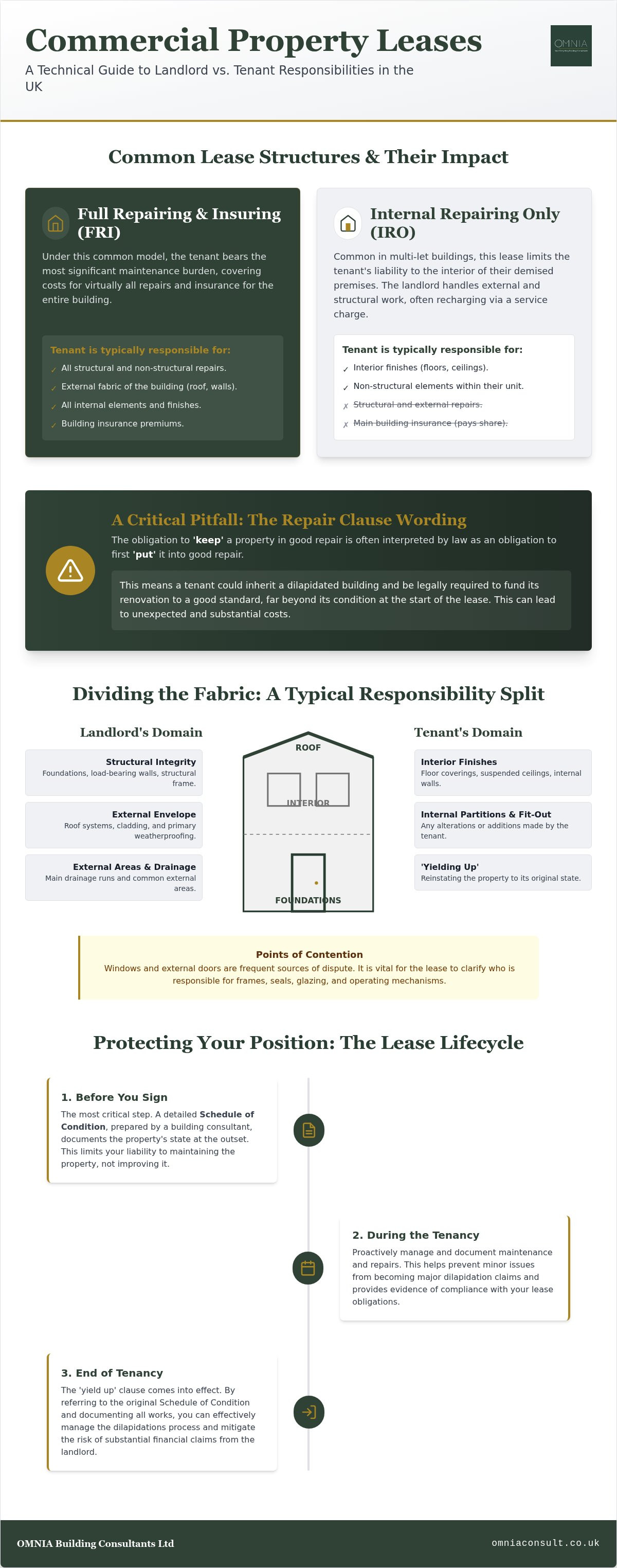
The most prevalent model is the 'Full Repairing and Insuring' (FRI) lease. Under this arrangement, the tenant typically carries the heaviest maintenance burden, covering all costs for repairs and insurance premiums. Conversely, an 'Internal Repairing Only' (IRO) lease limits the tenant's liability to the interior finishes and non-structural elements. This is common in multi-let office buildings where the landlord maintains the external fabric, often recovering costs through a service charge. Understanding whether a lease is 'Net' or 'Gross' is essential for long-term financial stewardship.
Why Lease Language Can Be Deceptive
Technical clarity is essential because legal terminology doesn't always align with physical reality. A prime example is the distinction between the obligation to 'keep in repair' and 'put in repair'. If a lease requires a tenant to 'keep' a building in good repair, and the property is already in a state of decay, the law often interprets this as an obligation to first 'put' the building into repair. This can inadvertently force a tenant to improve an asset beyond its original condition. Without a Building Condition Survey to document the initial state, a tenant might find themselves funding the landlord's capital improvements.
The regulatory environment is also shifting. The Landlord and Tenant Act 1954, which governs security of tenure, is undergoing a significant Law Commission review as of late 2026. This review explores proposals to extend the exclusion period for security of tenure from 6 months to 2 years. Meanwhile, the Renters' Rights Act 2025 has already impacted mixed-use assets by abolishing 'no-fault' evictions for residential components. These changes underscore why relying on generic templates for landlord vs tenant responsibilities commercial property UK is increasingly risky. Modern leasing requires a technical partner who understands both the legal framework and the physical asset's lifecycle.
Dividing the Fabric: Who Fixes What?
Moving from the legal framework to the physical reality of the building requires a granular look at the building's fabric. Whilst the lease provides the rules, the building's condition at the start of the term dictates the actual workload. Identifying the precise boundary lines for landlord vs tenant responsibilities commercial property UK is essential to prevent budget-breaking surprises. Typically, the division falls between the external "envelope" and the internal "fit-out", yet many disputes arise in the technical grey areas where these two meet.
External and Structural Responsibilities
Landlords generally retain responsibility for the structural integrity of the property, including the roof, foundations, and load-bearing walls. These costs are often recovered through a service charge, but the landlord remains the technical lead for procurement and execution. Windows and external doors frequently become a point of contention; they are part of the building's thermal envelope but are often operated solely by the tenant. It's vital to clarify who maintains the seals and frames versus the glass itself. External drainage and the integrity of the building's weatherproofing are almost always landlord-led duties to ensure the asset's long-term viability.
Internal and Decorative Obligations
The interior of the premises is typically the tenant's domain. This includes floor finishes, ceiling tiles, and any internal partitions installed during a fit-out. Under most tenant responsibilities for commercial property, there is a duty to 'yield up' the property in a specific state at the end of the term. This goes beyond simple cleaning; it often requires the removal of partitions and the reinstatement of original finishes. When damp or condensation appears, the technical investigation must determine if the cause is tenant behaviour, such as poor ventilation, or a structural failure in the landlord's envelope. A detailed Building Condition Survey can provide the evidence needed to resolve such disputes fairly.
Statutory Compliance and Safety
Compliance is a shared journey but with distinct milestones. The tenant is usually the 'responsible person' for the Fire Risk Assessment (FRA) within their occupied space, whilst the landlord manages common areas and structural fire protection. Complex Mechanical, Electrical, and Public Health (MEPH) systems, such as lifts and air conditioning, require rigorous maintenance schedules. With the government target for commercial properties over 1,000 square metres to achieve an EPC rating of B by 2031, energy performance is no longer a secondary concern. Ensuring building regulatory compliance services are integrated into any renovation is critical. Appointing a specialist for CDM Principal Designer services ensures that health and safety are designed into maintenance projects from the outset, protecting all parties from regulatory risk.
Dilapidations and the Lifecycle of Responsibility
Dilapidations represent the technical and financial settlement at the end of a lease term. It's often the point where any lingering ambiguity regarding landlord vs tenant responsibilities commercial property UK manifests as a significant financial liability. A landlord may serve an interim schedule during the lease to address urgent maintenance, or more commonly, a terminal schedule as the lease draws to a close. Crucially, a landlord's claim is often legally capped by the 'diminution in value' of the reversionary interest, a concept rooted in Section 18(1) of the Landlord and Tenant Act 1927. This ensures that a tenant isn't forced to pay for repairs that don't actually impact the property's market value.
The Dilapidations Process
Whilst UK government guidance on tenant responsibilities provides a helpful baseline, the specific nuances of the lease usually dictate the final settlement. A landlord can serve a schedule of dilapidations to identify breaches of the repair, decorating, and reinstatement covenants. Tenants have a right to challenge these demands, especially if the proposed works are unnecessary or exceed the standard required by the lease. Specialist surveyors are indispensable in this process. They act as navigators who use technical evidence to negotiate the final bill, ensuring that the settlement is grounded in physical reality rather than speculative costs.
Proactive Asset Management
Avoiding the financial shock at the end of a tenancy requires a shift from reactive fixes to strategic stewardship. Implementing asset management planning buildings allows both landlords and tenants to visualise the entire lifecycle of the asset. By adopting scheduled maintenance planning, repair costs are organised and distributed across the lease term. This prevents the accumulation of defects that often trigger massive terminal claims.
This proactive approach relies heavily on robust technical specifications. Without clear standards for the quality of repair work, disputes over whether an obligation has been met are inevitable. For occupiers of heritage assets, securing the correct listed building consent for any alterations is a critical compliance step. Failing to do so can lead to astronomical reinstatement costs, as tenants might be required to undo years of structural changes to restore the building's historical character. This level of technical due diligence ensures that the lifecycle of responsibility is managed with precision rather than left to chance.
Protecting Your Position: Before You Sign
The most effective way to manage landlord vs tenant responsibilities commercial property UK is to define them with absolute precision before the first pen touches the lease. Whilst legal teams focus on the wording of the covenants, the physical state of the asset often dictates the actual financial risk. Proactive protection starts with a shift in perspective; you aren't just renting space, you're inheriting a set of technical liabilities. Identifying these early allows for the negotiation of terms that reflect the building's true condition rather than a generic legal template.
The Power of the Schedule of Condition
A Schedule of Condition is the most powerful tool available to a commercial tenant. It serves as a comprehensive record of the property's state at the point of commencement, effectively "freezing" the repair standard. Without this document, a tenant might be legally required to return a building in a better state than they found it. A robust schedule combines high-resolution photographic evidence with descriptive technical notes that identify existing defects, damp, or structural wear. To be effective, this document must be formally incorporated into the lease to ensure it limits future repair and reinstatement duties during dilapidations negotiations.
Pre-Lease Technical Due Diligence
Conducting thorough technical due diligence is essential to uncovering "latent defects" that could otherwise become a tenant's financial burden. A commercial structural survey UK is vital for identifying deep-seated issues that aren't visible during a standard walkthrough. This assessment extends to the building's plant and machinery, such as HVAC systems and lifts. If these systems are nearing the end of their operational lifespan, the tenant should negotiate for the landlord to replace them or provide a specific exclusion from repair duties. Using commercial building fabric surveys as a negotiation lever can result in significant rent hols or reduced service charges.
Beyond the fabric of the building, tenants should seek to negotiate "service charge caps" for shared maintenance costs. This provides a predictable ceiling for annual expenditure, protecting against sudden spikes caused by major landlord-led repairs. To ensure your interests are protected from day one, we recommend commissioning a professional Building Condition Survey to document the property's state with technical precision and professional authority.
Partnering with OMNIA for Technical Stewardship
OMNIA provides the technical stewardship needed to translate complex lease covenants into actionable maintenance plans. We understand that the interplay of landlord vs tenant responsibilities commercial property UK requires more than a legal reading; it demands a deep technical understanding of the building fabric. By acting as a technical partner, we bridge the gap between the ambiguous language of a lease and the physical reality of the asset. This ensures that both parties can move forward with confidence, knowing that their interests are protected by professional oversight and technical clarity.
Expert Surveying and Consultancy
Our Building Condition Surveys establish a clear baseline for responsibility, preventing disputes before they arise. For those managing heritage assets, our specialised guidance on listed building renovation ensures that historical integrity is maintained whilst meeting modern standards. We go beyond immediate fixes to provide strategic Asset Management Planning, which organises maintenance into a predictable lifecycle. This holistic approach protects the long-term property value for landlords and ensures tenants aren't hit with unexpected costs due to neglected infrastructure.
Ensuring Seamless Project Execution
The execution of repair works requires rigorous standards to avoid future dilapidations claims. Acting as the Contract Administrator, we oversee the entire project lifecycle to ensure works meet the precise technical specifications required. Our role in commercial project management includes bid writing and contractor selection, ensuring you receive the best value without compromising on quality. This is a critical step in managing landlord vs tenant responsibilities commercial property UK, as it ensures that repairs are proportionate and technically sound.
We also manage the CDM Principal Designer role, ensuring that all health, safety, and regulatory compliance duties are met from the design phase through to completion. This end-to-end support provides the peace of mind that comes from having a steady hand at the helm of your property portfolio. Our team ensures that every structural or mechanical intervention is documented and executed with precision, safeguarding the asset's viability for years to come. Contact OMNIA today to discuss how we can support your commercial property obligations with technical authority and professional integrity.
Securing Your Property's Future Through Technical Clarity
Understanding the technical nuances of landlord vs tenant responsibilities commercial property UK is the first step toward effective asset stewardship. We've explored how ambiguous lease language often leads to unexpected costs and why a robust Schedule of Condition is your most powerful tool for limiting future liability. Whether you're navigating the complexities of dilapidations or preparing for a new tenancy, success depends on bridging the gap between legal text and the physical reality of the building fabric.
Managing commercial assets requires a steady hand and a proactive approach. OMNIA offers the chartered building consultancy expertise and national coverage needed to ensure your property remains compliant and commercially viable. Our team provides comprehensive regulatory compliance oversight, guiding you through every stage of the building's lifecycle with precision and integrity. Don't leave your financial position to chance; Request a Professional Building Condition Survey from OMNIA to gain the technical clarity your project deserves. We're here to help you navigate the built environment with confidence and peace of mind.
Frequently Asked Questions
Is a commercial landlord responsible for the roof in the UK?
Responsibility for the roof depends entirely on the specific lease structure. In a multi-let building, the landlord usually manages structural repairs and recovers costs via a service charge. However, in a standalone 'Full Repairing and Insuring' (FRI) lease, the tenant is often directly responsible for the roof's maintenance and repair. It's essential to check the 'demise' defined in the lease to see exactly where your obligations begin and end.
What happens if a tenant doesn't carry out repairs in a commercial lease?
If a tenant neglects their maintenance duties, they're in breach of the lease covenants. The landlord may serve an 'interim schedule of dilapidations' to enforce repairs during the term. In some cases, the landlord can exercise a 'right to enter' to perform the works and recharge the costs to the tenant as a debt. Severe or persistent breaches could also lead to lease forfeiture proceedings or significant financial claims.
Can a commercial landlord charge for repairs through a service charge?
Yes, a landlord can recover repair costs through a service charge if the lease contains the necessary provisions. This typically covers the maintenance of common parts, shared services, and the external building fabric in multi-let properties. Tenants should negotiate a service charge cap or a sinking fund exclusion during the pre-lease stage to ensure these costs remain predictable and manageable throughout the entire duration of the tenancy.
Do I need a survey before signing a commercial lease?
Commissioning a professional survey before signing is a critical step in technical due diligence. A Building Condition Survey identifies latent defects and structural issues that could otherwise become your financial burden. This information provides a powerful negotiation lever, allowing you to request repairs from the landlord or a rent-free period to account for the property's actual state at the point of commencement.
What is a 'Schedule of Condition' and why do I need one?
A Schedule of Condition is a detailed record of a building's physical state at the start of a lease. It includes photographic evidence and technical descriptions to "freeze" the standard of repair required. By incorporating this document into the lease, a tenant ensures they aren't forced to return the property in a better condition than they found it, which is vital for managing landlord vs tenant responsibilities commercial property UK.
Who is responsible for fire safety in a commercial building, landlord or tenant?
Responsibility for fire safety is a shared obligation under the Regulatory Reform (Fire Safety) Order 2005. The tenant is usually the 'responsible person' for the fire risk assessment within their specific unit. The landlord remains responsible for fire safety in common areas and for maintaining structural fire protection, such as fire-resistant doors and alarms in shared corridors. Both parties must collaborate to ensure total building compliance.
How do dilapidations work at the end of a commercial tenancy?
Dilapidations are technical claims made by a landlord at the end of a tenancy for breaches of repair and reinstatement covenants. The process begins with a terminal schedule of dilapidations, followed by technical negotiations between specialist surveyors. Under Section 18(1) of the Landlord and Tenant Act 1927, these claims are often capped by the 'diminution in value', ensuring the settlement reflects the actual loss to the landlord's interest.
What is an FRI lease and how does it affect maintenance?
An FRI lease stands for 'Full Repairing and Insuring', and it places the most significant maintenance burden on the tenant. Under this model, the tenant is responsible for all repairs, both structural and non-structural, as well as the cost of building insurance. This structure is the industry standard for standalone commercial buildings. It makes understanding landlord vs tenant responsibilities commercial property UK particularly important, as the tenant carries almost all the physical asset risk.


