
Commercial Property Structural Survey: 2026 Strategic Guide
- OMNIA Building Consultants

- 11 minutes ago
- 11 min read
What if the most significant risk to your commercial portfolio isn't market volatility, but a hidden structural defect masked by years of superficial maintenance? It's a question that keeps many investors awake, especially as the 2026 RICS ESG standards now make sustainability and structural integrity mandatory components of property valuation. Relying on a basic visual check is no longer enough to safeguard a high-value asset. Securing a detailed structural survey for commercial property is the only way to move from uncertainty to informed stewardship.
We understand that the complexity of building regulatory compliance, particularly with the full implementation of the Building Safety Act 2022, can feel like a moving target. You deserve a clear profile of your building's health without the stress of unforeseen repair costs. This strategic guide promises to reveal how professional oversight identifies hidden risks and provides the accurate cost estimates you need for effective asset management. We'll examine the critical differences between condition reports and structural assessments, whilst outlining how technical due diligence ensures your investment remains viable in an increasingly regulated landscape. By the end, you'll have a clear roadmap for managing your property with confidence and precision.
Table of Contents
Understanding the Scope of a Commercial Structural Survey
A structural survey for commercial property is a comprehensive technical assessment of an asset, designed to provide a granular understanding of its physical condition. Unlike a standard visual inspection, this process involves a rigorous examination of the building’s core components, from the primary load-bearing frame to the nuances of the external envelope. To understand What is a Structural Survey in a commercial context, one must recognise it as a pillar of technical due diligence. It's the definitive analysis of a building’s load-bearing integrity and fabric health.
Commercial assessments are significantly more complex than residential surveys. Whilst a domestic report might focus on timber decay or damp in a standard masonry shell, a commercial surveyor must evaluate reinforced concrete frames, steel portals, and complex mechanical integrations. The scale of these assets means that minor oversights can lead to seven-figure repair liabilities, making the role of a professional building surveyor indispensable. They act as your technical partner, translating complex structural data into actionable business intelligence that protects your investment from the outset.
The Core Objectives of a Structural Assessment
The primary aim is to identify immediate structural defects and latent risks that could compromise the asset's future. This goes beyond current safety; it assesses whether the property is actually fit for your intended commercial use. For instance, a floor plate originally designed for light office work may not support the high-density racking or heavy machinery required for a modern industrial operation. These technical findings provide a robust basis for lease negotiations or purchase price adjustments, ensuring you don't inherit significant liabilities without a corresponding reduction in the acquisition cost.
Regulatory Compliance and Professional Standards
Professional standards are the foundation of a reliable report. All assessments should adhere to the latest RICS professional standards, which were updated in early 2026 to include more stringent ESG and sustainability reporting requirements. This ensures the document is recognised by lenders, insurers, and legal advisors during the acquisition process. Equally important is the firm's Professional Indemnity insurance, which provides essential protection for the client. A chartered surveyor’s report isn't just a document; it's a risk-mitigation tool that gives you the confidence to proceed with complex transactions whilst maintaining compliance with the Building Safety Act 2022.
Key Technical Components of a Professional Structural Assessment
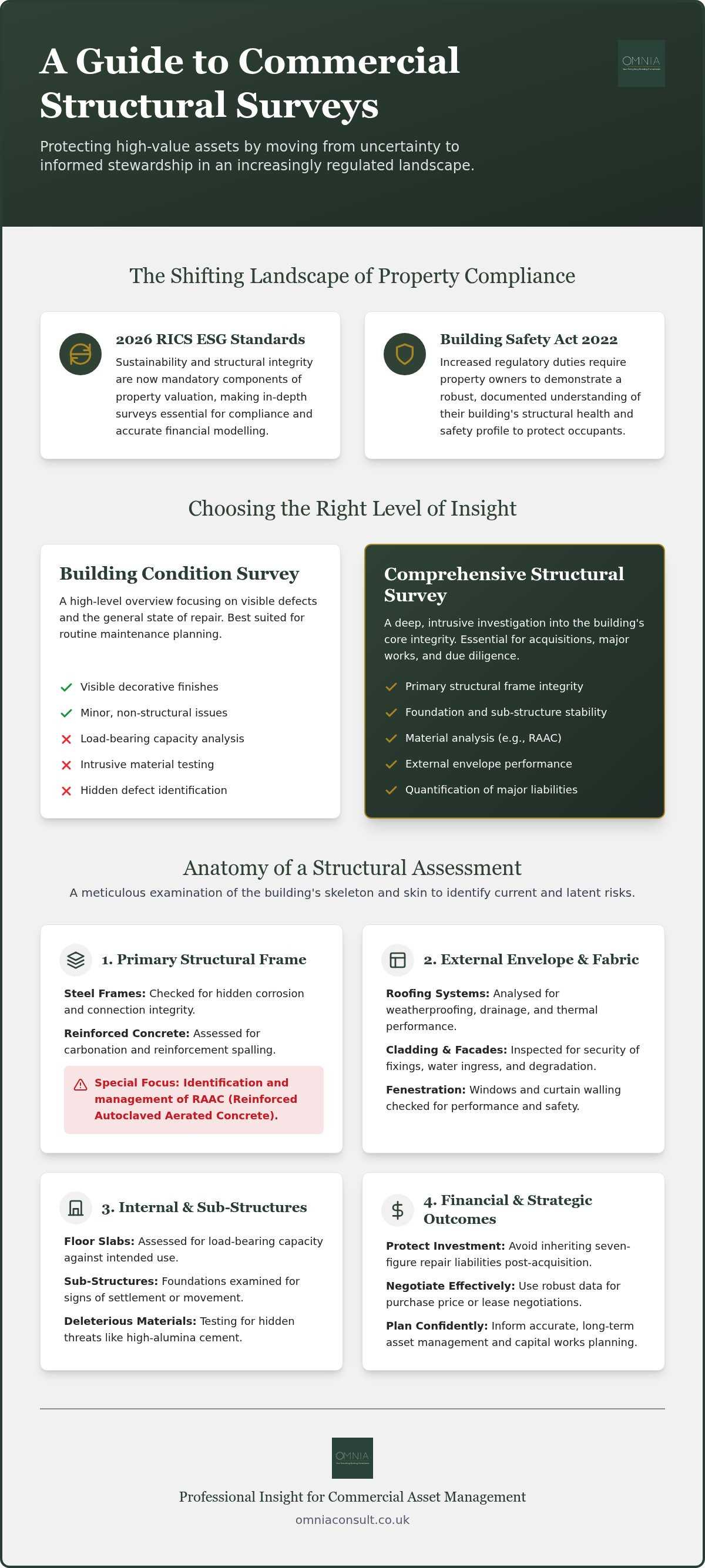
A professional structural survey for commercial property involves a meticulous breakdown of the building's skeleton and skin. The process begins with an analysis of the primary structural frame, typically comprising steel, reinforced concrete, or masonry. Each material presents specific risks. For example, steel frames require inspection for hidden corrosion, whilst concrete structures are assessed for carbonation and reinforcement spalling. A critical focus in 2026 remains the identification of Reinforced Autoclaved Aerated Concrete (RAAC), which requires specialist oversight to manage potential structural failure in older assets.
Beyond the frame, the evaluation covers the external envelope and building fabric. This includes:
Assessing the integrity of floor slabs under high point-loading from machinery or storage.
Inspecting roofing systems for weatherproofing, drainage efficiency, and thermal performance.
Evaluating sub-structures and foundations for signs of settlement or movement.
Material Analysis and Technical Specifications
Understanding technical specifications is essential for predicting an asset's long-term durability. We don't just look for surface defects; we investigate the chemical and physical properties of the materials used. This includes testing for damp, timber rot, or the presence of deleterious materials like high-alumina cement. Building age significantly dictates these requirements; an Edwardian warehouse requires a vastly different maintenance strategy compared to a modern distribution centre. By pinpointing these nuances, we ensure your asset management plan is grounded in physical reality rather than guesswork.
External Features and Surrounding Land
The assessment extends beyond the walls to the hardstanding, drainage systems, and boundary structures. Commercial sites often feature expansive concrete yards or complex subterranean drainage that can lead to foundation instability if neglected. We also identify risks from the surrounding terrain, such as subsidence or invasive species like Japanese Knotweed, which can devalue a property overnight. Finally, we evaluate the impact of neighbouring properties, ensuring that shared party walls or adjacent construction activities don't compromise your building's structural integrity.
Structural Survey vs Building Condition Survey: Choosing the Right Insight
Choosing between a Building Condition Survey and a full structural survey for commercial property depends entirely on your objective for the asset. A condition survey provides a broad overview of the property's state, focusing on visible defects in the fabric, decoration, and services. It's a vital tool for operational management and routine health checks. Conversely, a structural survey is a deep technical dive into the building's core stability and load-bearing integrity. Whilst a condition report might highlight a leaking roof, a structural assessment determines if the underlying trusses can support a new plant installation or a sustainable green roof upgrade.
Acquisitions require the highest level of scrutiny. A structural survey for commercial property is non-negotiable during the technical due diligence phase because it uncovers latent risks that could lead to catastrophic financial liabilities. For existing owners, a condition survey is often sufficient for routine maintenance planning, ensuring the asset remains in good repair without the intensity of a full structural analysis. The choice reflects a balance between the cost of the survey and the depth of insight required to protect your capital.
Acquisition vs. Maintenance Planning
Technical due diligence is the process of stripping away uncertainty during a property acquisition. By integrating structural data into your financial modelling, you can adjust your purchase price or negotiate repair covenants with precision. For commercial landlords, regular condition surveys support proactive stewardship. They allow for the creation of multi-year maintenance schedules that prevent minor issues from escalating into major structural failures. This holistic approach ensures that asset value is protected throughout the entire project lifecycle, moving from reactive fixes to strategic management.
Specialist Surveys for Listed Assets
Historic properties, such as Grade 2 listed assets, present a unique set of challenges. These buildings often feature non-standard construction methods that require a specialised understanding of heritage materials and traditional building techniques. Listed building consent consultants rely on detailed structural data to ensure that any proposed renovations respect the building's character whilst meeting modern safety standards. Balancing heritage preservation with the rigorous requirements of the Building Safety Act 2022 is a delicate task. It requires a surveyor who is both a strategist and a technician, capable of finding compliant solutions that don't compromise the asset's historic integrity.
Identifying Risks and Protecting Asset Value Through Technical Surveys
A structural survey for commercial property functions as a high-precision risk management tool, translating physical observations into actionable financial data. By quantifying repair liabilities, investors can integrate "cost to cure" figures directly into their financial modelling. This level of detail is essential for leasehold dilapidations, where an accurate record of a building's condition at the start of a term prevents disputes at the end. It also provides the technical foundation for professional bid writing; ensuring that when you tender for renovation works, the specifications are based on verified structural requirements rather than optimistic estimates.
Beyond financial protection, these surveys are critical for occupant safety. With the Building Safety Act 2022 now fully active, building owners carry significant accountability for managing safety risks. A technical assessment identifies latent hazards, such as compromised fire compartmentation or failing structural joints, before they become legal or physical liabilities. This proactive stewardship ensures compliance whilst maintaining the long-term viability of the asset.
Financial Implications of Structural Findings
Identifying a defect is only the first step; the true value lies in estimating the cost to remediate it. These findings directly influence property insurance premiums, as insurers often offer more favourable rates to owners who can prove their assets are structurally sound. During negotiations, having a chartered surveyor's report allows you to secure better purchase or lease terms by highlighting necessary capital expenditure that the current owner hasn't addressed. This transparency instils confidence in lenders and stakeholders alike.
Environmental and Sustainability Risks
As of April 2026, the RICS ESG standards make environmental factors a mandatory part of valuation. A technical survey evaluates the building’s fabric efficiency and thermal performance, identifying where retrofitting sustainable technologies is feasible. This is particularly relevant given the 2026 EPC reforms, which may require more frequent re-certification for listed buildings. A comprehensive structural survey for commercial property remains the most effective way to validate these sustainability claims whilst evaluating risks from flood, fire, or subsidence reinstatement. This ensures your asset management strategy is resilient against both environmental change and regulatory shifts.
If you require expert support to quantify your building risks, our team can provide the technical specifications and bid writing expertise needed to protect your investment.
Strategic Asset Management: Integrating Structural Insights into Project Lifecycles
A structural survey for commercial property shouldn't be viewed as a one-off transaction or a mere box-ticking exercise for an acquisition. Instead, it serves as the technical foundation for the entire lifecycle of an asset. When professional building consultants conduct these assessments, the data produced doesn't just sit in a report; it informs the immediate workflows of commercial project management companies. This integration ensures that the transition from identifying a defect to executing a repair through formal contract administration is seamless and evidence-based. By positioning the survey as the inaugural step in building project oversight services, owners can avoid the fragmented approach that often leads to budget overruns and technical failures.
Effective stewardship requires a holistic view of the built environment. The insights gained from a structural assessment allow for the creation of precise technical specifications that guide future works. These documents are vital when moving into the renovation phase, as they ensure that contractors are held to rigorous standards that match the building's actual needs. This methodical progression from data collection to project execution maintains the continuity of care required for high-value commercial investments, whilst ensuring that every pound spent on maintenance is targeted for maximum impact.
The Link Between Surveys and CDM Compliance
The relationship between structural reporting and regulatory safety is absolute. Under the Building Safety Act 2022, the role of a CDM Principal Designer is pivotal in managing health and safety risks during the design and construction phases. Structural reports provide the empirical evidence needed to identify safety risks early, allowing the Principal Designer to implement mitigation strategies long before a single worker sets foot on site. This data eventually forms the core of the building’s health and safety file, ensuring that future owners and managers have a clear record of the structure's integrity and any modifications made over time.
Holistic Architectural and Space Planning
Structural constraints are the primary boundaries for any creative architectural design for commercial property. Without a clear understanding of load-bearing walls, column placements, and floor-loading capacities, office space planning consultants risk proposing designs that are physically impossible or prohibitively expensive to implement. Integrating a structural survey for commercial property at the start of the design process ensures that space planning is both imaginative and technically viable. This collaborative approach prevents the need for costly redesigns later in the project lifecycle.
We invite you to contact OMNIA to learn how we integrate asset management planning buildings with technical surveying to provide a complete stewardship solution for your portfolio.
Securing the Future of Your Commercial Portfolio
The built environment is evolving rapidly. A reactive approach to building maintenance is no longer viable in the 2026 landscape. By prioritising a structural survey for commercial property, you move beyond surface-level inspections to a position of technical authority. This process ensures that every decision, from initial acquisition to long-term asset management planning, is grounded in empirical evidence and professional oversight. It's the most effective way to safeguard your capital whilst meeting the rigorous demands of the Building Safety Act.
Protecting your investment requires a partner who understands the nuances of complex technical specifications and regulatory compliance. As an RICS Regulated Firm with specific expertise in listed building consent and comprehensive project management support, we're here to guide you through every stage of your asset's lifecycle. We encourage you to contact OMNIA Building Consultants for a professional structural assessment to gain the clarity and peace of mind you need to manage your portfolio with confidence. Your property's longevity starts with a steady hand and expert insight.
Frequently Asked Questions
What is the difference between a commercial structural survey and a building condition survey?
A structural survey for commercial property is a deep technical analysis focusing on the building's core load-bearing integrity and primary frame. In contrast, a building condition survey provides a broader overview of the asset's general state, including non-structural elements like decoration and services. Whilst a condition report identifies visible defects, a structural assessment investigates latent risks and material durability, providing a definitive profile of the building's fabric health.
How much does a structural survey for a commercial property cost?
Fees for a professional assessment are determined by the property's size, age, and construction complexity. A large industrial warehouse with a complex steel frame requires a more intensive investigation than a smaller masonry office unit. We recommend requesting a bespoke quote that reflects the specific technical requirements of your asset. This ensures you receive a thorough report that aligns with RICS standards without paying for unnecessary scope.
How long does it take to receive a commercial structural survey report?
The turnaround time for a comprehensive report typically depends on the asset's scale and the level of technical detail required. Following the site inspection, a chartered surveyor usually requires several working days to analyse the findings and compile a detailed technical specification. For complex or multi-site portfolios, this duration may extend to ensure every structural risk is accurately quantified. We always advise clients on expected delivery dates during the initial consultation.
Is a structural survey mandatory for a commercial property lease?
Whilst not a legal requirement for signing a lease, a structural assessment is a critical component of technical due diligence. It protects tenants from inheriting significant repair liabilities under Full Repairing and Insuring (FRI) terms. By establishing a clear record of the building's condition at the start of the term, you can negotiate repair covenants more effectively. This proactive step prevents costly disputes over leasehold dilapidations when the tenancy eventually ends.
Can a structural survey help with listed building consent applications?
A detailed assessment is essential for securing listed building consent for Grade 2 or Grade 1 assets. These reports provide the empirical evidence that planning authorities require to ensure any proposed changes respect the property's historic integrity. By identifying the building's structural constraints early, our consultants can develop architectural designs that balance modern regulatory compliance with heritage preservation, significantly increasing the likelihood of a successful application for your project.
What are deleterious materials, and does a survey identify them?
Deleterious materials are substances that can cause structural failure or health risks, such as RAAC, high-alumina cement, or asbestos. A professional structural survey for commercial property specifically investigates the presence of these materials within the building's fabric. Identifying these risks early is vital for long-term asset management planning, as it allows owners to quantify remediation costs and manage safety obligations under the Building Safety Act 2022 effectively.
How often should a commercial property undergo a structural assessment?
We generally recommend a full structural assessment during major lifecycle events, such as an acquisition, a significant change of use, or before major renovations. For ongoing stewardship, integrating these insights into a five-year or ten-year asset management plan ensures the building remains viable and safe. Regular condition checks should be conducted more frequently, but a deep structural dive is reserved for when the asset's core integrity must be verified.
Does a structural survey include a valuation of the property?
A structural report is a technical assessment of a building's physical health rather than a formal valuation. However, the findings play a pivotal role in the valuation process. By identifying significant repair liabilities or latent defects, the survey provides the data needed for accurate financial modelling. RICS valuation standards now require surveyors to consider these technical and ESG factors, making the structural report an essential tool for protecting the property's market value.


