
Cost-Benefit Analysis for Commercial Construction 2026
- OMNIA Building Consultants

- 10 minutes ago
- 11 min read
What if the most expensive element of your next development isn't the concrete or the steel, but the technical data points missed during your initial survey? In an era of fluctuating material costs and tightening regulations, relying on a surface-level financial forecast is no longer enough to protect your margins. You likely recognise that securing funding and board approval requires more than just optimistic projections; it demands a rigorous, evidence-based approach that accounts for every hidden variable. This guide provides a comprehensive framework for conducting a cost-benefit analysis for commercial construction projects, ensuring your investment remains viable from the first stone to the final handover.
We'll explore how to quantify intangible benefits like ESG compliance and how professional technical specifications act as a shield against cost creep. Mastering these principles allows you to justify investments with clarity whilst mitigating the technical risks that often derail ambitious builds. By the end of this article, you'll have the tools to ensure long-term viability and lead your project with the composure of a seasoned navigator, knowing your data is rooted in professional oversight rather than guesswork.
Table of Contents
The Fundamentals of Cost-Benefit Analysis in Commercial Property
A Cost-Benefit Analysis (CBA) is a systematic process used to calculate and compare the total anticipated benefits of a project against its total costs. Whilst traditional financial appraisals focus heavily on immediate Return on Investment (ROI), a comprehensive cost-benefit analysis for commercial construction projects adopts a broader perspective. In the 2026 market, this involves weighing socio-economic factors, environmental impact, and long-term viability alongside capital costs. This evolution is driven by shifting interest rates, volatile material prices, and the non-negotiable requirements of Environmental, Social, and Governance (ESG) standards.
We view this process through the lens of technical stewardship. It's not merely about filling a spreadsheet; it's about guiding a project from its initial conception to its final operational state with professional integrity. By identifying technical risks early, we ensure that the project remains a sustainable asset rather than a financial liability. This holistic approach allows developers to see beyond the immediate build cost to the true value of the finished development.
Why CBA is Mandatory for Modern Project Justification
Securing institutional investment or bank lending now requires a level of data rigour that goes beyond simple profit margins. Lenders demand evidence that a development is resilient to regulatory changes and market shifts. Integrating your appraisal with asset management planning buildings ensures your goals align with the entire lifecycle of the property. For commercial stakeholders, a cost-benefit analysis for commercial construction projects acts as a robust risk-mitigation framework that translates technical uncertainties into quantifiable financial data.
The Core Components: Costs, Benefits, and Timeframes
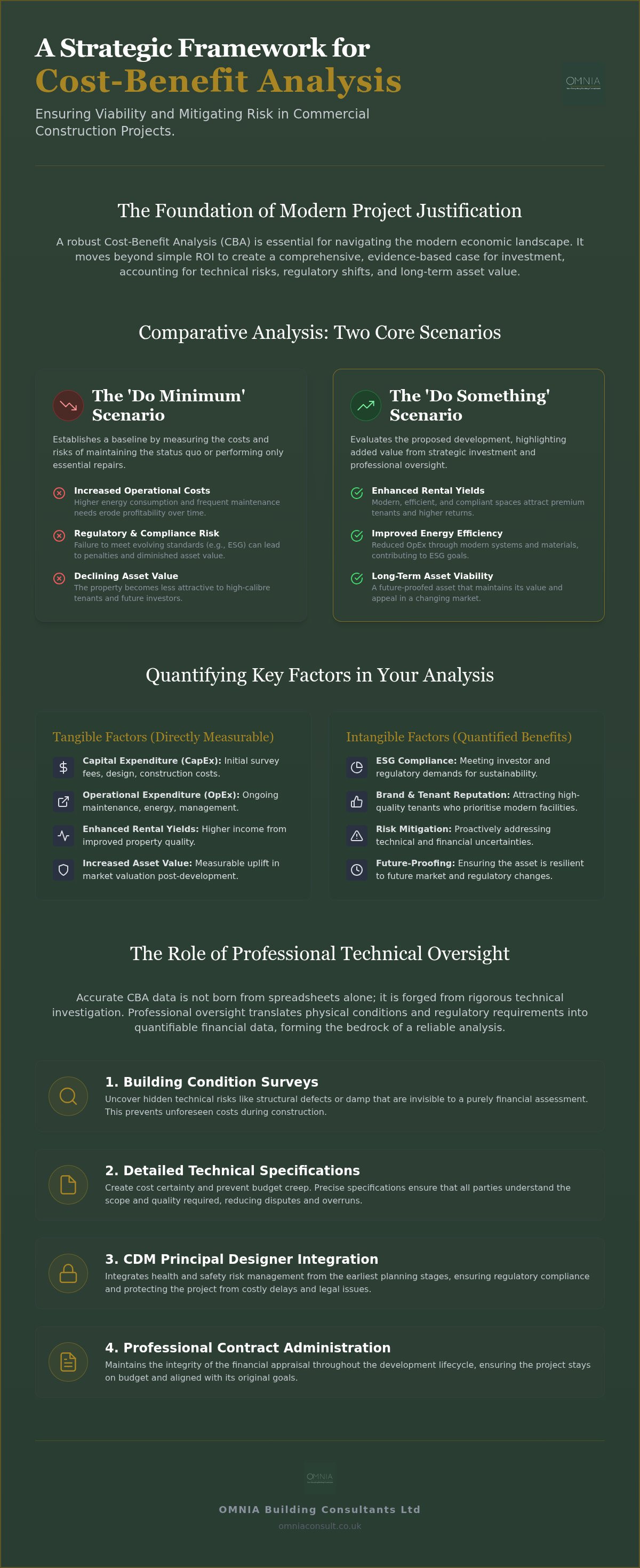
A successful appraisal distinguishes between Capital Expenditure (CapEx), such as initial survey fees and construction costs, and Operational Expenditure (OpEx), which includes ongoing maintenance and energy consumption. Because commercial assets are typically appraised over a 25 to 50-year period, the long-term impact of early technical decisions becomes clear. We utilise two primary scenarios to provide clarity:
The 'Do Minimum' Scenario: This establishes a baseline by measuring the costs and risks of maintaining the status quo or performing only essential repairs.
The 'Do Something' Scenario: This evaluates the proposed development or renovation, highlighting the added value in rental yields, energy efficiency, and regulatory compliance.
This comparative approach allows you to see the true cost of inaction versus the strategic benefit of investment. By establishing clear timeframes and cost categories, you can present a transparent case to board members and investors, demonstrating that every pound spent is an investment in the asset’s longevity.
Quantifying the Tangible and Intangible Factors
Effective quantification requires moving beyond basic accounting to understand how every technical decision influences the project lifecycle. Direct costs, such as design fees, structural surveys, and detailed technical specifications, represent the initial investment. However, the true value of a cost-benefit analysis for commercial construction projects is revealed when we measure these against direct benefits like enhanced rental yields and operational efficiency. Strategic architectural design for commercial property serves as a primary driver of this value, ensuring that space is not only utilised efficiently but also appeals to high-calibre tenants who prioritise quality.
Calculating Direct Financial Returns
Financial metrics like Net Present Value (NPV) and Internal Rate of Return (IRR) provide a snapshot of profitability, but they rely on the accuracy of your cost data. By applying a cost-benefit analysis for commercial construction projects to every phase of development, we use robust technical specifications to create cost certainty, preventing the budget creep that often occurs when details are left to chance. This level of precision allows for a clear comparison between initial capital expenditure and long-term savings.
Valuing ESG and Sustainability Benefits
Sustainability is no longer a peripheral concern; it's a core component of asset liquidity. Properties with superior EPC ratings often command a "Green Premium" in the UK market, attracting tenants willing to pay higher rents for lower carbon footprints. To quantify these gains, we look at a Methodology for Evaluating Energy Savings that translates technical performance into financial projections. Beyond energy, we must also consider intangibles like brand reputation and tenant wellbeing. Whilst harder to measure, a building designed for health and productivity reduces tenant turnover and void periods, securing the long-term viability of your development. Ensuring your project is supported by professional technical specifications from the outset is the most reliable way to secure these intangible rewards.
How Technical Surveys Inform Accurate CBA Data
A robust cost-benefit analysis for commercial construction projects is only as reliable as the data underpinning it. Whilst many stakeholders rely on industry averages or historical estimates, these figures often fail to account for the unique physical realities of a specific site. Relying on generic data introduces significant risk, as it ignores the specific technical state of the asset and its surrounding environment. A professional commercial building condition survey is therefore not just an administrative step; it's the essential foundation for any credible financial appraisal. Without this baseline, your CBA remains a theoretical exercise rather than a practical roadmap for investment.
Building Condition Surveys as a Baseline
These surveys allow you to distinguish between immediate capital needs and deferred maintenance costs that might arise years later. By identifying these issues early, you can prevent "Optimism Bias", the tendency to underestimate costs and overestimate benefits, from skewing your financial models. OMNIA’s surveys provide the technical truth required to anchor project budgets in reality, ensuring that your contingency funds are based on evidence rather than guesswork. This level of detail is particularly vital when validating space planning. A structural assessment confirms whether the existing frame can support new layouts or increased loads, preventing costly redesigns or structural failures once work has commenced.
Specialist Assessments: Damp, Structural, and Fabric
Neglecting specialist investigations into damp or structural movement can lead to catastrophic budget overruns during the construction phase. A damp survey or structural assessment identifies the root causes of fabric failure, allowing you to include precise remedial costs in your initial cost-benefit analysis for commercial construction projects. These assessments also play a critical role in energy efficiency planning. A fabric survey evaluates the thermal performance of the building envelope, providing the data needed to calculate the ROI of insulation or glazing upgrades with precision.
Integrating this survey data into the contract administration process ensures that technical specifications are accurate from the outset. This alignment reduces the likelihood of variations and disputes, maintaining the integrity of your CBA throughout the project lifecycle. By treating surveys as a strategic investment rather than a mere expense, you protect your development from the hidden costs that typically erode commercial margins. This methodical approach ensures that every stakeholder has a clear, evidence-based understanding of the project's physical constraints and financial requirements.
Regulatory Compliance and Risk Mitigation
Regulatory compliance is frequently perceived as a static cost or a bureaucratic hurdle; yet, within a sophisticated cost-benefit analysis for commercial construction projects, it functions as a vital mechanism for risk mitigation. Non-compliance is expensive. Fines from the Health and Safety Executive (HSE) are merely the starting point; the true financial burden lies in project cessation, remedial works, and the erosion of investor confidence. By integrating regulatory milestones into the early appraisal phase, we transform legal obligations into predictable project components, ensuring that your financial roadmap remains intact despite a tightening legislative landscape.
The Financial Impact of CDM 2015 Compliance
Budgeting for professional CDM Principal Designer services should be viewed as a high-yield risk-reduction investment rather than a peripheral fee. A proactive approach to safety design identifies potential hazards whilst the project is still on the drawing board, preventing costly on-site modifications later. This stewardship extends beyond the construction phase. Assets designed with inherent safety and maintenance access often benefit from reduced long-term insurance premiums and lower operational risk profiles. To maintain your CBA’s integrity, it's essential to map these regulatory requirements against your project timeline, ensuring that every safety-critical decision is backed by technical rigour.
Listed Buildings and Heritage Constraints
For developments involving historic assets, the appraisal must navigate the "Heritage Premium" with extreme care. Balancing conservation requirements with commercial viability is a delicate process that requires specialised insight. Whilst the costs of securing listed building consent and employing traditional materials are higher, the prestige of heritage status can significantly bolster the asset’s market value. Specialist heritage planning acts as a cost-saving measure by preventing the delays and enforcement actions that occur when conservation officers reject poorly conceived proposals. We help you weigh these conservation costs against the long-term rental premiums that unique, historic spaces command.
Effective risk management starts with understanding the specific constraints of your site before you commit to a design. If you are preparing to navigate the complexities of a sensitive or highly regulated development, our team can help you ensure regulatory compliance from the very first appraisal, protecting your investment from the costs of the unforeseen.
Executing the CBA: From Analysis to Project Management
A cost-benefit analysis for commercial construction projects should never be relegated to a drawer once funding is secured. It serves as the project’s technical and financial conscience, providing a baseline against which every subsequent decision is measured. Transitioning from the appraisal phase to active commercial project management requires a disciplined approach to ensure the projected benefits actually materialise. This phase is where theoretical value is converted into physical reality, and it demands constant vigilance to prevent the benefit erosion that occurs when short-term savings compromise long-term asset performance. Using the CBA as a benchmark allows for rigorous quality control, ensuring that the physical build aligns with the strategic objectives identified at the outset.
Contract Administration and Cost Control
Maintaining the integrity of the original appraisal depends heavily on robust contract administration. During construction, pressure often mounts to implement value engineering, a process that frequently sacrifices long-term operational efficiency for immediate capital savings. Without professional oversight, these changes can quietly dismantle the logic of your cost-benefit analysis for commercial construction projects. A consultant’s role is to verify that work meets the precise technical specifications established during the planning phase, ensuring that the energy savings or durability benefits promised in the CBA are not lost to inferior substitutions. By managing variations with a clear view of their impact on the original appraisal, we maintain cost control whilst protecting the asset’s future yield.
The OMNIA Approach: Technical Stewardship
At OMNIA, we bridge the gap between financial planning and technical execution through what we call technical stewardship. This end-to-end oversight ensures that the insights gained from initial building condition surveys and regulatory assessments are carried through to the final handover, preventing the loss of critical technical data. Professional building consultancy is the key to accurate project appraisal because it grounds every financial projection in physical reality, rather than optimistic assumptions. When the same partner who conducted the initial analysis also manages the project, there is a seamless continuity of purpose that protects your investment from the fragmentation that often plagues large developments.
Ultimately, a successful development is one where the final asset performs exactly as the initial data predicted. Ensuring this alignment requires a partner who understands the complexities of the built environment as well as the nuances of financial risk. To secure the long-term viability of your next development, contact OMNIA for a professional building survey or project management consultation today.
Securing the Future of Your Commercial Assets
A robust cost-benefit analysis for commercial construction projects is the difference between a speculative venture and a sustainable asset. By grounding your financial appraisals in the technical truth of professional surveys and integrating regulatory foresight from the outset, you protect your margins against the volatility of the 2026 market. We've explored how technical stewardship prevents benefit erosion, ensuring that design integrity and energy efficiency targets are maintained throughout the project lifecycle.
As Chartered Building Surveyors, we provide the steady hand needed to navigate complex developments. Whether you require expertise in Listed Building Consent, comprehensive CDM Principal Designer services, or detailed technical specifications, our team is here to support your long-term success. Moving from analysis to execution requires a partner who is as detail-oriented as they are strategically minded. We invite you to enquire about our professional building consultancy and surveying services to ensure your next project is built on a foundation of precision and peace of mind. Your vision deserves the clarity that only expert oversight can provide.
Frequently Asked Questions
What is the primary purpose of a cost-benefit analysis in commercial construction?
The primary purpose is to provide a systematic framework for comparing the total anticipated costs of a project against its projected benefits over the entire building lifecycle. It's designed to help stakeholders justify significant capital investments whilst identifying potential technical risks. By adopting this holistic approach, you'll ensure that a development isn't only profitable but also viable from a regulatory, environmental, and socio-economic perspective.
How does a building condition survey improve the accuracy of a CBA?
A building condition survey provides the empirical data needed to ground your financial projections in physical reality. It identifies hidden issues such as structural defects, damp, or fabric failure that generic industry averages often miss. By uncovering these technical truths early, you'll create a more accurate cost-benefit analysis for commercial construction projects, ensuring that your contingency funds aren't based on guesswork but on professional evidence.
Should I include CDM Principal Designer fees in my project appraisal?
Yes, you should include these fees as they represent a vital risk-reduction investment in your project appraisal. Proactive safety design through CDM Principal Designer services identifies hazards during the planning phase, preventing expensive on-site modifications later. Including these costs ensures you account for the full scope of regulatory compliance. This foresight often results in lower long-term insurance premiums and protects the project from the financial penalties of non-compliance.
What are the risks of performing a CBA without professional technical input?
The main risks include "Optimism Bias", where capital costs are significantly underestimated and benefits inflated. You risk missing critical fabric issues or structural constraints that only a professional surveyor can identify. This lack of data often results in unexpected project overruns, disputes during contract administration, and a final asset that doesn't perform as expected. Technical specifications are essential for providing the cost certainty required to secure institutional funding.
How do you quantify intangible benefits like tenant satisfaction or ESG?
You quantify intangibles by measuring their direct impact on the asset's long-term market performance. For instance, superior ESG ratings are linked to a "Green Premium" in rental yields and improved liquidity. Tenant satisfaction is valued through reduced turnover rates and shorter void periods. These factors are translated into financial figures by analysing historical data and market trends, allowing them to be weighed alongside more traditional capital returns within your appraisal.
Is a CBA necessary for listed building renovations?
Yes, a CBA is essential for navigating the complex balance between conservation requirements and commercial objectives in listed building renovations. It helps you understand the "Heritage Premium" associated with traditional materials and the process of securing Listed Building Consent. By weighing these specific costs against the prestigious market value and unique appeal of historic properties, you'll ensure that the renovation isn't just architecturally sensitive but also financially sustainable.
How often should a CBA be updated during the project lifecycle?
It's updated at every critical project milestone to maintain its integrity as a reliable decision-making tool. Key points for review include the completion of specialist technical surveys, the finalisation of technical specifications, and during the contract administration phase. Regular updates ensure that variations in material costs or design changes don't erode the project's justification, allowing you to manage the risk profile with professional composure and data-driven confidence.
What is the difference between ROI and Cost-Benefit Analysis?
The difference is that ROI is a narrow financial ratio used to measure efficiency, whilst a cost-benefit analysis for commercial construction projects is a holistic appraisal. CBA accounts for a wide spectrum of factors, including lifecycle maintenance, environmental impact, and socio-economic value. It provides a comprehensive view of the project’s worth, helping stakeholders understand the long-term stewardship of the asset rather than just looking at immediate profit margins.


