
Commercial Property Maintenance Strategy: 2026 Guide
- OMNIA Building Consultants

- 10 minutes ago
- 11 min read
What if the most expensive part of your building isn't the energy bill, but the repair you didn't see coming? For many property owners, maintenance often feels like a cycle of firefighting where emergency call-out fees and rising material costs erode annual budgets. It's frustrating to watch your asset's value stagnate whilst you struggle to keep pace with the complexity of UK building regulations. This uncertainty is particularly acute for those managing ageing or listed assets where structural health is a constant concern.
We understand that the burden of staying compliant can feel like a moving target. This guide is designed to help you transition from reactive repairs to a professional-led commercial property maintenance strategy that prioritises long-term structural health. You'll discover how a technical approach to asset preservation can lower lifecycle costs and provide a clear roadmap for full regulatory compliance. We'll explore the vital roles of building condition surveys, technical specifications, and strategic project management in securing your property's future through 2026 and beyond.
Table of Contents
The Evolution of Commercial Property Maintenance Strategy
A commercial property maintenance strategy is no longer a simple checklist of repairs. It has evolved into a sophisticated lifecycle management framework that treats buildings as dynamic assets rather than static liabilities. In the past, maintenance was often seen as an unavoidable overhead. Today, it's recognised as a critical discipline for protecting capital value and ensuring operational continuity.
As we look towards 2026, the priorities for property owners have shifted. Sustainability and structural integrity are now central to The Evolution of Commercial Property Maintenance Strategy, driven by more stringent environmental standards and a heightened awareness of building safety. This shift requires a move away from generic upkeep towards a technical approach that considers the long-term viability of the entire structure.
From Reactive to Proactive: Shifting the Paradigm
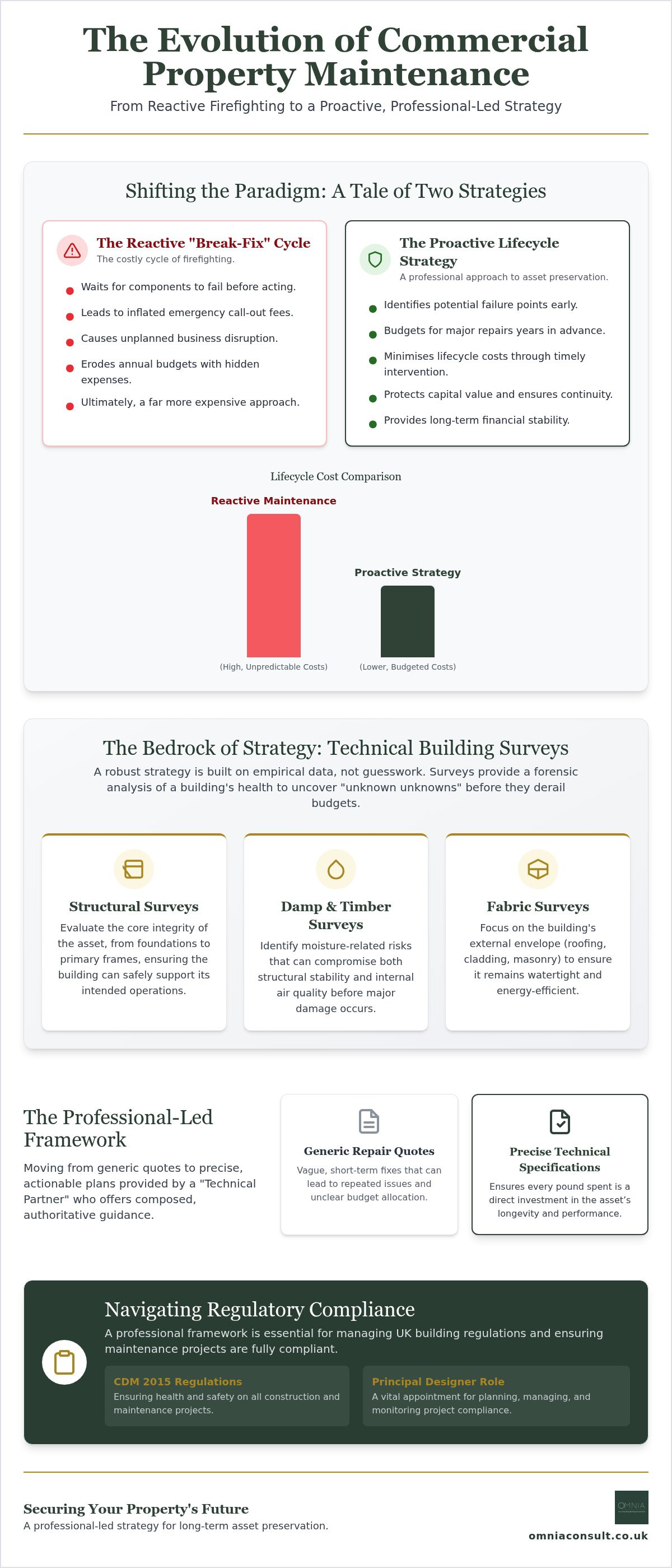
The traditional "break-fix" model is inherently flawed. It relies on components failing before they receive attention, which inevitably leads to inflated emergency call-out costs and unplanned business disruption. These hidden expenses can quickly spiral, making reactive maintenance far more expensive than a planned approach. Whilst basic preventive maintenance helps, it often lacks the strategic depth needed for modern, complex assets.
A proactive strategy aligns the physical condition of the property with broader investment goals. It involves:
Identifying potential failure points before they impact operations.
Budgeting for major repairs years in advance to avoid capital shocks.
Minimising the lifecycle cost of building components through timely intervention.
The Role of Professional Building Consultants
There is a vital distinction between general facilities management and technical building consultancy. Whilst facilities managers handle the daily rhythm of a building, professional consultants act as a "Technical Partner" for the owner. This role requires a combination of high-level strategic thinking and detail-oriented technical knowledge. They provide a level of risk mitigation that goes beyond routine cleaning or simple equipment servicing.
Professional surveyors offer a form of "quiet expertise." They don't rely on urgent language or sales tactics. Instead, they provide composed, authoritative guidance on complex building lifecycles. By providing clear technical specifications rather than generic quotes, they ensure that every pound spent on maintenance is an investment in the asset’s longevity. This holistic view is essential for navigating the regulatory and practical challenges of the modern built environment.
Technical Foundations: The Role of Building Condition Surveys
A robust commercial property maintenance strategy cannot exist in a vacuum. It requires a baseline of empirical data to move beyond guesswork. This is where commercial building condition surveys serve as the bedrock of your planning. Unlike a standard facilities walk-through, a professional technical survey provides a forensic analysis of the building's health, uncovering the "unknown unknowns" that often derail annual budgets.
For both modern steel-framed structures and historic brickwork, moisture remains a primary antagonist. Damp surveys are essential for identifying water ingress or rising damp that might otherwise remain hidden behind internal finishes until structural damage occurs. Similarly, fabric surveys examine the external envelope in detail, identifying latent defects in cladding, masonry, or roofing before they escalate into catastrophic failures. Identifying these issues early is the difference between a minor repair and a major capital expenditure project.
Types of Surveys for Strategic Planning
To build a comprehensive strategy, owners should utilise specific technical assessments tailored to the asset's age and use:
Structural surveys: These evaluate the core integrity of the asset, from foundations to primary frames, ensuring the building can safely support its intended operations.
Damp and timber surveys: Critical for identifying moisture-related risks that compromise both structural stability and internal air quality.
Fabric surveys: These focus specifically on weatherproofing and the external envelope to ensure the building remains watertight and energy-efficient.
Turning Survey Data into Actionable Specifications
Data is only valuable if it informs action. High-quality technical data allows for accurate budget forecasting, typically spanning a five to ten-year horizon. This foresight prevents the "sticker shock" of major repairs and allows for smoother cash flow management. The transition from survey findings to technical building specifications is where the strategy gains its teeth.
These specifications ensure that when works are tendered, contractors are bidding on precise professional requirements rather than generic, high-level quotes. This level of detail is also necessary to meet the legal obligations under the Construction (Design and Management) Regulations 2015, which often apply to maintenance projects involving structural alteration or significant risk. If you are unsure where your asset stands, commissioning a detailed structural survey is the most reliable way to begin your strategic planning journey.
Strategic Asset Management vs. Planned Maintenance
Whilst many use the terms interchangeably, there is a fundamental difference between tactical upkeep and Strategic Asset Management. Planned Preventative Maintenance (PPM) is a tactical tool; it focuses on the "how" and "when" of routine tasks. Conversely, Asset Management Planning is the overarching commercial property maintenance strategy that dictates the "why". It ensures that every maintenance pound spent aligns with the long-term investment objectives of the building owner. Tactical upkeep is the "doing"; strategic planning is the "thinking".
Adopting a "whole-life" cost approach is central to this distinction. Instead of merely choosing the cheapest repair option today, a strategic approach evaluates the total cost of a building component over its entire lifespan. This includes the initial installation, energy consumption, routine servicing, and eventual decommissioning. By categorising assets based on their criticality to operations and their replacement cost, owners can prioritise resources where they'll have the greatest impact on preserving value.
Developing a Robust PPM Schedule
A well-structured PPM schedule targets high-wear areas such as HVAC systems, roofing membranes, and structural expansion joints. The frequency of these interventions shouldn't be arbitrary. It must be balanced against the age of the asset and its specific usage patterns. For instance, a distribution centre with constant heavy vehicle movement requires a different joint maintenance rhythm than a low-traffic office block. Using PPM effectively extends the operational life of expensive plant and machinery, delaying the need for capital-intensive replacements.
Asset Lifecycle Planning for Long-Term Value
Strategic budgeting for major capital expenditure (CapEx) projects is the hallmark of a mature commercial property maintenance strategy. Without this foresight, portfolios often accumulate "maintenance debt", which is a backlog of essential repairs that eventually compromises the building's structural integrity. Professional consultancy provides the data needed to avoid this trap. Consider two identical assets over twenty years: the managed asset receives incremental technical investment and retains its Grade A status, whilst the neglected one suffers from systemic failures, requiring a total refurbishment that costs triple the original saved maintenance budget.
Navigating Regulatory Compliance and CDM 2015 Obligations
Many property owners mistakenly believe that routine upkeep falls outside the scope of health and safety legislation. However, a comprehensive commercial property maintenance strategy must account for the fact that maintenance projects frequently trigger the Construction (Design and Management) Regulations 2015. Whether you're replacing a roof or upgrading a HVAC system, if the work involves more than one contractor or requires a design element, CDM obligations apply. Neglecting these duties doesn't just risk physical safety; it exposes landlords and owners to significant legal liabilities and potential prosecution.
Professional technical specifications are vital here. They don't just tell a contractor what to fix; they define how to fix it safely and in compliance with the law. By using detailed specifications, you ensure that health and safety standards are baked into the project from the start. This structured approach provides a clear paper trail of compliance that protects the asset owner should an incident occur.
The Principal Designer’s Role in Maintenance
The appointment of CDM Principal Designer services is a legal requirement for most non-domestic projects. This role focuses on managing health and safety risks during the design and planning phase, ensuring that "safety by design" is a reality rather than an afterthought. They act as a central co-ordinator, bridging the gap between the building owner and the contractors on-site. As part of their core duties, CDM Principal Designer responsibilities include the provision of pre-construction information to all relevant parties to ensure risks are identified before work begins on-site.
Statutory Compliance Beyond Safety
Compliance isn't limited to physical safety on-site. A strategic maintenance framework must also address:
Building Regulations approval for significant alterations or structural repairs.
Fire safety compliance, including the integration of fire door inspections and alarm servicing.
Environmental standards, ensuring that repair cycles are used as opportunities to improve energy efficiency.
Managing these overlapping requirements can be complex, but it's a non-negotiable part of modern asset stewardship. If you're planning significant works, seeking professional regulatory compliance advice ensures your project remains on the right side of the law whilst protecting your long-term interests.
Implementing a Professional-Led Maintenance Framework
Transitioning to a professional commercial property maintenance strategy requires a shift from administrative oversight to technical stewardship. This framework moves beyond simple task lists, prioritising the long-term integrity of the building through evidence-based decision-making. It's about moving away from a siloed approach where repairs are treated as isolated incidents. Instead, every intervention is seen as a step in a broader journey of asset preservation. By integrating professional bid writing and technical specifications into your procurement process, you ensure that contractors are selected based on their ability to meet precise standards rather than just the lowest price. This technical rigour protects you from the risks of substandard workmanship that often leads to repeat repairs.
Special Considerations for Historic and Listed Assets
Historic structures demand a nuanced approach that standard maintenance models often overlook. Using modern, non-breathable materials on a traditional masonry building can cause irreversible damage to the fabric, trapping moisture and leading to structural decay. Managing a listed building renovation requires a deep understanding of heritage techniques and the specific legal protections in place. Even minor repairs often necessitate early engagement with listed building consent consultants to ensure all works are authorised and sympathetic to the building's character. Balancing these operational needs with heritage preservation is a delicate task that requires a technical partner who respects the building's history whilst securing its future.
Contract Administration and Project Oversight
The final stage of a professional framework is robust contract administration. This provides a layer of quality control that ensures maintenance works are completed on time, within budget, and to the exact technical specifications provided. A consultant acts as your navigator, managing contractor relationships and verifying that the work performed matches the strategic goals of the asset. This oversight is particularly valuable during complex projects where multiple trades are involved. Once major works are concluded, the loop is closed by updating the asset management plan. This ensures your property records are accurate and that your future planning is based on the most current data available. It transforms maintenance from a reactive burden into a controlled, professional discipline.
Securing the Future of Your Commercial Asset
Transitioning from a reactive repair cycle to a professional commercial property maintenance strategy is a vital step in protecting your building's long-term capital value. By moving beyond simple facilities management and embracing technical stewardship, you ensure that every maintenance decision is backed by empirical data and precise specifications. This approach not only stabilises your annual expenditure but also provides the peace of mind that your asset remains fully compliant with evolving building regulations and safety standards.
Whether you are managing a modern portfolio or a complex historic landmark, expert guidance is essential for managing the technical and regulatory requirements of your assets. You can partner with OMNIA for expert technical property consultancy to benefit from our chartered building expertise. As specialists in CDM 2015 and listed building compliance, we provide a comprehensive national service that protects the structural health and integrity of your commercial assets. Let us act as your trusted navigator, supporting your property as a high-performing investment through 2026 and beyond.
Frequently Asked Questions
What is the difference between reactive and proactive commercial property maintenance?
Reactive maintenance involves fixing building components only after they have failed, whilst proactive maintenance uses a planned framework to prevent issues before they occur. A proactive commercial property maintenance strategy reduces expensive emergency call-out fees and minimises operational downtime. By anticipating the lifecycle of building elements, owners can transition from unpredictable firefighting to a controlled, budget-led approach that protects the asset's structural integrity and capital value over many years.
Do I need a CDM Principal Designer for routine maintenance works?
Yes, if the maintenance involves more than one contractor or requires a design element, you must appoint a CDM Principal Designer. This is a legal requirement under the Construction (Design and Management) Regulations 2015. Even projects that seem routine, such as significant roof repairs or HVAC upgrades, often trigger these obligations. The Principal Designer ensures that health and safety risks are managed during the design phase to protect all parties.
How often should a commercial building condition survey be conducted?
Most industry professionals recommend a comprehensive building condition survey every three to five years, though this depends on the asset's age and use. For older or listed properties, more frequent technical inspections may be necessary to identify latent defects early. Regular surveys provide the empirical data required to update your maintenance roadmap, ensuring that your financial forecasts remain accurate and that no structural issues are left to escalate into liabilities.
What are the risks of neglecting a commercial property maintenance strategy?
Neglecting a formal commercial property maintenance strategy leads to "maintenance debt", where a backlog of repairs creates systemic structural risks and inflated emergency costs. Beyond the financial burden, owners face potential legal prosecution for non-compliance with safety and environmental regulations. Over time, the building's capital value will stagnate, and the lack of a clear roadmap makes the asset less attractive to high-quality tenants who prioritise operational continuity and safety.
How does strategic maintenance planning affect the resale value of a property?
A well-documented commercial property maintenance strategy significantly enhances resale value by providing prospective buyers with a transparent record of the building's structural health. It demonstrates professional stewardship and reduces the perceived risk for investors. When a property has a clear history of technical surveys and planned upgrades, it often commands a higher price because the buyer isn't inheriting a backlog of hidden defects or immediate capital expenditure requirements.
Can a maintenance strategy help with listed building compliance?
Absolutely, a technical maintenance strategy is essential for navigating the complexities of listed building consent. It ensures that only sympathetic, breathable materials are used, preventing the structural damage caused by inappropriate modern repairs. By planning works in advance, you can engage with conservation officers early and secure the necessary permissions. This structured approach preserves the heritage character of the asset whilst ensuring it meets modern operational and safety standards.
What is included in a professional technical building specification?
A professional technical specification includes a detailed description of the required materials, the exact methods of application, and the performance standards the contractor must achieve. Unlike a generic quote, it provides a precise blueprint for the works, ensuring quality control and consistency across the project. These documents are vital for the tendering process, as they allow you to compare contractor bids on an equal basis whilst ensuring full regulatory compliance.
How do I balance maintenance costs with long-term asset preservation?
Achieving this balance requires a "whole-life" cost analysis rather than focusing on immediate repair prices. By investing in higher-quality technical specifications and proactive surveys now, you extend the operational life of building components and avoid the catastrophic costs of emergency failure. Strategic asset management allows you to distribute capital expenditure evenly over several years, ensuring that the property remains viable and profitable without suffering from sudden, unbudgeted financial shocks.


