
Heritage Building Planning Permission: Busting the Myths of Historic Property Development
- OMNIA Building Consultants

- 10 hours ago
- 12 min read
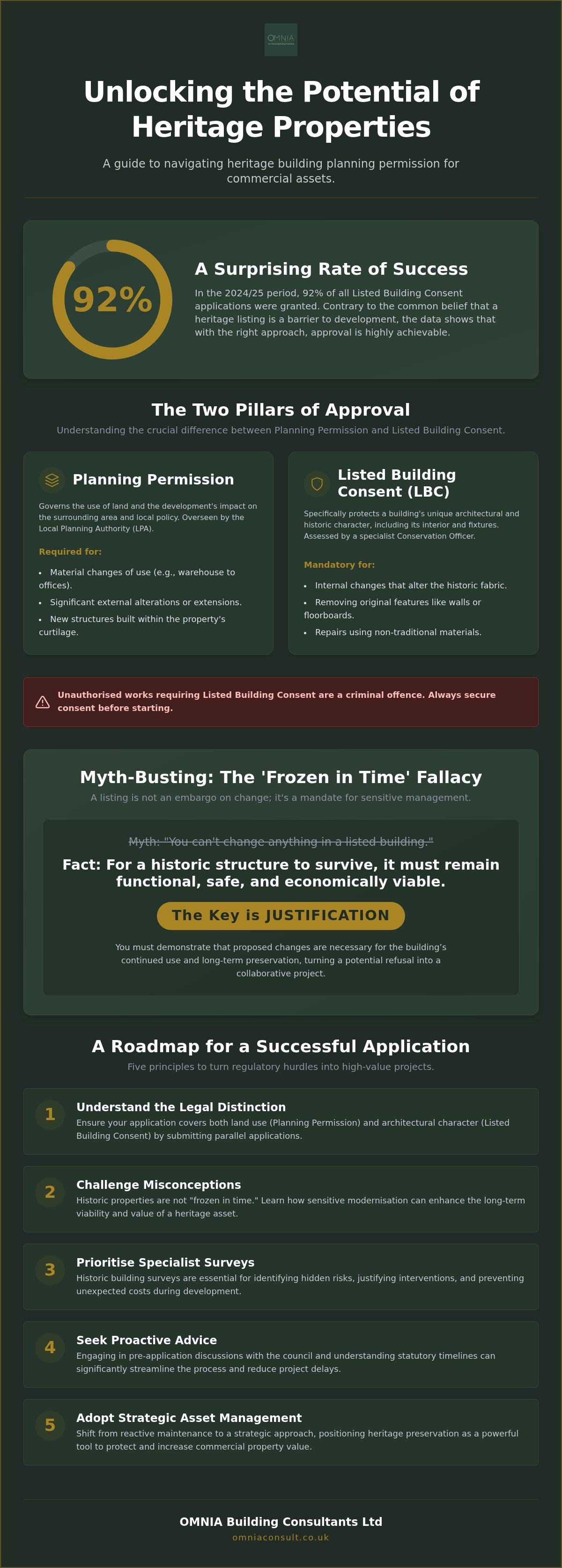
Did you know that 92% of all Listed Building Consent decisions were granted in the 2024/25 period? Many commercial property owners view a heritage listing as a permanent "no" to development, fearing that the complexities of heritage building planning permission will lead to spiralling costs or the risk of prosecution for unauthorised works. It's natural to feel hesitant when faced with the perceived conflict between modern commercial requirements and the strict preservation of historic character.
We’re here to show you that these hurdles are far from insurmountable. This article dismantles common myths surrounding historic property development, proving how professional guidance and sensitive design turn regulatory hurdles into successful, high-value projects. You’ll gain a clear understanding of the legal requirements, including the vital distinction between Planning Permission and Listed Building Consent. We provide a roadmap for a successful application, ensuring you have the confidence that your commercial goals are entirely compatible with heritage preservation and the long-term viability of your asset.
Table of Contents
Understanding Heritage Building Planning Permission vs Listed Building Consent
One of the most common stumbling blocks for property owners is the assumption that Planning Permission and Listed Building Consent are interchangeable. In reality, they're distinct legal processes that often run in parallel. Securing heritage building planning permission requires a holistic understanding of how these two frameworks overlap. While Planning Permission typically governs the use of land and the impact on the surrounding area, Listed Building Consent is specifically concerned with the preservation of a building's unique architectural or historic interest.
The decision-making process involves two key figures. The Local Planning Authority (LPA) assesses the broader development impact, whilst the Conservation Officer acts as a specialist guardian for the Listed Building. The "Dual Application" myth suggests that one consent covers all bases. In truth, many projects fail because owners secure Planning Permission but forget LBC, or vice-versa. By submitting parallel applications, you ensure that both the external impact and the internal integrity of the asset are considered simultaneously. This proactive approach reduces the risk of conflicting conditions from the council and ensures your project remains on a solid legal footing.
The LPA oversees general development, ensuring projects align with local policy. However, the Conservation Officer provides the technical expertise required to judge if a proposal respects the building's "special interest." They don't just look at what you're building; they look at how you're building it. A surveyor who understands both sides of the coin can facilitate a smoother dialogue between these two parties, ensuring that commercial requirements don't clash with preservation duties. This collaboration is essential for obtaining heritage building planning permission without unnecessary delays.
When is Planning Permission Required?
Planning Permission is mandatory when the proposed works affect the external appearance of the asset or change its fundamental use. For commercial heritage projects, this often includes material changes of use, such as converting an old industrial warehouse into a modern office space. Significant external alterations or extensions that might alter the local streetscape also require this consent. Additionally, any new structures built within the "curtilage", the land immediately surrounding the main building, must be approved to ensure they don't negatively impact the historic setting.
When is Listed Building Consent (LBC) Mandatory?
Unlike standard planning, LBC covers the entire structure, including the interior and any fixtures. You'll need it for internal changes that alter the historic fabric, such as removing original partition walls or replacing period floorboards. It's also required when repairs involve non-traditional materials, like substituting traditional lime mortar with modern cement, which can cause long-term structural damage. Carrying out works that require Listed Building Consent without obtaining prior authorisation is a criminal offence.
Myth-Busting: "You Can’t Change Anything in a Listed Building"
A common misconception amongst property owners is that listed status acts as a permanent embargo on any physical change. This "Frozen in Time" myth often leads to the neglect of historic assets, as developers fear that modern requirements will be flatly rejected. In reality, the planning system recognises that for a historic structure to survive another century, it must remain functional, safe, and economically viable. The secret to success lies in "justification." You must demonstrate to the council that your proposed changes are necessary for the building’s continued use and long-term preservation.
Our approach to architectural design focuses on this delicate balance. We work to ensure that modern interventions respect the original fabric whilst meeting 21st-century standards. When applying for heritage building planning permission, the goal isn't to hide change, but to manage it sensitively. By providing clear evidence that a modification supports the asset's future, you turn a potential refusal into a collaborative project with the local authorities. This proactive stewardship is what keeps our built heritage alive and relevant.
Improving Energy Efficiency and Sustainability
There's a persistent belief that you can't improve the thermal performance of a historic building. Whilst you might not be able to install standard uPVC windows, there's a significant shift in national policy towards "Green Heritage." Conservation Officers are increasingly open to solutions like high-quality secondary glazing or breathable internal insulation. The focus has moved toward finding the "least harmful" way to reduce carbon footprints. Navigating these requirements for Listed Building Consent requires a technical understanding of how traditional materials behave, ensuring that modern upgrades don't cause unintended damp issues.
Adapting Heritage Spaces for Commercial Use
Transforming a historic shell into a modern office or retail space requires expert space planning. It's about more than just aesthetics; it's about making the building work for its occupants. This includes integrating complex IT infrastructure and ensuring compliance with the Disability Discrimination Act (DDA). Achieving heritage building planning permission for commercial use is often about finding creative ways to hide modern services behind historic finishes. Installing a lift or a ramp in a centuries-old building is challenging, but it's rarely impossible with the right design strategy. If you're unsure how your vision fits within the regulations, our team can provide the architectural design expertise needed to bridge the gap.
The Role of Technical Surveys in the Planning Process
Securing heritage building planning permission depends heavily on the quality of technical evidence provided at the start of the process. Whilst a standard commercial survey might identify general defects, it often lacks the forensic depth required to satisfy a Conservation Officer. This is where a historic building survey becomes indispensable. It doesn't just list what's broken; it explains why a building is significant and how its physical fabric contributes to that importance. By providing this context, you show the council that you're a responsible steward of the asset.
Many developers fear the "hidden costs" associated with old properties, assuming that heritage projects are inherently unpredictable. However, most expensive surprises during construction stem from a lack of early technical due diligence. By identifying structural movement, timber decay, or rising damp before you apply for Listed Building Consent, you can factor these repairs into your initial budget and design. This transparency builds trust with the Local Planning Authority (LPA) and ensures your application is grounded in reality rather than guesswork.
A specialist survey also forms the basis of the "Statement of Significance." This document is a mandatory requirement for most heritage applications. It tells the story of the building, identifying which parts are high value and which might be more suitable for sensitive change. Without this baseline, the planning process often grinds to a halt as officials request more information. Starting with a technical foundation ensures that your heritage building planning permission journey is methodical and evidence-led.
Building Condition Surveys for Heritage Assets
A heritage-focused condition survey goes beyond surface-level aesthetics. It assesses the structural integrity of historic masonry and complex timber frames, which often behave differently than modern steel or concrete. One critical area is the "breathability" of traditional buildings. Older structures were designed to manage moisture through porous materials like lime and stone. Using modern, impermeable coatings can trap water, leading to severe damp issues. Our surveys identify these risks early, creating a baseline for scheduled maintenance that protects your asset's value whilst ensuring your application remains technically sound.
The Importance of Technical Specifications
The LPA rarely grants consent based on vague promises. They require detailed technical specifications of the materials and methods you intend to use. This is where the surveyor's role in writing "Method Statements" becomes vital. These documents provide a step-by-step guide for delicate repairs, ensuring that every contractor on site follows the approved preservation standards. Precise technical due diligence doesn't just satisfy regulatory compliance; it provides a clear roadmap for the construction phase, reducing the likelihood of costly revisions or enforcement action later on.
Navigating the Application: Timelines and Expectations
A frequent concern amongst property owners is that the bureaucracy of heritage building planning permission will stall their project for years. Whilst heritage applications involve extra layers of scrutiny, the statutory timeframe for a decision is usually eight to thirteen weeks. The perception of lengthy delays often stems from poorly prepared submissions that require multiple rounds of clarification. By engaging in the Pre-Application Advice phase, you can address the Conservation Officer's concerns before the formal clock starts ticking, which significantly reduces the risk of a late-stage refusal.
During the process, the Local Planning Authority (LPA) often consults statutory bodies like Historic England. These organisations typically have a 21-day window to provide comments on applications affecting Grade I or II* buildings. Managing these various stakeholders requires a methodical approach to ensure that no technical query goes unanswered. Our role as your technical partner is to act as a bridge between your commercial objectives and the regulatory requirements, ensuring the project lifecycle remains predictable and transparent.
The Standard Timeline for Heritage Consents
A typical application follows a structured sequence: validation (1-2 weeks), followed by a public consultation period (3-4 weeks), and finally the officer report and decision. Whilst standard planning applications often target an 8-week turnaround, those requiring heritage building planning permission frequently extend to 10-12 weeks. This extra time allows for the detailed assessment of the Statement of Significance and the impact on the historic fabric. Professional project management is essential here to coordinate surveys and design revisions, keeping the project on track despite these regulatory requirements.
Handling Planning Conditions
Receiving your Decision Notice is a milestone, but it isn't the end of the regulatory journey. Most heritage consents come with "Pre-commencement conditions," which require you to submit more detailed information, such as material samples or joinery details, before work can begin. Failing to "discharge" these conditions properly can invalidate your consent and lead to enforcement action. This is where contract administration becomes vital; it ensures that your building team adheres strictly to the approved plans and technical specifications. If you need assistance managing these complex requirements, our team can provide the regulatory compliance expertise needed to move from consent to construction without delay.
Strategic Asset Management for Heritage Property
Owning a historic property is a commitment to stewardship that extends far beyond the initial renovation. Whilst securing heritage building planning permission is a critical milestone, the long-term viability of the asset depends on proactive asset management planning. This strategic approach ensures that the property remains compliant with evolving regulations whilst protecting its commercial value. Beyond the planning phase, landlords must navigate complex legal duties, including the Construction (Design and Management) Regulations 2015 (CDM) and stringent fire safety standards tailored for historic structures.
Effective management requires looking at the building as a living entity that needs constant, expert oversight. Regulatory compliance is not a static requirement; it evolves alongside the building’s use and condition. By positioning OMNIA as your ongoing technical partner, you ensure that every decision, from minor repairs to major space planning, is handled with the same level of technical precision used during the initial application. This continuity of care is essential for maintaining the delicate balance between commercial utility and historic integrity.
The Role of the CDM Principal Designer
Health and safety in heritage environments presents unique challenges that standard modern sites rarely encounter. Historic fabrics often contain hazardous materials such as lead paint or asbestos, and the buildings themselves may have fragile structures or unconventional layouts. For any complex works, there is a legal duty to appoint a CDM Principal Designer. We integrate safety into the architectural design from the outset, ensuring that risks are managed without compromising the building's historic character. This technical oversight provides peace of mind for commercial landlords, ensuring that all site works meet the highest safety and regulatory standards.
Scheduled Maintenance vs. Reactive Repair
There is a persistent myth that heritage buildings are "impossible to maintain" due to their age and materials. In reality, the most significant costs usually arise from reactive repairs following years of neglect. By creating a structured 5-year or 10-year maintenance plan, you can identify minor issues before they escalate into major structural failures. Proactive stewardship isn't just about preservation; it's a sound financial strategy for commercial investors. Regular, documented maintenance also demonstrates to the Local Planning Authority that you are committed to the asset's future, which can simplify the process when you next seek heritage building planning permission for further developments. OMNIA acts as your ongoing technical partner, providing the continuity and expertise needed to manage these unique assets effectively through every stage of their lifecycle.
Realising the Potential of Your Heritage Asset
Securing heritage building planning permission shouldn't be a source of anxiety for commercial property owners. We’ve seen that success lies in a methodical, evidence-led approach that respects the building's historic fabric whilst meeting modern commercial needs. By prioritising specialist technical surveys and understanding the distinct requirements of Listed Building Consent, you can move from a place of uncertainty to a position of strategic control over your project's future.
At OMNIA, we act as your trusted navigator through the complexities of the planning system. As Chartered Building Surveyors and specialists in Listed Building Consent, we provide the comprehensive project management needed to turn regulatory challenges into successful preservation projects. Whether you're at the initial feasibility stage or ready to submit a formal application, we're here to ensure your project's long-term viability and integrity. Partner with OMNIA for your heritage planning application and take the first step towards a successful development. Your vision for a historic building is entirely achievable with the right technical expertise by your side.
Frequently Asked Questions
Do I need planning permission for internal changes to a listed building?
You don't usually need standard planning permission for internal works, but you almost certainly require Listed Building Consent (LBC). LBC is mandatory for any internal alteration that affects the building's character or historic fabric, such as removing walls, changing floor plans, or altering original fireplaces. Failing to secure this consent before starting work is a criminal offence. It's essential to distinguish between these two regulatory paths to ensure your project remains fully compliant.
How long does listed building consent take in 2026?
In 2026, the statutory timeframe for a decision on Listed Building Consent remains eight weeks for most applications. However, complex projects involving Grade I or II* assets often take up to thirteen weeks due to the required consultation with statutory bodies like Historic England. To avoid delays, ensure your application is validated quickly by providing high-quality technical drawings and a comprehensive Statement of Significance at the point of submission.
Can I install double glazing in a Grade 2 listed building?
You can rarely install standard double glazing in a Grade II listed building, but slimline heritage units or secondary glazing are often acceptable alternatives. Conservation Officers typically resist modern uPVC frames because they compromise the building's historic aesthetic and material integrity. Success depends on demonstrating that the proposed solution provides thermal benefits whilst maintaining the original window proportions. Specialist architectural design is key to finding a balance between modern efficiency and heritage preservation.
What happens if I carry out heritage work without planning permission?
Carrying out unauthorised works to a listed building is a criminal offence that can lead to unlimited fines or even imprisonment. Local Planning Authorities have the power to issue an enforcement notice, requiring you to reverse the changes and restore the building to its original state at your own expense. This risk applies to both current and future owners, as unauthorised works often complicate or halt the sale of a heritage asset during the conveyancing process.
Is it more expensive to get planning permission for a heritage building?
Whilst the application for Listed Building Consent itself is free, the overall process of securing heritage building planning permission often involves higher professional fees. You'll need to invest in specialist technical surveys, heritage statements, and detailed architectural drawings to satisfy the Conservation Officer's requirements. These early investments are vital for preventing expensive surprises during construction and ensuring that your commercial objectives align with the building's sensitive regulatory constraints.
Do I need a heritage consultant for my planning application?
You aren't legally required to hire a heritage consultant, but their expertise significantly increases the likelihood of a successful application. A specialist surveyor or consultant understands how to navigate the red tape and can provide the technical justification needed for sensitive changes. Their role involves acting as a bridge between your commercial goals and the preservation requirements of the local council, ensuring that your submission is robust, evidence-led, and professionally presented.
What is a Statement of Significance and why do I need one?
A Statement of Significance is a mandatory document that explains the architectural and historic value of your building. It identifies which parts of the structure are of high importance and which are less significant, providing the evidence the LPA needs to assess your proposal. Without this document, the council cannot judge the impact of your changes. It serves as the technical foundation for your entire heritage building planning permission application, guiding the design process from the start.
Can I change the use of a heritage building from office to residential?
You can change the use of a heritage building, but it requires a full planning application alongside Listed Building Consent. Such conversions are often complex because residential requirements, like increased fire compartmentation and soundproofing, can conflict with the preservation of historic features. Success depends on a sensitive design that accommodates modern living standards without damaging the original fabric. It's a strategic process that benefits from professional project management to ensure all regulatory hurdles are cleared.


