Understanding CDM Principal Designer Services: 2026 Guide
- OMNIA Building Consultants

- 1 day ago
- 12 min read
What if the greatest risk to your construction project isn't a physical hazard on site, but a misunderstood clause in a regulatory document? With the introduction of the Building Safety Act alongside existing CDM 2015 regulations, the landscape of legal accountability has shifted significantly. Many clients and developers now find themselves uncertain about where one duty ends and another begins. It's understandable to feel a sense of unease regarding potential HSE fines or the complexities of coordinating multiple design consultants. You aren't alone in seeking clarity amidst these evolving standards.
This 2026 guide is designed to help you master these complexities and ensure your project remains compliant, safe, and professionally managed. By engaging expert CDM Principal Designer services, you can transform a daunting legal obligation into a strategic framework for success. We'll examine the nuances of the dual Principal Designer roles, outline your specific statutory duties, and provide a clear roadmap for effective pre-construction coordination. Whether you're managing a sensitive listed building or a modern commercial development, this overview provides the peace of mind that comes from thorough, expert oversight and a holistic approach to building safety.
Table of Contents
What are CDM Principal Designer Services and Why are They Mandatory?
The Construction (Design and Management) Regulations 2015 (CDM 2015) represent a fundamental shift in how the UK construction industry approaches safety. Instead of treating health and safety as an afterthought, this framework embeds it into the heart of the design process. The role of the Principal Designer was created to replace the previous CDM Coordinator position, moving the responsibility to a professional who has a direct influence over the design. This ensures that safety isn't just monitored but is actively designed into the project from the outset.
The legal requirement for CDM Principal Designer services is triggered as soon as a project involves more than one contractor. It's a common pitfall to assume this only applies to major infrastructure works. In reality, if your project requires a builder and a separate specialist, such as an electrician or a plumber, the law applies. Failing to appoint a competent professional in writing means that all statutory duties and legal liabilities rest with you, the client. This can lead to Health and Safety Executive (HSE) intervention, substantial fines, and project delays that could've been easily avoided with proper oversight.
The Pre-Construction Phase Explained
The pre-construction phase encompasses the entire journey from the initial concept and feasibility studies through to the start of physical works on site. It's during this period that your influence over the project's safety is at its peak. Decisions made on a drawing board have a far greater impact on site safety than any protective equipment worn by workers later on. A Principal Designer doesn't simply review finished drawings; they work alongside the design team to identify and eliminate hazards. This proactive stewardship ensures that the building is safe to construct, maintain, and eventually demolish, protecting both the workers and your long-term investment.
Who Can Act as a Principal Designer?
To fulfil this role, an appointee must possess the right mix of technical design knowledge and health and safety competence. Whilst an individual designer can be appointed, many clients opt for an organisational appointment to ensure a broader range of expertise. Choosing a chartered consultancy for your CDM Principal Designer services provides a steady hand in a complex regulatory environment. We act as a technical partner, combining our surveying and design experience to manage the flow of information between all parties. This holistic approach is particularly vital for complex or heritage projects where securing listed building consent and maintaining regulatory compliance require a high level of professional integrity and quiet expertise.
Key Duties and Responsibilities of the Principal Designer
The Principal Designer acts as the strategic lead for health and safety during the pre-construction phase. This isn't a static box-ticking exercise. It requires ongoing planning and monitoring as the design matures from a concept into a technical reality. By identifying foreseeable risks early, such as hazardous materials or structural instabilities, we can control them through design modifications rather than relying on site-level fixes. Professional CDM Principal Designer services provide the framework needed to manage these complexities without compromising the architectural vision or the project's commercial viability.
A core part of the role involves fostering a culture of cooperation. We facilitate effective communication between the client, the various design consultants, and the contractors. This ensures that everyone is working from the same set of safety assumptions. As the project transitions to the site, we maintain a steady liaison with the Principal Contractor, ensuring that any design changes during construction are reviewed for safety implications. This continuity of oversight is what differentiates a well-managed project from one prone to unforeseen risks and delays.
Developing the Pre-Construction Information (PCI)
Gathering accurate data is the first step in any successful project. We work to identify what information is already available and what needs to be obtained through further surveys or investigations. This includes details on existing structures, underground services, and environmental hazards. This data forms the PCI pack, which is vital for contractors to price the works accurately and plan for safety. The Pre-Construction Information serves as the foundational document for project safety and tender accuracy.
The Health and Safety File: A Legacy Document
Our stewardship continues long after the design is finalised. We compile the Health and Safety File, which is a vital record containing information for the future use, maintenance, and cleaning of the building. This document is handed over to the client upon completion, acting as a manual for the building’s lifecycle. Having a high-quality file is essential when commissioning commercial building condition surveys in years to come. It ensures that future owners and managers have a clear understanding of the asset's technical specifications and any residual risks. If you're managing a complex development, our team can help you coordinate these statutory duties with precision and professional integrity.
CDM 2015 vs Building Regulations: Navigating the Dual Roles
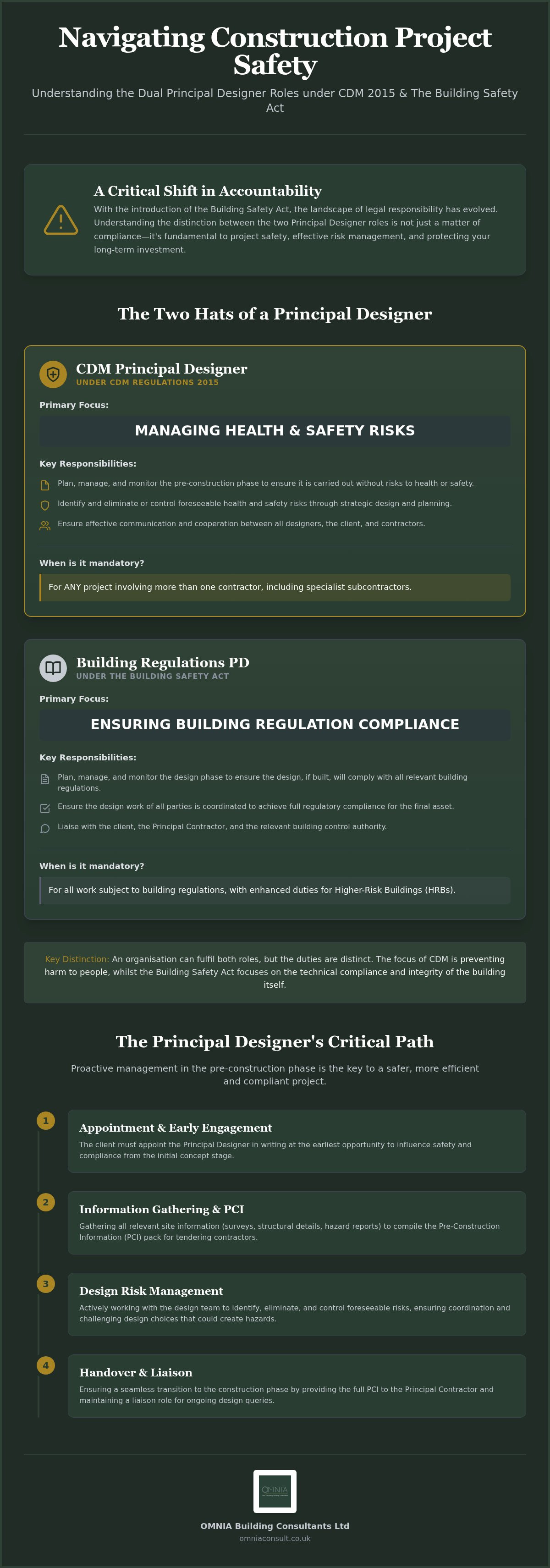
The landscape of UK construction oversight changed fundamentally with the enactment of the Building Safety Act 2022. This legislation introduced a second "Principal Designer" role, this time under the Building Regulations framework, which exists alongside the established CDM 2015 position. It's vital to understand that whilst these roles share a title, their objectives are distinct. One focuses on the health and safety of people during the construction process, whilst the other ensures the finished building complies with all relevant technical standards. This shift means clients now face a more complex appointment process to meet their statutory obligations.
For many projects, particularly those involving multiple design disciplines, the requirement for two distinct professional appointments is now the norm. The liability for ensuring these roles are filled by competent professionals rests squarely with the client. In the case of Higher-Risk Buildings (HRBs), the documentation and evidence requirements are even more stringent, requiring a robust "golden thread" of information. Engaging CDM Principal Designer services that understand this dual landscape is essential to avoid regulatory friction or potential legal challenges during the project lifecycle.
The Building Regulations Principal Designer Role
This role is centred on technical compliance rather than site safety. The Building Regulations Principal Designer must take all reasonable steps to ensure that the design work, if built, would comply with every applicable part of the Building Regulations. They are responsible for managing the flow of information between designers and verifying the competency of each team member. At the end of the project, they must provide a formal compliance declaration. This document confirms that the design meets the required standards, providing a clear trail of accountability that is now a mandatory requirement for project completion.
Managing Overlap and Coordination
The true value of these roles is found in their synergy. When the CDM Principal Designer and the Building Regulations Principal Designer work in tandem, they provide a holistic shield for your project. One ensures that the structural integrity and fire safety (compliance) are sound, whilst the other ensures that these elements can be built and maintained safely (CDM). Appointing a single consultancy like OMNIA Building Consultants Ltd to manage both functions often proves to be the most efficient path for clients. This unified approach eliminates "gaps" between safety and compliance, providing a steady hand through the complexities of the new regulatory environment. It ensures that technical specifications are not just safe for the workers, but also robust enough to meet the long-term requirements of the built environment.
How Professional Oversight Protects Your Building Investment
Professional oversight is often the difference between a project that merely meets legal minimums and one that achieves true technical excellence. Whilst many view health and safety as a hurdle, strategic CDM Principal Designer services act as a catalyst for better design coordination. By integrating safety considerations into the earliest stages, we eliminate the friction that often occurs when design intent meets site reality. This proactive approach reduces the likelihood of expensive on-site variations and unexpected delays, ensuring the project remains on schedule and within budget.
There is a direct synergy between CDM oversight and the development of high-quality technical building specifications. When design risks are identified and managed effectively, the resulting documentation is more robust and precise. This clarity benefits the entire project lifecycle, from the accuracy of tender returns to the long-term maintainability of the asset. A building that is designed for easy cleaning, maintenance, and repair is inherently more valuable and viable over its operational life.
Risk Mitigation as a Financial Safeguard
The financial implications of a safety failure extend far beyond immediate legal penalties. An accident on site can lead to catastrophic costs, including project shutdowns, reputational damage, and increased insurance premiums. By identifying design clashes and structural risks before a single brick is laid, we significantly reduce the need for costly rework. This level of professional stewardship instils confidence in stakeholders and enhances the property's value for future sale or lease, as buyers can rely on a clear record of technical integrity and regulatory compliance.
Specialist Oversight for Complex Projects
Heritage and listed building renovations present a unique set of challenges that require a steady, expert hand. These projects often involve coordinating a multitude of specialist surveys, including damp, structural, and fabric assessments. We integrate these findings into the design process to ensure that the proposed works are both safe and sympathetic to the building's historic character. This "quiet expertise" is vital when navigating the complex planning hurdles associated with listed building consent. It ensures that every technical decision is backed by sound professional judgement and a holistic view of the project's success. If you are planning a sensitive renovation, you can contact our team to discuss our comprehensive CDM and project management services.
Appointing a CDM Principal Designer: Timing and Requirements
The law is clear: a Principal Designer must be appointed as soon as design work begins. Legally, this is the latest point at which the role should be filled to ensure full compliance. If a client neglects to make this appointment in writing, they automatically inherit the legal responsibilities and liabilities of the role. This isn't just a paperwork issue; it's a significant legal risk that can lead to HSE intervention or even criminal prosecution if safety standards aren't met during the project lifecycle.
Appointing a professional too late in the pre-construction phase is a common mistake that often leads to friction. By the time many clients consider CDM Principal Designer services, major design decisions have frequently been finalised. This makes it much harder to eliminate risks at the source, which is the primary goal of the regulations. A late appointment often results in a rushed Pre-Construction Information pack, which can lead to contractors pricing for unknowns and ultimately driving up your project costs. Early involvement allows for a methodical approach to risk management and more accurate tender returns.
Assessing competency is a critical part of the client's statutory duty. You must ensure the appointee has the skills, knowledge, and experience necessary for the specific project. For complex works or heritage assets, look for chartered status and a proven track record in similar sectors. Once the design phase concludes, the Principal Designer ensures a smooth transition of health and safety information to the Principal Contractor. This handover is vital, as it enables the contractor to develop a robust Construction Phase Plan before any physical work starts on site.
The Appointment Process
Establishing a clear framework for appointment protects your interests from day one. This process should follow three distinct steps:
Step 1: Identify the need for a Principal Designer at the concept stage, as soon as it's clear more than one contractor will be involved.
Step 2: Verify the professional qualifications, resources, and experience of the firm to ensure they can handle the project's specific technical challenges.
Step 3: Formally appoint the firm in writing. This is a mandatory legal trigger that transfers the statutory duties from the client to the professional appointee.
Partnering with OMNIA for Your Next Project
We provide a steady hand through the complexities of modern UK building legislation. Our approach to CDM Principal Designer services isn't isolated from the rest of the project. Because we are also experts in building condition surveys and technical specifications, our safety advice is rooted in a deep, practical understanding of building fabric and structural integrity. We support you through the entire journey, from the initial survey to the final handover of the Health and Safety File. This integrated technical consultancy ensures your project remains a safe, compliant, and viable asset for the long term.
Securing Your Project’s Technical Future
Master the complexities of modern UK legislation by viewing health and safety as a cornerstone of design excellence. You've seen that the Principal Designer is no longer just a safety officer; they're a strategic steward of your building's integrity. By integrating CDM 2015 and the Building Safety Act requirements early, you protect your investment from regulatory friction and unnecessary on-site delays. This proactive approach ensures that safety and compliance are woven into the very fabric of your project.
Choosing a partner with the right technical depth is essential for navigating these dual roles. OMNIA operates as a team of chartered building surveyors with national coverage, acting as expert advisors for listed and complex commercial assets. We specialise in technical compliance and project oversight, ensuring your statutory duties are met with precision. Contact OMNIA today to discuss your CDM Principal Designer requirements and secure a steady hand for your next development. With the right professional oversight, you can move forward with confidence, knowing your project is safe, compliant, and built for long-term success.
Frequently Asked Questions
Is a CDM Principal Designer required for all construction projects?
Yes, a Principal Designer is required for any project where it's foreseeable that more than one contractor will be working on site at any time. This includes projects with a main contractor and a single sub-contractor. If your project involves only one contractor for its entire duration, the role isn't legally required, but the client still retains basic CDM duties. This ensures that safety is considered holistically before any physical work begins.
Can my architect also act as the CDM Principal Designer?
Your architect can take on the role if they possess the necessary technical knowledge and health and safety competence. However, many architectural firms prefer to focus on the creative design and recommend specialist CDM Principal Designer services to manage the regulatory burden. It's essential to verify that your appointee has the capacity and specific insurance to fulfil these statutory duties effectively throughout the pre-construction phase.
What happens if I fail to appoint a CDM Principal Designer?
Failing to make a formal appointment in writing means you automatically inherit all the legal duties and liabilities of the Principal Designer yourself. This makes you personally responsible for coordinating health and safety during the design phase. Non-compliance can lead to HSE intervention, project stoppages, and significant fines. It also complicates the transition to the construction phase, as the Principal Contractor cannot legally start without the required pre-construction information.
What is the difference between a CDM Advisor and a Principal Designer?
The Principal Designer is a statutory role with specific legal duties under CDM 2015 to coordinate health and safety during design. A CDM Advisor is typically a consultant hired to assist the client in fulfilling their own duties, such as checking the competency of other appointees. Whilst an advisor provides expert guidance, they don't hold the same legal accountability for design coordination that a statutory Principal Designer does.
How much do CDM Principal Designer services typically cost?
Fees for CDM Principal Designer services vary based on the project's scale, complexity, and the level of risk involved. Instead of a fixed industry rate, costs are usually calculated as a percentage of the total project value or as a fixed fee based on the estimated hours required for oversight. Complex projects, such as listed building renovations, typically require more intensive management and documentation, reflecting a higher professional fee for expert stewardship.
Does a domestic client have the same CDM duties as a commercial client?
Domestic clients have CDM duties, but these are usually transferred automatically to the contractor or the Principal Designer. This protects homeowners from the heavy legal burden faced by commercial developers. However, if a domestic client fails to appoint a Principal Designer in writing, the designer in control of the pre-construction phase automatically takes on the role. It's always safer to clarify these appointments at the start of any home renovation project.
How does the Building Safety Act 2022 change the Principal Designer role?
The Building Safety Act 2022 introduced a second Principal Designer role focused specifically on Building Regulations compliance. This exists alongside the CDM 2015 role, which remains focused on health and safety. On many projects, the same consultancy can perform both roles, but they must demonstrate competency in both safety coordination and technical compliance. This change has increased the documentation requirements, particularly for higher-risk buildings, to ensure a golden thread of information is maintained.
Can the same person be the Principal Designer and the Principal Contractor?
It's legally permissible for one organisation to hold both roles, provided they can demonstrate the necessary competency for each. This often occurs in design and build contracts where a single firm manages the project from inception to completion. However, the organisation must ensure they have distinct resources to manage the design-phase safety coordination and the on-site construction safety separately. Most clients find that separate appointments provide better checks and balances for project oversight.