
CDM Principal Designer Responsibilities: 2026 Guide
- OMNIA Building Consultants

- 10 minutes ago
- 12 min read
The role of the CDM Principal Designer has evolved from a regulatory checkbox into the most critical safeguard for your project's legal and structural integrity. Managing a commercial development in the UK is increasingly complex, especially whilst navigating the tighter integration between the CDM 2015 regulations and the Building Safety Act 2022. It's natural to feel concerned about the weight of personal liability or the potential for information gaps to stall your progress. Understanding the core cdm principal designer responsibilities is no longer just about health and safety; it's about protecting the long-term viability of your asset.
We've designed this 2026 guide to help you master these statutory duties and see the strategic value a proactive partner brings to the pre-construction phase. You'll gain a clear perspective on how to streamline the flow of information between design teams and contractors, effectively reducing your project's risk profile. We will break down the essential requirements for maintaining the "Golden Thread" and explain how professional oversight ensures your project transitions smoothly from the drawing board to the construction site without compromising on compliance or quality.
Table of Contents
The Evolution of CDM Principal Designer Responsibilities
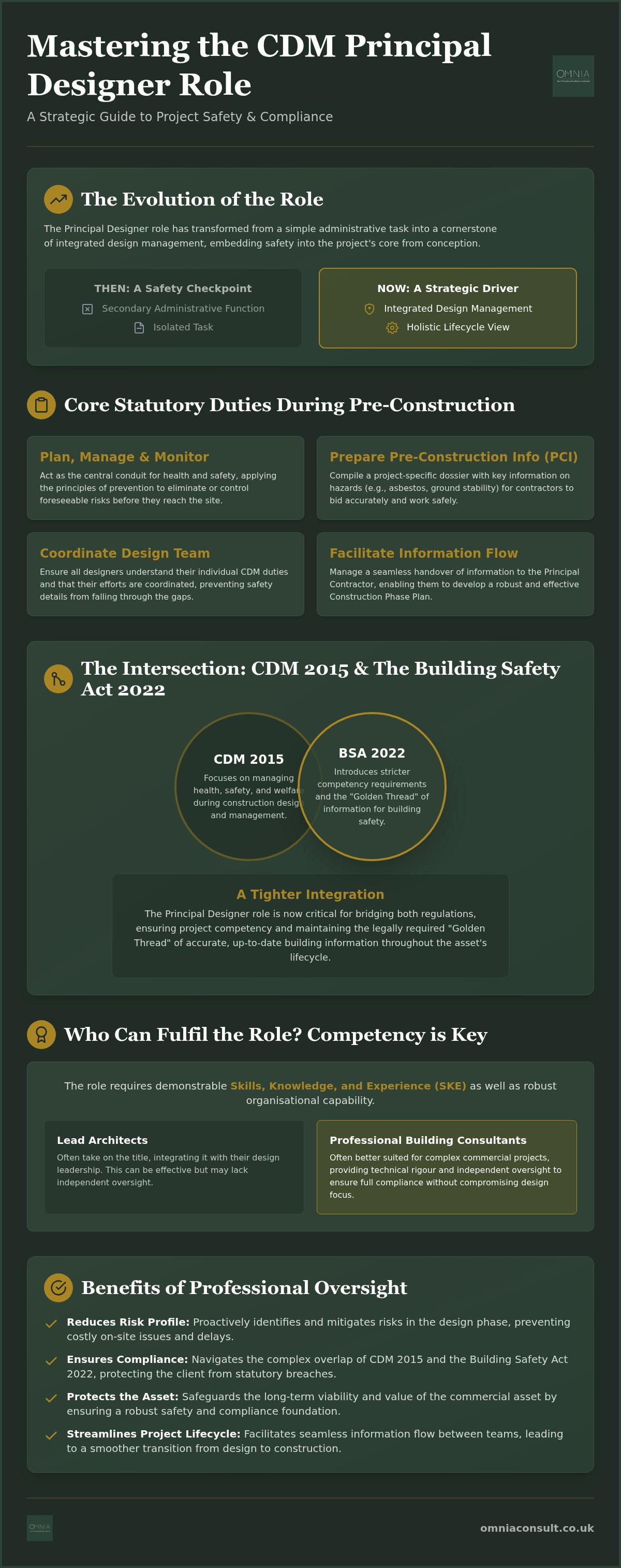
The role of the CDM Principal Designer (PD) has undergone a significant transformation since its formal introduction. It's no longer a secondary administrative function but a cornerstone of the modern construction lifecycle. We've seen a clear shift away from simple safety coordination toward a model of integrated design management. This evolution ensures that health and safety considerations are woven into the fabric of a project from the very first sketch, rather than being treated as an isolated task to be "fixed" later. For any project involving more than one contractor, appointing a Principal Designer in writing is a mandatory requirement. This role acts as a vital safeguard, protecting the client from statutory breaches and ensuring that health and safety failures don't compromise the project's long-term viability.
Understanding the history of these changes helps clarify the current landscape. The transition from previous iterations of the Construction (Design and Management) Regulations to the current 2015 framework moved the responsibility for coordination from a "coordinator" to a "designer". This was intended to place the power to influence safety directly in the hands of those making the design decisions. In 2026, this responsibility has expanded even further, requiring a holistic view of the building's entire lifecycle.
The Core Purpose: Eliminating and Reducing Risk
The primary objective within cdm principal designer responsibilities is to apply the principles of prevention during the pre-construction phase. This involves identifying potential hazards and either eliminating them through clever design or reducing the risk to a manageable level for those who will build and maintain the asset. Early appointment is essential; if a PD is brought in too late, the opportunity to influence the design for safety is often lost, leading to costly retrofits or increased site risks. Whilst all designers have individual duties, the Principal Designer provides the necessary oversight to ensure these efforts are coordinated across the entire design team, ensuring no detail falls through the gaps.
Who Can Fulfil the Role?
To fulfil the cdm principal designer responsibilities effectively, an individual or organisation must demonstrate sufficient skills, knowledge, and experience (SKE). In the current regulatory landscape, this also extends to organisational capability. Whilst lead architects often take on this title, many commercial clients find that professional building consultants or chartered surveyors are better suited to the task. These specialists possess the technical rigour to manage complex regulatory overlaps, providing a level of independent oversight that a design-focused architect might lack. A professional consultant acts as a steady hand, ensuring that the project remains compliant whilst the design team focuses on the aesthetic and functional aspects of the build.
Statutory Duties During the Pre-Construction Phase
The pre-construction phase is the most influential period for a project's safety profile. During this stage, cdm principal designer responsibilities centre on planning, managing, and monitoring health and safety with surgical precision. The PD acts as a central conduit, ensuring that the client, designers, and contractors remain aligned on risk management. By identifying and eliminating foreseeable risks before they reach the site, the PD prevents the "bolt-on" safety culture that often leads to accidents or project delays. This oversight ensures that every designer involved in the project understands their individual CDM duties, creating a culture of shared responsibility and technical rigour.
Proactive management during these early weeks pays dividends later in the project lifecycle. It's the PD's task to facilitate a seamless flow of information, ensuring that designers aren't working in silos and that the client is fully aware of their own statutory obligations. This collaborative approach reduces the risk of expensive design changes once construction has already commenced.
Preparing the Pre-Construction Information (PCI)
A robust Pre-Construction Information pack is far more than a collection of generic site rules. It's a project-specific dossier that provides contractors with the clarity they need to bid accurately and work safely. Effective PCI should incorporate data from technical assessments, such as building condition surveys or structural reports, to highlight hidden hazards like asbestos, fragile roof structures, or unstable ground. According to the HSE guidance on principal designer duties, the PD must ensure this information is provided in a timely manner to every designer and contractor appointed, or being considered for appointment. If you're unsure if your current documentation meets these standards, a professional CDM Principal Designer can help you compile a compliant PCI pack.
The Design Risk Management Process
The PD's role is to lead, not just observe. This involves chairing design risk workshops where the project team can openly discuss and mitigate hazards. A live Design Risk Register is the primary tool for this, documenting how risks were identified, evaluated, and ultimately reduced. It's the PD’s job to challenge design decisions that create unnecessary construction or maintenance risks. For example, if a design requires complex work at height that could be avoided with a different material or layout, the PD must advocate for the safer alternative. This proactive stewardship secures the "Golden Thread" of information, ensuring that safety decisions made at the drawing board are clearly communicated to those on the tools.
Coordinating Health and Safety: A Practical Framework
The transition from the pre-construction phase to the actual build is a delicate period where information loss often occurs. It's during this handover that the true value of cdm principal designer responsibilities becomes evident. The PD doesn't simply hand over a folder and walk away. They act as a bridge. This continuity is vital for maintaining the "Golden Thread" of information, a concept now central to compliance in 2026. By remaining involved during the early stages of construction, the PD ensures the design intent is fully understood by those on the ground.
One of the PD’s most important tasks during this transition is assisting the Principal Contractor (PC) with the development of the Construction Phase Plan (CPP), a core element of cdm principal designer responsibilities that ensures site safety is rooted in design logic. Whilst the PC is responsible for writing the plan, the PD provides the essential technical data and reviews the proposed safety arrangements. If design changes occur once the physical works have started, the PD remains involved to oversee these revisions, ensuring that new risks aren't inadvertently introduced into the project lifecycle.
Liaising with the Principal Contractor
Effective liaison is about more than just attending meetings. It involves a technical exchange where the PD provides the contractor with all relevant information for site safety, particularly regarding the interface between permanent and temporary works. For instance, if a design requires a specific sequence of structural support, the PD must ensure the contractor's temporary works designs don't compromise the stability of the permanent structure. This level of technical oversight is now a key part of meeting Building Safety Act requirements, which demand higher levels of competency and coordination throughout the project lifecycle.
The Health and Safety File: Delivering the Asset Legacy
The Health and Safety File shouldn't be a last-minute compilation at the end of a project. Instead, a professional PD treats it as a live document, gathering information from the moment the first designer is appointed. This file is the building's legacy; it contains everything a future owner or facility manager needs to maintain the asset safely. In 2026, this increasingly means handing over a digital record that includes technical specifications, "as-built" drawings, and maintenance schedules. By ensuring this record is accurate and accessible, the PD protects the client's long-term interests and the safety of everyone who will interact with the building for decades to come.
The Intersection of CDM and the Building Safety Act 2022
The Building Safety Act 2022 has fundamentally reshaped the regulatory environment for commercial projects across the UK. It hasn't replaced the existing framework; instead, it has layered a sophisticated new set of statutory duties on top of the CDM 2015 regulations. This means cdm principal designer responsibilities now include a dual mandate: you must ensure the design work complies with all relevant building regulations whilst simultaneously managing health and safety risks. In 2026, demonstrating professional rigour is non-negotiable. For Higher-Risk Buildings (HRBs), the Principal Designer is a pivotal figure in the Gateway process, providing the necessary technical assurance to the Building Safety Regulator (BSR) at Gateway 2 before construction can even begin.
This shift represents a move toward greater accountability. The Principal Designer is no longer just a coordinator; they are a guarantor of regulatory alignment. This requires a deep understanding of how physical design choices impact long-term building safety, from fire spread prevention to structural integrity. Failing to bridge the gap between CDM and the new building regulations can lead to significant project delays, rejected applications, and potential legal exposure for duty holders.
Managing the Golden Thread of Information
A central pillar of the new regime is the "Golden Thread" of information. The PD is responsible for maintaining the integrity of digital records from the earliest design stages through to completion. This isn't merely about filing drawings; it's about ensuring that technical specifications and design decisions are documented in a way that supports the building's safety case report. Every material choice and structural calculation must be traceable. This ensures that "as-built" data accurately reflects the safety intent of the original design, providing a reliable record for the building’s entire lifecycle. It's a level of stewardship that requires both technical expertise and a methodical approach to data management.
Regulatory Compliance and Oversight
The new duty holder regime places significant pressure on commercial landlords and developers to prove competency. You must be able to demonstrate that those you appoint have the skills, knowledge, and experience to manage these complex cdm principal designer responsibilities effectively. Working closely with the BSR requires a proactive stance, where compliance is viewed as a continuous process rather than a one-off event. Technical building consultancy offers the best defence against non-compliance, as it provides the independent oversight needed to navigate these complex regulatory overlaps. If you need assistance meeting these enhanced standards, our team provides expert Regulatory Compliance support to ensure your project remains fully compliant and viable.
Appointing a Professional CDM Principal Designer
Selecting a competent Principal Designer is a strategic decision that affects every stage of your commercial project. You need a partner who understands that cdm principal designer responsibilities extend far beyond health and safety paperwork. The ideal candidate should possess a blend of technical surveying knowledge and project management rigour to ensure the design remains viable and safe. Whilst the regulations allow for various professionals to take this role, selecting an independent expert provides a level of scrutiny that lead designers might naturally overlook. This independent oversight ensures that safety and compliance remain primary objectives, rather than secondary considerations to the aesthetic vision.
OMNIA Building Consultants Ltd acts as a proactive technical partner, ensuring continuity from the initial design stages through to the final handover. Our role is to provide a steady hand in a complex industry, guiding you through the regulatory landscape with confidence. By integrating design oversight with structural safety, we help you manage the dual requirements of CDM 2015 and the Building Safety Act 2022, effectively reducing your project's risk profile from the outset.
The Value of Chartered Building Surveyors in CDM
Chartered building surveyors bring a unique perspective to the role of the Principal Designer. Their technical expertise in building fabric and structural safety allows them to anticipate how design choices will impact the physical asset over its entire lifecycle. This holistic view is essential for identifying hidden risks that might not be apparent on a standard architectural drawing, such as maintenance access issues or long-term structural vulnerabilities. By integrating these insights, we help clients maintain the "Golden Thread" of information from the first survey to the final handover. You can learn more about how this technical rigour benefits your project by exploring our CDM Principal Designer services.
Securing Your Project's Future
The 2026 regulatory landscape leaves no room for ambiguity. Appointing a professional who can navigate cdm principal designer responsibilities with precision is the best way to reduce the risk of costly delays or enforcement action. A structured approach to risk management protects the long-term value of your property investment, ensuring that the building is safe to occupy and maintain for decades to come. Taking the first step involves a professional consultation and a thorough pre-construction risk assessment to set the standard for the works to follow. This proactive stance provides the peace of mind that your commercial asset is in capable, experienced hands, allowing you to focus on the broader goals of your development programme.
Securing Professional Stewardship for Your Next Project
The 2026 construction landscape demands more than just basic compliance; it requires a commitment to technical integrity and proactive risk management. We've explored how the modern cdm principal designer responsibilities have shifted toward a holistic model of stewardship, bridging the gap between design intent and site safety. By securing the "Golden Thread" of information and aligning with the rigorous standards of the Building Safety Act, you ensure that your commercial asset remains both safe and viable throughout its lifecycle.
Appointing a partner with the right technical rigour is vital for navigating these complex statutory duties without stalling your project's momentum. As Chartered Building Surveyors and specialists in 2026 regulatory compliance, we provide the steady hand needed to manage your project's unique challenges. We invite you to contact OMNIA Building Consultants to discuss your CDM Principal Designer requirements and discover how our expert project management for commercial assets can protect your investment. It's a proactive step that ensures your project is built on a foundation of safety and excellence, allowing you to move forward with complete peace of mind.
Frequently Asked Questions
What are the primary CDM Principal Designer responsibilities?
The primary cdm principal designer responsibilities involve planning, managing, and monitoring health and safety during the pre-construction phase. This includes identifying and eliminating foreseeable risks through design and coordinating the work of other designers. They ensure that everyone involved has the information they need to work safely. They are also responsible for preparing the Pre-Construction Information and the Health and Safety File, providing a technical bridge between the design and construction phases.
Is a Principal Designer required for all construction projects?
A Principal Designer must be appointed for any construction project where more than one contractor is likely to be involved. This includes any project where there is a main contractor and a subcontractor, which covers the vast majority of commercial developments. If a client fails to appoint a Principal Designer in writing, they automatically take on these legal duties themselves. It's therefore essential to formalise the appointment as early as possible.
What is the difference between a Principal Designer and a Principal Contractor?
The Principal Designer manages health and safety during the pre-construction or design phase, whereas the Principal Contractor takes the lead during the construction phase. Whilst the Principal Designer focuses on identifying and designing out risks before they reach the site, the Principal Contractor is responsible for managing the physical works and site safety. Both roles must collaborate closely to ensure a seamless flow of information and a robust Construction Phase Plan.
Can the client act as the CDM Principal Designer?
A client can legally fulfil the role if they possess the necessary skills, knowledge, and experience. However, for complex commercial projects, this is rarely advisable. The role requires a deep understanding of design risk management and current building regulations. Most clients prefer to appoint a professional building consultant to ensure their cdm principal designer responsibilities are met with technical rigour, protecting them from the legal risks associated with non-compliance.
What happens if a project does not have a Principal Designer appointed?
If no appointment is made in writing for a project with multiple contractors, the client is legally deemed to be the Principal Designer. This means the client becomes personally liable for any breaches of the CDM 2015 regulations. Lack of a formal appointment can lead to significant project delays, increased risk of accidents, and potential enforcement action from the Health and Safety Executive. It also complicates the handover of essential safety information.
How do CDM responsibilities change for listed building renovations?
CDM duties remain the same for listed buildings, but the practical application becomes more complex due to structural constraints. The Principal Designer must balance health and safety requirements with the need to preserve historic fabric. This often involves detailed building condition surveys to identify hidden hazards like unstable masonry or lead paint. Expert oversight is crucial to ensure that safety measures don't conflict with Listed Building Consent or other heritage requirements.
What is the Health and Safety File, and who is responsible for it?
The Health and Safety File is a digital record containing information for the safe future use, maintenance, and demolition of a building. The Principal Designer is responsible for preparing, reviewing, and updating this file throughout the pre-construction and construction phases. Once the project is complete, the file is handed over to the client. It's a vital component of the building's legacy, ensuring that facility managers have the technical data needed for safe operations.
How does the Building Safety Act 2022 affect the Principal Designer role?
The Building Safety Act 2022 has expanded the role to include a mandate for ensuring that design work complies with all relevant building regulations. For Higher-Risk Buildings, the Principal Designer must now demonstrate a higher level of competency and is a key figure in the Gateway process. They are also responsible for maintaining the "Golden Thread" of information, ensuring that every design decision is documented and traceable for the building's entire lifecycle.


