
Commercial Damp Survey: A Professional Guide to Protecting Building Assets in 2026
- OMNIA Building Consultants

- 11 minutes ago
- 11 min read
The most expensive advice you'll ever receive regarding your property might be a "free" inspection from a damp-proofing contractor. While it's tempting to seek a quick fix for visible moisture, these reports often lead to costly, unnecessary remedial works that mask symptoms rather than addressing the root cause. You understand that maintaining the structural integrity of your portfolio is paramount; yet, the frustration of rising tenant complaints about air quality and recurring mould can make any solution seem attractive. Commissioning a professional commercial damp survey is the only way to ensure your response is based on technical fact rather than a sales target.
This guide explains how to identify and manage moisture issues through expert independent surveying, protecting your assets from long-term decay. We'll examine the diagnostic process, the importance of detailed technical specifications, and how to safeguard your building's value against the evolving regulatory landscape of 2026. By the end, you'll have the framework to secure a definitive diagnosis that puts your interests as a property owner first.
Table of Contents
Understanding the Role of a Commercial Damp Survey in Asset Management
A commercial damp survey is far more than a simple visual inspection; it's a rigorous technical assessment of moisture ingress and its long-term effect on the building's fabric. For property owners, moisture management isn't a standalone task but a cornerstone of asset management planning buildings. By identifying the root causes of moisture, you can move away from reactive fixes toward a proactive strategy that preserves the building's lifecycle and protects your investment.
The primary objectives of these surveys are focused on professional stewardship:
Protecting the structural integrity and longevity of the building fabric.
Ensuring the safety and comfort of tenants through improved air quality.
Preserving the capital value and investment yield of the property.
In large-scale commercial portfolios, neglecting even minor moisture issues can lead to exponential financial liabilities. Unchecked damp eventually compromises structural members and internal finishes, often resulting in complex remedial projects that disrupt business operations and drain capital reserves. Without a clear diagnostic baseline, maintenance becomes guesswork, leading to spiralling costs and avoidable structural decay.
The Impact of Damp on Commercial Property Value
Moisture ingress accelerates the deterioration of everything from structural timber and masonry to high-end internal finishes. When water enters the building envelope, it triggers chemical and biological processes that weaken the material's bond. This becomes particularly critical during the dilapidations process at the end of a commercial lease. Landlords and tenants often find themselves in protracted disputes over moisture damage that could've been avoided with earlier intervention. A professional survey prevents "yield erosion" by ensuring maintenance budgets are allocated to verified technical requirements rather than reactive, speculative repairs.
Regulatory Compliance and Occupier Health
Landlords have a clear duty of care under UK health and safety legislation to provide a safe environment for occupiers. Damp and mould aren't just aesthetic issues; they significantly degrade indoor air quality, potentially leading to respiratory problems for staff. A commercial damp survey also plays a vital role in meeting Minimum Energy Efficiency Standards (MEES). Saturated walls have much lower thermal resistance than dry ones, making the building harder to heat and potentially dragging its EPC rating below legal thresholds. Ensuring a property remains fit for purpose keeps tenants satisfied and protects the landlord from regulatory penalties or legal claims related to building performance.
Identifying the Core Causes: From Rising Damp to Condensation
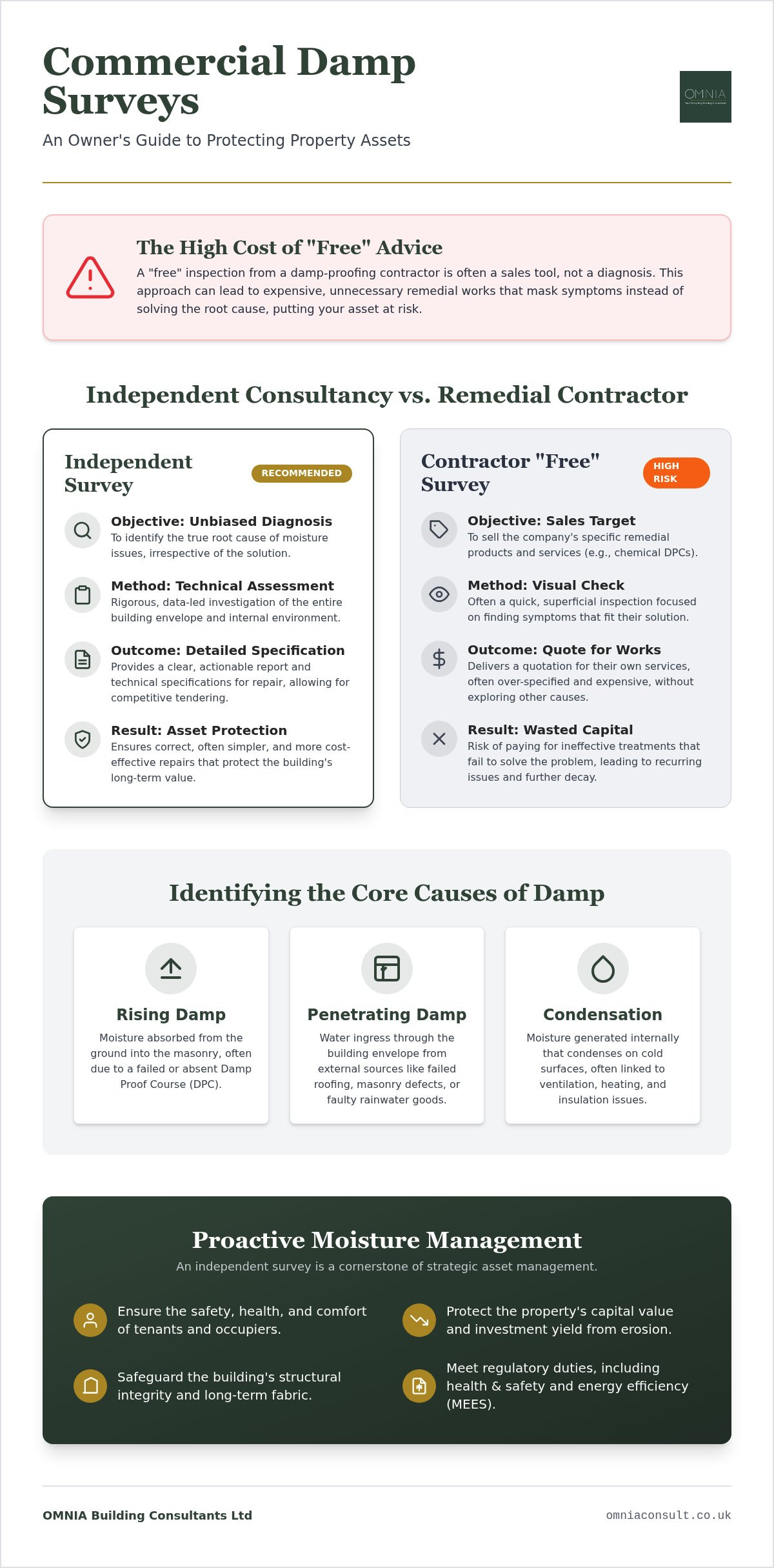
Commercial buildings present a unique set of diagnostic challenges. Unlike residential properties, the sheer scale and architectural diversity of commercial stock mean that moisture is rarely a single-issue problem. A comprehensive commercial damp survey must look beyond the surface to identify whether the moisture is rising from the ground, penetrating through the building envelope, or condensing from within the internal environment. These three core types-rising, penetrating, and condensation-often overlap in complex structures, requiring a surveyor to untangle multiple sources of ingress to reach an accurate conclusion.
It's essential to view the "building envelope" as a single, interconnected system. A damp patch in a ground-floor retail unit might be caused by a failed parapet wall several storeys above. Because symptoms can be misleading, we often find that what appears to be a moisture issue is actually a sign of underlying structural fatigue. In these instances, a commercial structural survey UK provides the necessary technical depth to differentiate between simple water ingress and more serious building movement.
Penetrating Damp and Building Fabric Failure
Defects in masonry, roofing, and rainwater goods are the most frequent causes of water ingress in UK commercial property. High-rise structures are particularly vulnerable to wind-driven rain on exposed elevations, which can force moisture through microscopic cracks in mortar or failed window sealants. Modern cladding systems also require careful oversight. Whilst they provide excellent thermal performance, they can trap moisture behind the external skin if the internal drainage paths or "weep holes" become obstructed by debris or poor maintenance. Identifying these failures early prevents the saturation of internal insulation and the subsequent decay of the structural frame.
Condensation and Environmental Control in Workplaces
As commercial buildings become more airtight to meet energy efficiency standards, the risk of condensation increases. In many office and retail environments, the HVAC system isn't always balanced to handle the moisture load generated by high occupancy. This is often exacerbated by "cold bridging" in steel-framed or concrete buildings. These materials conduct cold from the exterior to the interior, creating localised cold spots where moisture in the air will inevitably condense. Managing this requires a holistic look at ventilation rates, insulation continuity, and even occupant behaviour to maintain a healthy indoor climate. If you're unsure about the source of moisture in your property, seeking a professional building assessment is the most reliable way to secure a long-term solution.
Independent Consultancy vs. Remedial Contractor Surveys
The fundamental difference between a consultant's diagnostic report and a contractor's quote lies in the objective. A contractor visits a site to identify work they can perform; a consultant visits to identify the truth of the building's condition. Whilst "free" surveys are often marketed to property managers, they frequently lead to over-specified, unnecessary remedial works that don't address the root cause of the moisture. In the context of a commercial damp survey, paying for an independent assessment is an investment in clarity that typically saves thousands in avoidable construction costs.
The Conflict of Interest in Remedial Sales
Contractors are often incentivised to recommend chemical injections and proprietary waterproofing systems because these are the products they sell. Their business model relies on the volume of remedial work rather than the accuracy of the diagnosis. In contrast, an independent surveyor uses evidence-based diagnostics, employing calibrated moisture meters, thermal imaging, and salt analysis to pinpoint the exact source of ingress. At OMNIA, we maintain absolute integrity by not offering physical repair services. Our only goal is to provide a technical specification that solves the problem permanently, avoiding the cycle of recurring damp issues.
Technical Specifications and Professional Oversight
One of the most significant benefits of using a consultant is the creation of a detailed technical specification. Instead of asking three contractors for their "best guess" on how to fix a damp wall, we provide a precise set of instructions for them to tender against. This process ensures competitive pricing and maintains strict quality control for the landlord. These findings are often integrated into a wider school building condition survey or a commercial maintenance programme. This holistic approach ensures that damp remediation isn't treated as an isolated event but as part of a coordinated strategy to maintain the building's lifecycle. Professional oversight during the works further ensures that contractors adhere to the specification, protecting the client's interests from start to finish.
How to Organise and Prepare for a Technical Damp Inspection
Facilitating a thorough commercial damp survey requires more than just unlocking the front door. It's a collaborative process where the property manager acts as the primary facilitator, ensuring the surveyor has the context needed for a precise diagnosis. Gathering historical data is a critical first step. Previous leak records, maintenance logs for rainwater goods, and even past reports of HVAC performance provide a technical narrative of the building's behaviour over time. This background information allows the surveyor to act as a "Trusted Navigator," guiding you through the complexities of the building fabric to find the root cause of moisture ingress rather than merely documenting its symptoms.
Unhindered access is paramount for a successful inspection. A truly professional assessment isn't limited to the visible damp patches in the lobby or retail area. Your surveyor needs to reach plant rooms, basements, and roof voids where the primary causes of moisture often reside. If you're ready to secure a definitive diagnosis for your property, you can book a professional building assessment to begin the process. Providing clear pathways and keys to these restricted areas ensures the survey is comprehensive and avoids the need for costly follow-up visits.
Coordinating with Tenants and Stakeholders
Managing access requirements whilst minimising disruption to business operations is a delicate balance. It's vital to survey occupied spaces, as tenant activities and internal environmental controls directly impact moisture levels and condensation risks. Communicating the purpose of the survey clearly helps to reassure tenants. Rather than seeing an inspection as a sign of building failure, they should view it as a proactive commitment to their workplace safety and the long-term viability of the asset. This transparency fosters a sense of partnership between the landlord and occupier.
The Surveyor’s Toolkit: Advanced Diagnostic Equipment
Modern diagnostics move beyond visual guesswork to provide quantifiable data. Thermal imaging cameras are essential for detecting hidden moisture paths behind wall finishes or within insulation layers that are invisible to the naked eye. Electronic moisture meters and salts analysis then allow the surveyor to distinguish between different types of damp, such as identifying if a patch is caused by active ingress or residual salts from a historic leak. Drone technology is often utilised for high-level fabric inspections to capture high-resolution imagery of gutters, parapets, and roof elevations that would otherwise require expensive scaffolding or specialist access equipment to inspect safely.
Interpreting Your Report and Planning Long-Term Remediation
A professional report is a strategic roadmap for asset preservation rather than just a list of defects. It typically opens with an executive summary designed for high-level decision-making, supported by technical appendices that contain the granular data required for site-specific action. When you receive a commercial damp survey, the focus should be on the prioritisation of works. We categorise repairs into immediate interventions-those essential to stop active ingress-and long-term monitoring or environmental adjustments. It's vital to address the root cause, such as a failing parapet or blocked drainage, before applying any surface treatments. This technical stewardship is a hallmark of commercial project management companies, ensuring that every pound spent on remediation is backed by diagnostic fact.
From Diagnosis to Contract Administration
The transition from survey findings to managed works is where many property owners feel most vulnerable. We support this journey by providing comprehensive contract administration, ensuring that the remedial contractors you appoint adhere strictly to the technical specification. This oversight is particularly important when managing the CDM (Construction Design and Management) implications of damp-related structural repairs. By maintaining professional distance from the physical construction, we ensure that the quality of the work meets the high standards required to protect your building's long-term value and regulatory standing.
Future-Proofing the Asset
A successful remediation strategy doesn't end when the walls are dry. Establishing a scheduled maintenance plan is the most effective way to prevent the recurrence of moisture issues. This proactive approach is especially critical for complex assets or listed building renovations, where ongoing monitoring helps track how the historic fabric responds to modern occupancy and heating patterns. Regular inspections of gutters, flashings, and ventilation systems ensure that minor defects don't escalate into major capital liabilities. If you're ready to secure the future of your property portfolio, Contact OMNIA Building Consultants to organise your independent commercial damp survey and take the first step toward definitive building health.
Securing the Future of Your Property Assets
Protecting a commercial portfolio in 2026 requires a shift from reactive fixes to technical stewardship. We've explored how a professional commercial damp survey provides the unbiased evidence needed to avoid expensive, unnecessary works whilst ensuring your building remains compliant and healthy for occupiers. By prioritising root-cause diagnosis over surface-level treatments, you safeguard both the structural integrity and the capital value of your investment.
As Chartered Building Surveyors, we provide the independent technical advice necessary to navigate complex moisture issues within a comprehensive asset management perspective. Our role is to act as your trusted partner, ensuring that every remedial action is justified by data and executed to a precise specification. This methodical approach doesn't just solve immediate problems; it builds a foundation for long-term property performance and tenant satisfaction.
Instruct OMNIA Building Consultants Ltd for your independent commercial damp survey to gain total clarity on your building's condition. Taking control of your property's environmental health today ensures its viability for years to come.
Frequently Asked Questions
What is a commercial damp survey and how does it differ from a residential one?
A commercial damp survey is a technical assessment of moisture ingress tailored to the scale and complexity of business premises. Unlike residential surveys, which focus on domestic living spaces, commercial inspections must account for large building envelopes, industrial HVAC systems, and complex structural frames. The process involves identifying multi-source moisture issues that often affect high-rise elevations or expansive flat roofs, providing a level of diagnostic depth required for professional asset management and long-term building stewardship.
How much does a professional commercial damp survey cost in the UK?
The cost of a professional commercial damp survey is determined by several factors, including the floor area, the age of the building, and the complexity of the structure. Unlike contractor quotes, which are often provided for free as a sales tactic, an independent survey carries a fixed professional fee. This ensures the advice you receive is entirely unbiased and focused on the technical requirements of the asset rather than selling a specific remedial system.
Why should I choose an independent surveyor over a damp-proofing contractor?
Choosing an independent surveyor eliminates the conflict of interest inherent in contractor-led inspections. Contractors often recommend proprietary systems or chemical injections because they profit from the physical works. An independent professional provides a definitive, evidence-based diagnosis and a technical specification that contractors must tender against. This approach ensures you only pay for necessary repairs, often saving significant capital that would otherwise be spent on over-specified or ineffective treatments.
Can damp issues in a commercial building lead to structural failure?
Sustained moisture ingress can lead to structural failure if left unaddressed. Water weakens masonry through salt crystallisation and causes timber members to succumb to wet or dry rot. In modern buildings, damp can also lead to the hidden corrosion of steel frames or the deterioration of reinforced concrete. Identifying these risks early through a technical survey prevents minor leaks from escalating into major structural defects that compromise the safety and value of the asset.
Is a damp survey required for a commercial lease or property acquisition?
Whilst not always a legal requirement, a damp survey is a vital component of the due diligence process for leases and acquisitions. For a tenant, it provides a baseline of the building's condition to protect against unfair dilapidations claims at the end of the term. For an investor, it identifies hidden liabilities that can be used to negotiate price reductions or retentions, ensuring that the capital value of the acquisition is accurately represented.
What advanced equipment is used during a technical damp inspection?
Professional surveyors utilise a suite of advanced diagnostic tools to pinpoint moisture sources. Thermal imaging cameras identify cold spots and hidden leaks behind wall linings, whilst electronic moisture meters provide quantifiable readings across different materials. Salts analysis is often employed to distinguish between rising damp and historical leaks. For high-level inspections of gutters and parapets, drone technology is frequently used to capture high-resolution data without the need for expensive scaffolding.
How long does it take to receive a full commercial damp survey report?
The timeframe for receiving a full commercial damp survey report depends on the scale of the site and the complexity of the findings. Following the on-site inspection, our surveyors meticulously analyse the data and laboratory results to produce a comprehensive technical document. You'll typically receive the report within a professional timeframe that allows for thorough internal review and the creation of detailed remedial specifications, ensuring you have the clarity needed to plan your next maintenance steps.
What happens if the survey identifies significant rising damp in my property?
If significant rising damp is identified, the surveyor will provide a detailed technical specification for the necessary remedial works. This doesn't always mean a chemical damp-proof course is required. Often, the solution involves addressing the root cause, such as lowering external ground levels or improving sub-floor ventilation. This specification allows you to invite competitive tenders from contractors, ensuring the works are completed to a high standard and provide a permanent, cost-effective solution for the building.


