
2026 Scheduled Maintenance Plan: Commercial Buildings
- OMNIA Building Consultants

- 19 hours ago
- 12 min read
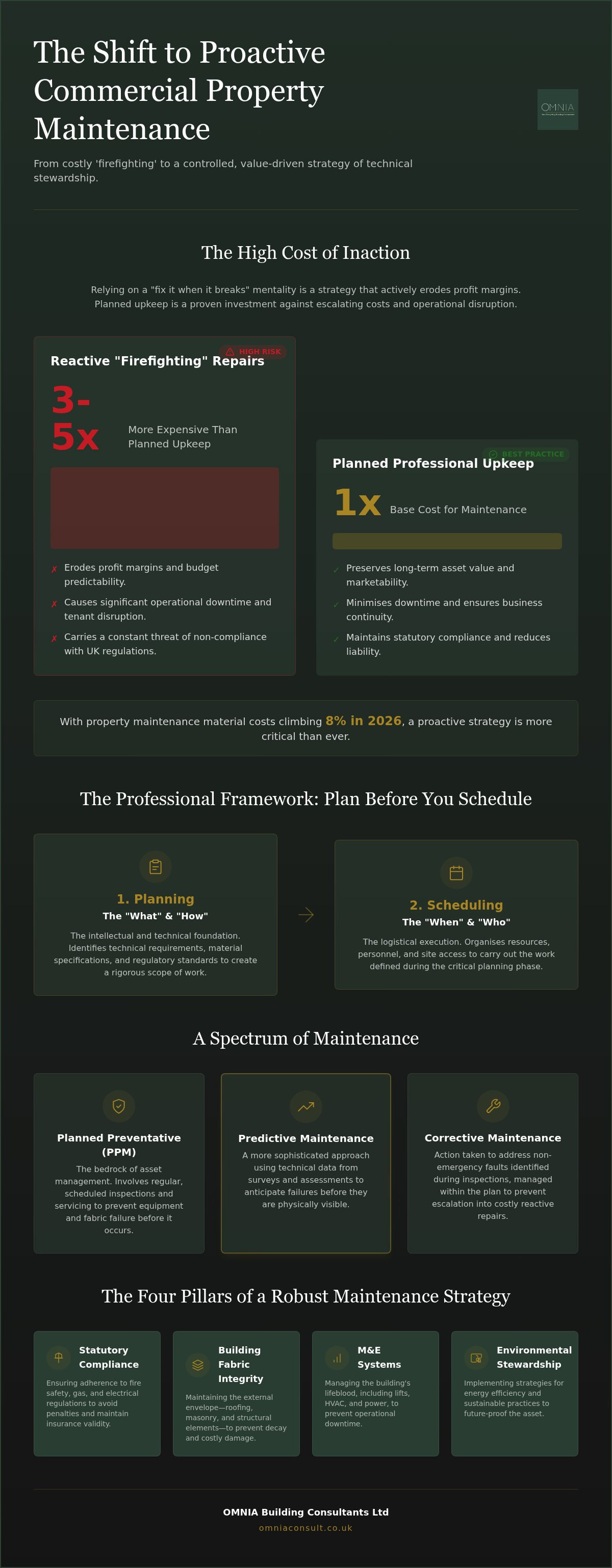
Did you know that reactive "firefighting" repairs are typically three to five times more expensive than planned upkeep? In an environment where property maintenance material costs have climbed 8% in 2026, relying on a "fix it when it breaks" mentality is a strategy that actively erodes your profit margins. We understand the pressure of managing a diverse estate whilst constantly looking over your shoulder at the threat of non-compliance with UK building regulations. It’s a complex balancing act that requires more than just a checklist; it demands a disciplined approach to scheduled maintenance planning commercial landlords can rely on for long-term stability.
This article provides the professional framework you need to master commercial asset management through technical stewardship. By shifting your focus from immediate crises to a structured oversight model, you'll reduce operational downtime and preserve the intrinsic value of your assets. We'll guide you through prioritising essential tasks, navigating regulatory requirements, and implementing a clear, actionable template that transforms your maintenance strategy into a predictable, value-driven process. You'll gain the confidence of a steady hand, ensuring every building under your care remains compliant, efficient, and resilient for years to come.
Table of Contents
Understanding Scheduled Maintenance Planning in the Commercial Sector
Scheduled maintenance planning commercial property owners implement is far more than a simple calendar of repairs. It's a proactive strategy designed to preserve the physical and financial integrity of an asset. Unlike reactive repairs, which occur only after a failure has disrupted operations, a managed maintenance cycle anticipates deterioration before it becomes a liability. This shift in mindset, often referred to as technical stewardship, ensures that every component of a building is managed with its entire lifecycle in mind. It's about moving from a position of constant crisis management to one of controlled, professional oversight.
By adopting this professional framework, landlords can significantly reduce long-term capital expenditure. Verified data from 2026 suggests that reactive "firefighting" is often three to five times more expensive than planned interventions. Beyond the immediate cost savings, consistent technical oversight preserves the market value of the property. A well-maintained building is a more attractive proposition for high-quality tenants and future investors, ensuring that the asset remains a performing part of a portfolio rather than a drain on resources.
The Difference Between Planning and Scheduling
Whilst these terms are often used interchangeably, they represent distinct phases of asset management. Planning is the intellectual and technical foundation. It focuses on the "what" and "how," identifying specific technical requirements, material specifications, and the regulatory standards that must be met. Scheduling, by contrast, is the logistical execution. It addresses the "when" and "who," organising the necessary resources and securing site access for the work to take place.
In a professional consultancy environment, planning must always precede scheduling. Without a rigorous technical plan, scheduling becomes guesswork. You can't effectively time a repair or allocate a budget if you haven't first defined the exact scope of work required to maintain the building fabric. This sequence ensures that resources aren't wasted on superficial fixes that fail to address underlying structural or mechanical issues.
Types of Maintenance: From Preventative to Predictive
Effective estate management relies on several distinct types of maintenance to ensure continuity. Planned Preventative Maintenance (PPM) remains the bedrock of this discipline, involving regular, scheduled inspections to prevent failure. However, the industry is increasingly moving towards predictive maintenance. This uses technical data from building condition surveys and structural assessments to anticipate fabric failure before it's visible to the naked eye. It's a more sophisticated level of scheduled maintenance planning commercial managers use to stay ahead of the curve.
Corrective maintenance also plays a role within a structured plan. When a professional inspection reveals a non-emergency fault, the plan provides a framework to address the issue before it escalates. This holistic approach ensures that no element of the building's health is left to chance, providing peace of mind for landlords and tenants alike.
The Pillars of a Robust Commercial Maintenance Strategy
A robust strategy is built on four central pillars that ensure a property remains safe, functional, and valuable. Without these, even the most detailed preventive maintenance strategies can fail to protect the landlord's interests. Statutory compliance serves as the primary foundation, encompassing fire safety, gas certifications, and electrical testing. In the UK, failing to meet these legal obligations can result in severe penalties and invalidated insurance. Beyond safety, building fabric integrity focuses on the external envelope. This includes roofing, masonry, and structural elements that, if neglected, lead to damp and decay. Effective scheduled maintenance planning commercial landlords adopt must prioritise the building's fabric to prevent exponential repair costs.
Mechanical and Electrical (M&E) systems are the building’s lifeblood. Managing lifts, HVAC, and power distribution prevents the operational downtime that can frustrate tenants and damage reputations. Finally, environmental stewardship has moved from a "nice-to-have" to a core requirement. Maintenance plans must now incorporate energy efficiency upgrades to meet modern building performance standards and decarbonisation targets. Integrating these four pillars creates a cohesive framework for asset preservation.
Regulatory Compliance and the CDM 2015 Framework
When maintenance tasks move beyond simple repairs into more complex technical works, the Construction (Design and Management) Regulations 2015 come into play. It’s a common misconception that CDM only applies to new builds. In reality, many maintenance projects require the formal appointment of CDM Principal Designer services to manage health and safety risks during the pre-construction phase. This professional oversight ensures that a landlord's legal obligations are met, providing a clear audit trail and ensuring that small-scale works don't trigger significant compliance failures.
Heritage and Listed Building Considerations
Maintaining Grade I or Grade II listed properties requires a specialised approach that balances modern utility with historic preservation. You can't simply apply standard materials to a 17th-century facade without risking structural damage or legal action. Expert listed building consent consultants are vital here. They guide the scheduled maintenance planning commercial owners of heritage assets must perform, ensuring that all works are sympathetic to the building's character. This technical stewardship protects the unique market value of historic assets whilst ensuring they remain fit for contemporary commercial use. For those managing a diverse portfolio, seeking professional asset management planning is the most reliable way to navigate these complexities.
Auditing Your Estate: The Role of Building Condition Surveys
Effective scheduled maintenance planning commercial managers undertake begins with a clear understanding of the building's current state. Whilst many property management platforms suggest starting with a simple asset list, an inventory alone is insufficient for long-term stewardship. A generic list tells you that a boiler exists; a professional technical assessment tells you its remaining lifecycle, its efficiency rating, and whether it poses a looming risk to your operations. Building condition surveys provide the empirical data required to move beyond guesswork and into a phase of informed decision-making.
These professional audits are specifically designed to identify latent defects that standard scheduling software inevitably misses. A digital dashboard might remind you to check a roof every six months, but it won't spot the subtle signs of masonry fatigue or the early indications of water ingress behind a parapet wall. Integrating a commercial structural survey UK into your planning ensures you're addressing the building's fundamental health, not just its superficial appearance. This level of technical oversight separates a truly resilient estate from one that's perpetually on the verge of a costly failure.
Identifying Risk Areas: Damp and Structural Movement
Damp is one of the most persistent threats to commercial building fabric, often remaining hidden until the damage is extensive. Commissioning a commercial damp survey allows you to identify moisture issues at the source, whether they stem from interstitial condensation or failed weatherproofing. By catching structural risks early, you avoid the transition into reactive, expensive repairs that disrupt your tenants and drain your reserves. Technical due diligence serves as the indispensable foundation of comprehensive asset protection.
Prioritising Tasks Based on Survey Data
Once the survey is complete, the data must be translated into an actionable plan. We utilise the "Red, Amber, Green" (RAG) system to categorise findings based on urgency and risk. This methodical approach ensures your budget is allocated where it's needed most, rather than being spread thinly across the entire estate. Professional surveyors help you navigate this data to avoid the common pitfall of over-maintaining low-risk assets whilst neglecting the high-risk elements that determine the property's long-term viability.
Red: Immediate attention required to address statutory non-compliance or critical fabric failure.
Amber: Necessary works that should be planned within the next 12 to 24 months to prevent escalation.
Green: Routine maintenance items that maintain the building’s standard but carry lower immediate risk.
Developing Your Scheduled Maintenance Planning Template
Developing a robust template for scheduled maintenance planning commercial property owners can implement is a multi-layered process. It moves beyond a simple list of tasks into a strategic document that governs asset health. The framework begins with Step 1: Asset Identification and Professional Condition Audit, ensuring every component is accounted for. Step 2 focuses on risk-based prioritisation; statutory requirements like fire safety must always take precedence, followed by building fabric integrity and finally cosmetic improvements.
Step 3 involves the creation of technical specifications for required works, providing clear, unambiguous instructions for contractors. This is followed by Step 4: Budgetary Allocation and Lifecycle Costing Analysis. Industry data from 2026 suggests that annual maintenance budgets often range from 1% to 3% of the property's total value. Finally, Step 5 concludes with resource allocation and contractor selection oversight, ensuring the right expertise is matched to the specific technical need. This methodical progression ensures that no element of building stewardship is left to chance.
The 52-Week Maintenance Cycle
Visualising your maintenance as a 52-week cycle allows for a methodical approach to seasonal challenges. Guttering and drainage should be prioritised in autumn to prevent winter water ingress, whilst heating systems are best serviced in summer to avoid mid-winter failures. Statutory inspections for fire, gas, and electrical systems must be hard-coded into this cycle to ensure they're never overlooked. This rhythmic approach prevents the "bunching" of costs and ensures the building remains operational year-round.
Technical Specifications and Contract Administration
The success of any maintenance plan rests on the quality of the technical specifications. Precise specifications prevent "scope creep" and budget overruns by defining exactly what materials and methods are required. A structured approach to scheduled maintenance planning commercial teams follow ensures that these specifications are never left to interpretation. Contract administration then provides the professional oversight needed to ensure work meets these standards. When combined with professional bid writing, this process ensures you achieve true value for money rather than just the lowest initial quote. If you're ready to formalise your strategy, our team can provide the expert asset management planning required to secure your building's future.
Technical Stewardship: Why Professional Consultancy Outperforms Reactive Repairs
Technical stewardship represents the pinnacle of property oversight. It moves beyond the transactional nature of reactive contractors, who often focus only on the immediate defect without considering the wider implications for the building fabric. Instead, a holistic approach to building asset management considers the interconnectedness of every system and structural element. By investing in professional consultancy, landlords transition from a position of vulnerability to one of controlled authority. This strategic shift is central to the scheduled maintenance planning commercial estates require to thrive in an increasingly regulated environment.
The long-term ROI of this approach is undeniable. Whilst reactive repairs might seem cheaper on a single invoice, the cumulative cost of emergency call-outs, tenant disruption, and accelerated fabric decay is substantial. Professional oversight reduces the administrative burden significantly; instead of managing a dozen different trades, landlords partner with a "Trusted Navigator" who coordinates the technical requirements, compliance hurdles, and project lifecycles on their behalf. This ensures that every pound spent on maintenance is an investment in the building's longevity rather than a temporary fix.
The OMNIA Approach to Commercial Stewardship
We combine chartered surveying expertise with rigorous project management to provide a comprehensive technical partnership. This dual perspective ensures that we don't just identify a problem; we specify the correct technical solution and oversee its execution to the highest standards. Our commitment is to the long-term integrity of your commercial assets. Whether navigating complex listed building consents or acting as CDM Principal Designer for major works, we protect your investment whilst guiding you through the technical landscape with precision. We pride ourselves on being a steady hand, ensuring that your property remains a high-performing asset.
Next Steps for Your Commercial Estate
Assessing your current maintenance maturity is the first step towards a more resilient future. Are you currently "firefighting" issues as they arise, or do you have a proactive framework in place? Transitioning to a proactive model requires a clear understanding of your estate's condition and a structured path forward. A professional consultation is the most effective way to kickstart your scheduled maintenance planning commercial strategy. By choosing a partner dedicated to technical stewardship, you gain the peace of mind that comes from knowing your estate is in expert hands, allowing you to focus on your core business objectives with confidence and professional reliability.
Securing the Future of Your Commercial Assets
Moving from the uncertainty of reactive repairs to a disciplined, 52-week maintenance cycle is the most effective way to preserve your building's value. By utilising professional condition surveys and risk-based prioritisation, you ensure that your resources are focused where they're needed most. This proactive approach doesn't just manage costs; it ensures statutory compliance and protects the structural integrity of your estate against long-term decay. Successful scheduled maintenance planning commercial owners implement relies on this technical foundation to turn potential liabilities into resilient assets.
As chartered surveyors with national UK coverage, we provide the steady hand needed to navigate complex regulatory landscapes, including CDM Principal Designer roles and listed building consent. Our holistic approach to technical stewardship ensures your portfolio remains compliant and efficient whilst you focus on your core business. Partner with OMNIA for expert commercial building consultancy and strategic asset management. Taking control of your maintenance strategy today is a vital investment in the long-term success and professional reliability of your property portfolio.
Frequently Asked Questions
What is the difference between planned and scheduled maintenance?
Planning is the "what" and "how," defining technical requirements and specifications based on asset health. Scheduling is the "when" and "who," managing the logistics of resource allocation and site access. Professional scheduled maintenance planning commercial managers utilise both to ensure building stewardship is technically accurate and timely. Planning ensures you address the root cause of issues, whilst scheduling ensures the work happens without disrupting your tenants' operations.
How do I create a scheduled maintenance planning template for a commercial building?
Start with a professional condition audit to identify all building assets and their current state. You then categorise these tasks using a risk-based prioritisation system, such as the RAG (Red, Amber, Green) model. This template should include statutory compliance dates, technical specifications for repairs, and lifecycle costing estimates. It acts as a live document that guides your budgetary decisions and contractor selection throughout the 52-week maintenance cycle.
Is a building condition survey necessary before starting a maintenance plan?
A professional building condition survey is the essential starting point for any effective maintenance strategy. Without one, you're merely guessing the state of your assets. A technical survey identifies latent defects, such as structural movement or damp, that aren't visible during a casual walk-around. This empirical data allows you to build a plan based on evidence rather than assumptions, preventing expensive reactive repairs and ensuring long-term fabric preservation.
How often should commercial building maintenance be reviewed?
You should review your maintenance plan at least once a year to account for building wear and changing UK regulations. However, high-risk elements or statutory requirements often need more frequent checks. A quarterly review of your scheduled maintenance planning commercial strategy ensures that your budget remains aligned with the actual condition of the building fabric. This ongoing oversight helps you adjust priorities as assets age or environmental conditions shift.
What are the risks of neglecting scheduled maintenance in commercial property?
Neglect leads to exponential cost increases, as reactive "firefighting" repairs are typically three to five times more expensive than planned upkeep. Beyond the financial drain, you risk catastrophic fabric failure, tenant dissatisfaction, and legal liability. In the UK, failing to maintain fire safety or electrical systems can result in severe penalties and invalidated insurance. Neglect also causes rapid depreciation of the property's market value and shortens the overall asset lifecycle.
Can scheduled maintenance help with building regulatory compliance?
A structured plan is the primary tool for ensuring your estate meets all UK health, safety, and fire regulations. By hard-coding statutory inspections into your annual cycle, you ensure that fire risk assessments, gas safety checks, and electrical testing never lapse. This structured approach provides a clear audit trail for regulators. It also ensures that maintenance work meets the CDM 2015 framework, protecting you from significant non-compliance risks.
Why should a commercial landlord hire a consultant instead of a contractor for planning?
Consultants provide independent technical stewardship focused on the building’s long-term health rather than a single repair job. Unlike contractors, who may have a transactional interest in physical works, a consultant offers impartial advice on technical specifications and asset management. We act as a "Trusted Navigator," ensuring that maintenance work is necessary, correctly specified, and competitively tendered. This professional oversight prevents scope creep and ensures high standards of contract administration.
How does scheduled maintenance affect the value of a commercial asset?
Consistent maintenance preserves and often enhances the capital value of a commercial property by extending the lifecycle of its core components. A well-documented maintenance history provides confidence to future investors and high-quality tenants, who prioritise buildings with low operational risk. It prevents the accumulation of "deferred maintenance" liabilities that can lead to significant price reductions during a sale. Professional stewardship ensures the asset remains a performing part of your investment portfolio.


